Introduction
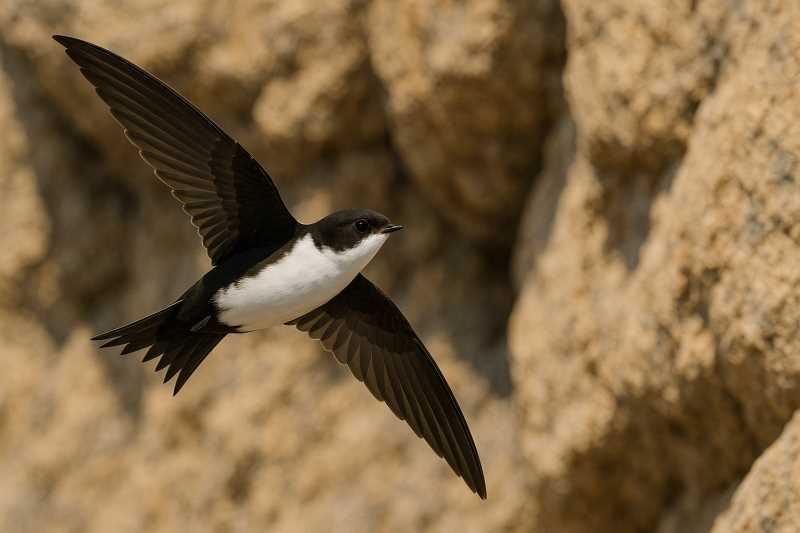
The White-throated Swift (Aeronautes saxatalis) is a fast-flying, cliff-nesting swift of western North America. Its contrasting black-and-white plumage, long narrow wings and highly agile flight make it one of the most distinctive aerial insectivores in the region. It is usually seen in the air, often in small groups or large flocks above cliffs, canyons, mountains and open country.
Physical Description
The White-throated Swift is a fairly large, slender swift measuring approximately 15–18 centimetres in length and weighing about 28–36 grams. Its wings are long, narrow and strongly curved, while the tail is relatively long and shallowly forked.
The upperparts are blackish brown to black. The throat, chest and central breast are white, with additional white on the flanks and sides of the rump. A pale strip continues down the centre of the underparts. The white markings are especially useful when the bird passes overhead, although they may be difficult to see in poor light or during rapid flight.
Males and females are alike in plumage and show no reliable field differences in size. Juveniles resemble adults but are generally duller and paler, particularly around the head and neck.
Range and Habitat
The species breeds from southern British Columbia and the western United States southwards through parts of Mexico. It is associated mainly with mountainous and rugged landscapes, including cliffs, canyon walls, rocky pinnacles and large outcrops. It may also nest on bridges, buildings, quarries and highway overpasses where suitable crevices are available.
White-throated Swifts forage over a wide variety of habitats, including grasslands, shrublands, forests, deserts, lakes and agricultural land. The availability of secure nesting or roosting crevices and concentrations of flying insects appears to be more important than the vegetation immediately below a nesting site. The species occurs from near sea level to high mountain elevations, with some nests recorded above 3,000 metres.
Many populations are migratory or partly migratory. Birds breeding in northern areas and at higher elevations generally move south or to lower elevations during the colder months, while substantial numbers remain year-round in parts of California, Arizona, New Mexico and Mexico. In Central America, a darker regional form is often recognised as the subspecies Aeronautes saxatalis nigrior.
Where to See This Species
Black Canyon of the Gunnison National Park, Colorado, United States
White-throated Swifts are documented at Black Canyon of the Gunnison National Park, where the steep canyon walls and rising air currents provide suitable nesting and foraging conditions. The park advises visitors to watch for them along canyon routes and from overlooks, particularly during the warmer months when aerial insect activity is high.
Nearby accommodation: Montrose is the most practical service town, with hotels, guest houses, campgrounds and other visitor accommodation. Camping is also available in and around the park, subject to seasonal conditions and park regulations.
Colorado National Monument, Colorado, United States
The sheer canyon walls and open skies of Colorado National Monument provide suitable habitat for White-throated Swifts. The National Park Service identifies the monument’s overlooks as good places to watch their rapid aerial manoeuvres below the rim, especially during the breeding season and warmer parts of the day.
Nearby accommodation: Fruita and Grand Junction provide the nearest broad range of hotels, motels, guest houses, campgrounds and self-catering accommodation.
Montezuma Castle National Monument, Arizona, United States
White-throated Swifts are documented at Montezuma Castle National Monument, where they nest and roost in crevices around the cliffs associated with the historic site. They are particularly conspicuous in summer, when birds may be seen entering and leaving the cliffs and hunting insects over the Verde Valley.
Nearby accommodation: Camp Verde is the nearest practical gateway settlement, with hotels, motels, guest houses, campgrounds and other visitor accommodation.
Behaviour and Diet
White-throated Swifts are active by day and spend most of their lives in flight. They are highly social and may forage in pairs, small groups or flocks numbering dozens to hundreds of birds. Their flight consists of rapid wingbeats, steep turns, sudden changes of direction and long glides. They often exploit rising air along cliffs and canyons, and may travel considerable distances from nesting areas while feeding.
The diet consists mainly of flying insects, including flies, beetles, bugs, bees, wasps and flying ants. Spiders may also be taken. Prey is caught in the air, usually high above the ground, although the birds may descend when insects are concentrated by weather or local air currents. They sometimes drink by skimming over lakes and ponds.
Courtship includes fast chases, calling and dramatic plunging displays near nesting cliffs. A pair may fly together during a steep descent before separating close to the ground. White-throated Swifts generally nest colonially or semi-colonially and show strong attachment to traditional nesting and roosting sites.
The nest is a shallow cup made from feathers, grasses, moss, plant down and other materials, which are collected in flight and bound together with sticky saliva. It is placed in a deep crevice on a cliff, canyon wall or similar structure. Both adults incubate the eggs and feed the young. The usual clutch contains approximately four or five white eggs, and young birds remain dependent on the adults until they are ready to fly.
Identification Tips
- Look for a slim, cigar-shaped bird with very long, narrow, scimitar-like wings.
- The combination of blackish upperparts, a white throat and chest, a pale central breast and belly, and white flank or rump patches is distinctive.
- The species is usually seen in flight rather than perched. Its rapid, erratic flight and high-pitched calls are useful clues when plumage details are difficult to resolve.
- White-throated Swifts are generally larger and more strongly marked than Vaux’s Swifts, with a much more obvious white throat and underparts.
- They can resemble swallows at a distance, but their wings are longer and narrower, their bodies are more streamlined, and they do not regularly perch on wires or exposed branches.
- The Black Swift is darker overall and lacks the White-throated Swift’s strongly contrasting white throat and central underparts.
Conservation Status
The White-throated Swift is currently assessed as Least Concern globally. It remains widespread, but population monitoring in North America suggests a possible long-term decline, although the size and significance of that decline are uncertain.
Potential pressures include the loss or disturbance of traditional cliff roosts and nesting sites, changes in insect abundance, pesticide exposure and broader environmental changes affecting aerial insectivores. Protecting important cliffs, canyon walls, bridges and other nesting structures, while reducing unnecessary disturbance during the breeding season, can help conserve local colonies. Maintaining healthy insect populations and continuing population monitoring are also important.
Frequently Asked Questions
Where does the White-throated Swift live?
It occurs across western North America, from southern British Columbia through the western United States and into Mexico. Related southern populations extend into Central America.
What does a White-throated Swift look like?
It is a slender, long-winged swift with blackish upperparts and conspicuous white on the throat, chest, central underparts and flanks. It usually appears as a fast-moving black-and-white shape in the sky.
What does the White-throated Swift eat?
It feeds mainly on flying insects such as flies, beetles, bugs, bees, wasps and flying ants. Spiders may also be taken.
Where does the White-throated Swift nest?
It usually nests in deep crevices on vertical cliffs, canyon walls and rocky outcrops. It may also use bridges, buildings, quarries and highway overpasses.
Is the White-throated Swift migratory?
Some populations migrate, particularly those breeding in northern regions and at high elevations. Other populations remain year-round in parts of the southwestern United States and Mexico.
Is the White-throated Swift endangered?
No. It is currently classified as Least Concern globally, although possible declines and threats to aerial insectivores mean that monitoring and protection of nesting and roosting sites remain important.
References
- Cornell Lab of Ornithology
- National Park Service
- BirdLife International
Related posts