Klages’s Antbird: A Symphony in the Understory
The lush rainforests of the Amazon basin are home to a stunning array of biodiversity, with every layer of the canopy teeming with life. Among the inhabitants of this vibrant ecosystem is a particularly captivating species known as Klages’s Antbird (Drymophila klagesi). This elusive bird, though not as widely known as some of its avian counterparts, plays a critical role in the ecological tapestry of its native habitat.
Taxonomy and Nomenclature
Klages’s Antbird belongs to the family Thamnophilidae, a diverse group of birds commonly referred to as antbirds. Named after the American ornithologist Frederick Klages, Drymophila klagesi was first described in 1912. The genus name Drymophila is derived from Greek, meaning "lover of the woods," a fitting moniker for a bird that thrives in dense forest habitats.
Physical Characteristics
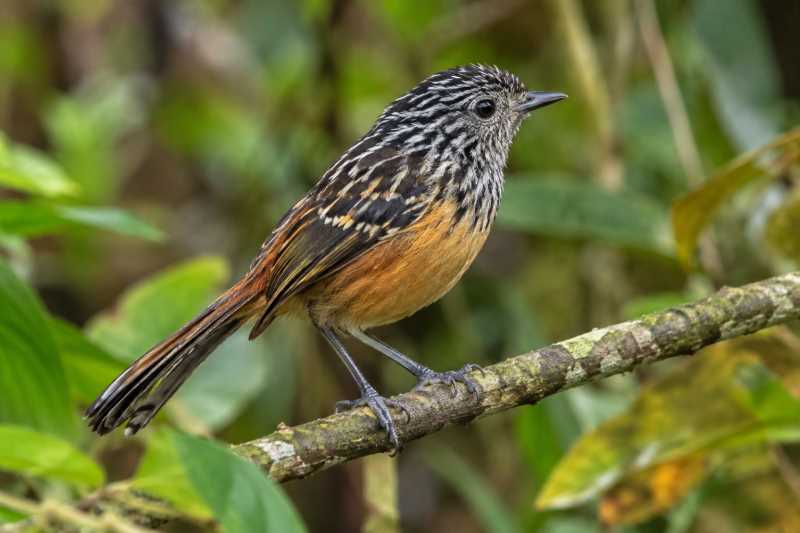
Klages’s Antbird is a small passerine bird characterized by its distinctive plumage and slender build. The males are adorned with a striking combination of black and white, with a bold black hood and contrasting white throat and underparts. Females, on the other hand, exhibit a more subdued coloration, with brownish tones replacing the stark black of the males. This sexual dimorphism is typical of many antbird species and serves as a visual cue in mate selection.
Habitat and Distribution
Endemic to the northern regions of South America, Klages’s Antbird is primarily found in the lowland rainforests of Venezuela and parts of Colombia. The bird favors dense understory vegetation, where it can often be seen flitting through the shadows in search of food. Its preference for such specific habitat types makes it highly susceptible to changes in land use and deforestation, which pose significant threats to its population.
Behavior and Ecology
Klages’s Antbird is an insectivorous species, feeding predominantly on ants and other small invertebrates. It employs a unique foraging strategy known as "army ant following," where it trails swarms of army ants to capture prey items that are disturbed by the ants’ advance. This behavior not only provides the bird with a reliable food source but also illustrates the complex interdependencies that exist within rainforest ecosystems.
The bird is also known for its vocalizations, which consist of a series of rapid, high-pitched notes. These calls are used for communication between mates and to establish territory within the dense forest. During the breeding season, which typically coincides with the wet season, pairs will construct a cup-shaped nest hidden in the understory. The female lays two to three eggs, which both parents help incubate and raise.
Conservation Status
The International Union for Conservation of Nature (IUCN) currently classifies Klages’s Antbird as a species of Least Concern. However, this status does not imply that the bird faces no threats. Habitat destruction due to logging, agriculture, and mining operations continues to encroach upon its natural habitat, potentially leading to population declines in the future. Conservation efforts aimed at preserving large tracts of contiguous rainforest are crucial to ensuring the long-term survival of this and other forest-dependent species.
The Role of Klages’s Antbird in the Ecosystem
Beyond its intrinsic value as a species, Klages’s Antbird plays a vital role in the health and functioning of its ecosystem. As an insectivore, it helps regulate insect populations, which in turn influences the dynamics of plant growth and nutrient cycling. Additionally, by following army ant swarms, the bird contributes to the dispersal of seeds and other organic material, further supporting the forest’s biodiversity.
Future Research Directions
While much has been learned about Klages’s Antbird, there remain many areas ripe for further study. Research into its breeding biology, population dynamics, and responses to habitat fragmentation would provide valuable insights into the factors that influence its survival. Moreover, understanding the effects of climate change on its distribution and behavior could inform conservation strategies that buffer the species against future environmental changes.
Conclusion
Klages’s Antbird is a testament to the rich biological heritage of the Amazon rainforest. Its presence within this complex ecosystem underscores the intricate web of life that sustains it. As we continue to explore and understand the natural world, the conservation of species like Klages’s Antbird becomes ever more critical. Preserving the delicate balance of the rainforest not only protects individual species but also ensures the survival of the myriad life forms that depend on this unique and precious environment.
In conclusion, the story of Klages’s Antbird is one of wonder and warning—a reminder of nature’s beauty and the fragility of the ecosystems that support it. Through concerted conservation efforts and continued research, we can hope to secure a future where this remarkable bird continues to thrive in the heart of the Amazon.
Related posts