Introduction
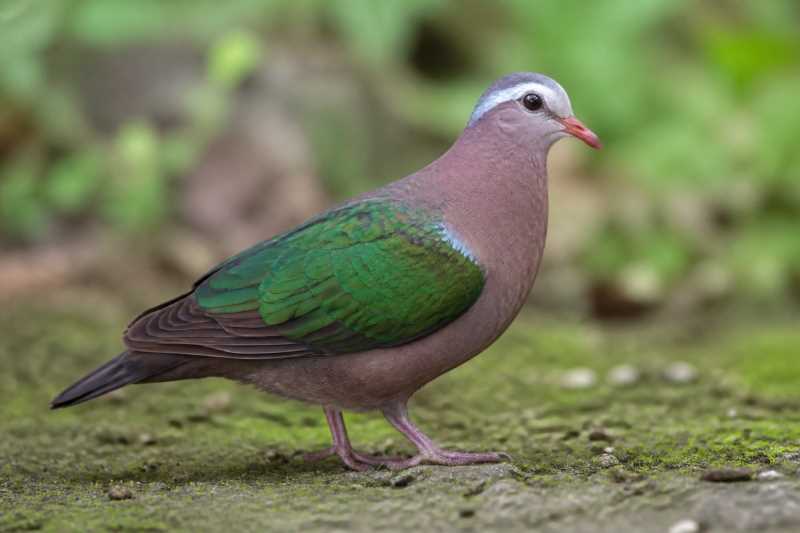
The Common Emerald Dove, also known as the Asian Emerald Dove or Grey-capped Emerald Dove, is a shy, ground-feeding pigeon of tropical and subtropical forests. Its accepted scientific name is Chalcophaps indica. The species is recognised by its iridescent green wings, warm brown head and underparts, and contrasting pale forehead and shoulder markings.
Physical Description
The Common Emerald Dove is a compact, robust dove measuring approximately 23–28 centimetres in length. Adults have metallic green wings and upperparts, a reddish-brown to vinous chest and belly, and a greyish crown and nape. The forehead is usually pale in males, while the shoulder shows a distinctive pale patch that can be conspicuous in flight or during interactions with other doves.
The bill and legs are reddish. The tail is dark, with pale edging that may be visible when the bird is flushed from the forest floor. Males and females are similar, although females are generally duller and browner, with less contrasting head and shoulder markings. Juveniles are less brightly coloured and often show brownish, scaled plumage that helps them blend with leaf litter and dense vegetation.
Range and Habitat
The Common Emerald Dove is a resident species distributed across the Indian subcontinent and much of South and Southeast Asia. Its range extends from India, Sri Lanka, Nepal and Bangladesh through Myanmar, southern China, Taiwan and the Philippines, and southwards through parts of Indonesia. Some island populations are treated separately under current taxonomic arrangements, and mainland Australian birds are generally assigned to the Pacific Emerald Dove, Chalcophaps longirostris.
It occurs mainly in lowland and foothill forest, including broad-leaved woodland, rainforest, bamboo forest, gallery forest, forest clearings, mangroves, plantations and some well-vegetated rural or suburban areas. It is usually associated with habitats that provide dense cover and leaf litter for feeding. The species is generally resident rather than migratory, although local movements may occur in response to food availability and habitat conditions.
Where to See This Species
Bukit Timah Nature Reserve, Singapore
The National Parks Board records the Common Emerald Dove in Bukit Timah Nature Reserve, where mature forest, shaded paths and dense undergrowth provide suitable habitat. It is most likely to be encountered quietly walking on the forest floor or flying low and directly between patches of cover.
Nearby accommodation: Singapore offers a wide range of hotels, guest houses, serviced apartments and other accommodation, with Bukit Timah accessible from the city’s established urban areas.
Chitwan National Park, Bagmati Province, Nepal
Chitwan National Park’s official species records include the Common Emerald Dove. Forest edges, sal woodland, riverine vegetation and other well-wooded areas provide suitable places to search, particularly during quiet walks or wildlife drives when birds may be feeding on the ground.
Nearby accommodation: Sauraha is the main gateway settlement and provides lodges, hotels, guest houses and safari-oriented accommodation.
Bardia National Park, Lumbini Province, Nepal
The official Bardia National Park bird list includes the Common Emerald Dove. The park’s sal forests, riverine woodland and forest clearings offer appropriate habitat, although the species can be difficult to detect because it is quiet, wary and often remains close to cover.
Nearby accommodation: Thakurdwara is the principal gateway area, with lodges, guest houses, homestays and safari camps.
Behaviour and Diet
Common Emerald Doves are primarily terrestrial and spend much of their time walking quietly through leaf litter and low vegetation. They are usually seen alone or in pairs, although several may gather where food is plentiful. When disturbed, they often remain still until approached closely before flying rapidly into dense vegetation.
The diet consists mainly of fallen fruits, seeds, berries and grains. Small invertebrates, including termites and other insects, may also be taken. Feeding usually takes place on the ground, where the bird searches beneath trees and shrubs rather than foraging high in the canopy.
The species communicates with soft, repeated cooing calls. Breeding can occur during much of the year, with timing varying between regions. The nest is a small, lightly built platform of twigs placed in a shrub, low tree or other sheltered vegetation. Two cream-coloured eggs are normally laid.
Identification Tips
- Look for a compact dove with glossy emerald-green wings and back.
- The warm brown or vinous head, breast and underparts contrast with the green wings.
- An adult male usually shows a pale forehead and a noticeable pale shoulder patch.
- The red bill and red legs are useful supporting features at close range.
- It is commonly encountered walking on the forest floor, often in shade or among leaf litter.
- Do not confuse it with a green pigeon. Green pigeons are usually more arboreal and have a different body shape, bill structure and plumage pattern.
- In northern and eastern Australia, check the identification carefully because birds formerly included within the broader Chalcophaps indica grouping are generally treated as Pacific Emerald Doves, Chalcophaps longirostris.
Conservation Status
The Common Emerald Dove is currently assessed as Least Concern. It remains widespread and can tolerate a range of wooded habitats, but local populations may be affected by forest clearance, habitat fragmentation, hunting and trapping. Conservation depends on protecting remaining forests, maintaining connected woodland and regulating the taking of wild birds.
The species is also recorded in protected areas across its range. Regional monitoring remains important because a broad global assessment can conceal local declines, especially where forest loss or hunting pressure is severe.
Frequently Asked Questions
Where does the Common Emerald Dove live?
It occurs across the Indian subcontinent and much of South and Southeast Asia, including forests, woodland, bamboo stands, mangroves, plantations and well-vegetated clearings.
Is the Common Emerald Dove migratory?
It is generally a resident species. Individuals may make local movements, but it is not regarded as a long-distance migrant.
What does the Common Emerald Dove eat?
It mainly eats fallen fruits, berries, seeds and grains gathered from the ground. It may also take small invertebrates such as termites and other insects.
How can the species be identified?
Look for the combination of iridescent green wings, a brown or vinous head and breast, a pale forehead or shoulder patch, and a red bill. Its habit of walking quietly on the forest floor is also distinctive.
Does the Common Emerald Dove live in Australia?
Most mainland Australian birds formerly included in this group are now generally treated as Pacific Emerald Doves, Chalcophaps longirostris. The Common Emerald Dove, Chalcophaps indica, remains associated with the Asian part of the complex and some island populations.
Where is the best place to look for one?
Search quietly along shaded forest paths, woodland edges and clearings with leaf litter. Bukit Timah Nature Reserve in Singapore and Chitwan and Bardia national parks in Nepal all have official records of the species.
References
- IOC World Bird List
- IUCN Red List of Threatened Species
- National Parks Board Singapore and Department of National Parks and Wildlife Conservation, Nepal
Related posts