Introduction
The Cauca Guan (Penelope perspicax) is a large, forest-dwelling cracid endemic to Colombia. It occurs mainly in the Andean forests of the middle Cauca Valley and is recognised by its brown-grey plumage, blue facial skin, coral-red throat and legs, and long tail. Once more widely distributed, it now survives in isolated forest populations and remains a significant conservation priority.
Physical Description
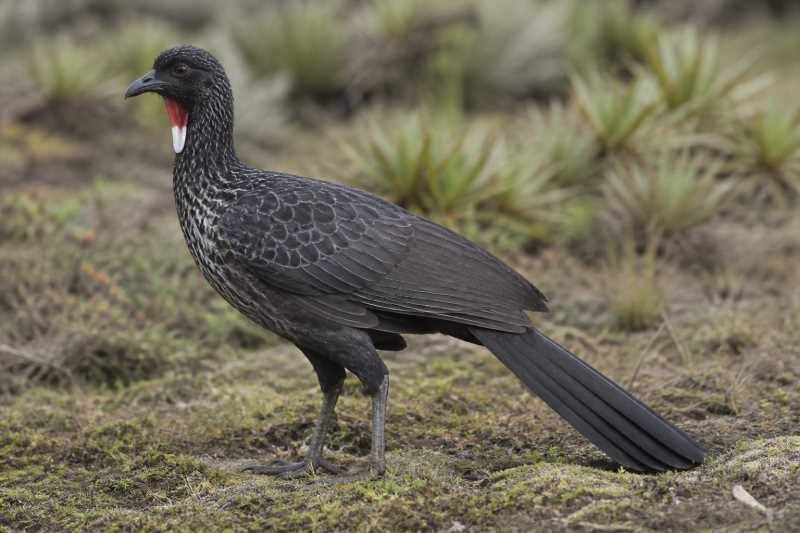
The Cauca Guan is approximately 76 cm long and weighs about 1.2 kg. It has a relatively small head, a short crest, a long tail and a noticeable dewlap, or loose throat skin. The facial skin is bare and blue, while the throat and legs are coral-red.
The head, neck, upper back and breast are brownish grey. Fine pale scaling is visible on the mantle and is denser on the breast. The lower back and tail are chestnut, with the outer tail feathers somewhat darker. The sexes are generally similar in appearance. Juvenile plumage is poorly documented, although young birds are expected to resemble adults, as in other species of Penelope.
Range and Habitat
The Cauca Guan is endemic to Colombia. Its historical range extended through the Cauca, Dagua and Patía valleys, from Risaralda and Quindío south through Valle del Cauca to Cauca. The species is now concentrated in isolated remnants on the western and central slopes of the Colombian Andes, particularly around the middle Cauca Valley.
It is associated mainly with humid sub-Andean and montane forest, generally between about 1,000 and 2,100 metres above sea level. It can also use secondary forest, forest edges, streamside vegetation and some plantations, but the probability of occurrence generally increases with the amount of available forest. The remaining populations are fragmented, and connectivity between forest patches is important for movement and long-term persistence.
Behaviour and Diet
Cauca Guans forage in trees and shrubs from the understorey to the canopy. They may occur alone, in pairs or in small family groups, and larger gatherings can form where food is concentrated. Their movements appear to respond partly to seasonal changes in fruit and leaf availability.
The diet consists mainly of fruit and other plant material, including leaves and flowers. At Otún-Quimbaya, guans have been recorded feeding heavily on the leaves of Chinese ash (Fraxinus chinensis) when forest fruits are scarce. This resource use demonstrates dietary flexibility, but it does not replace the need to conserve native forest.
As a large frugivorous bird, the Cauca Guan is likely to contribute to seed dispersal and forest regeneration. Detailed information on its nesting biology, reproductive rates and juvenile survival remains limited, so these aspects should not be inferred beyond the available evidence.
Identification Tips
Look for a large, long-tailed guan in humid Andean forest. The most useful field marks are:
- Brownish-grey head, neck, upper back and breast.
- Fine pale scaling on the mantle and especially the breast.
- Chestnut lower back and tail.
- Bare blue facial skin.
- Coral-red throat skin and legs.
- Short crest, small head and conspicuous dewlap.
The combination of blue facial skin, coral-red throat and legs, and finely scaled brown-grey underparts helps separate the Cauca Guan from other guans in its Colombian range. Identification should also take account of location, elevation and habitat, because several Penelope guans have broadly similar shapes and brown plumage.
Conservation Status
The Cauca Guan is listed as Vulnerable (VU) on the IUCN Red List assessment cited by recent Colombian conservation literature. Earlier sources described the species as Endangered, reflecting older assessments and the severe decline that followed the loss of its historical range.
The principal threats are the conversion and fragmentation of forest for agriculture, pasture, plantations and settlement, together with hunting. Research has shown that the species’ former distribution was much larger than its present occupied range and that surviving populations are isolated. Hunting pressure can be particularly serious because the birds are large, vocal and often predictable in their use of forest remnants.
Conservation priorities include protecting remaining forest, restoring degraded habitat, maintaining corridors between fragments and reducing hunting. Protected areas such as Otún-Quimbaya, Ucumarí and Yotoco are important for the species. Continued surveys and population monitoring are needed because densities vary among sites and local improvements do not remove the risks associated with small, isolated populations.
Frequently Asked Questions
Where does the Cauca Guan live?
The Cauca Guan lives only in Colombia, mainly in humid sub-Andean and montane forests on the western and central Andean slopes around the Cauca Valley.
What does the Cauca Guan eat?
It mainly eats fruit, supplemented by leaves and flowers. In some protected areas it also feeds on Chinese ash leaves when native forest fruits are less available.
How can the Cauca Guan be identified?
Key features include a long tail, brown-grey plumage with pale scaling, chestnut rear parts, blue bare facial skin, and coral-red throat skin and legs.
Is the Cauca Guan endangered?
The species is currently assessed as Vulnerable on the IUCN Red List, although some older references classify it as Endangered. It remains threatened by habitat loss, fragmentation and hunting.
Does the Cauca Guan migrate?
There is no evidence that the Cauca Guan undertakes long-distance migration. It may move locally between forest patches and feeding areas in response to food availability.
How is the Cauca Guan being conserved?
Conservation work focuses on protecting forest remnants, restoring habitat, improving connectivity, controlling hunting and monitoring populations in protected areas and other important sites.
References
- BirdLife International. 2021. Penelope perspicax. The IUCN Red List of Threatened Species 2021: e.T22678379A188319595. International Union for Conservation of Nature. https://www.iucnredlist.org/species/22678379/188319595. Accessed 8 September 2026.
- Gill, F., Donsker, D. and Rasmussen, P. (eds.). 2026. IOC World Bird List, version 15.2. International Ornithologists’ Union. https://www.worldbirdnames.org/. Accessed 8 September 2026.
- Kattan, G. H., León, A., Corredor, G., Beltrán, W. and Parada, M. 2006. Distribution and population density of the Endangered Cauca Guan Penelope perspicax. Bird Conservation International, 16(4), 299–307. https://doi.org/10.1017/S0959270906000475.
- Kattan, G. H., Roncancio, N., Banguera, Y., Kessler-Rios, M., Londoño, G. A., Marín, O. H. and Muñoz, M. C. 2014. Spatial variation in population density of an endemic and endangered bird, the Cauca Guan (Penelope perspicax). Tropical Conservation Science, 7(1), 161–170. https://doi.org/10.1177/194008291400700106.
- Muñoz, M. C., Ríos, M. M., Londoño, G. A. and Kattan, G. H. 2007. Diet of the Cauca Guan: Exploitation of a novel food source in times of scarcity. The Condor, 109(4), 841–848. https://doi.org/10.1093/condor/109.4.841.
- Roncancio-Duque, N., Ramírez-González, M. G. and Vallejo-López, J. M. 2025. Estimación de densidad y ocupación de Penelope perspicax y Alouatta seniculus en el Santuario de Fauna y Flora Otún Quimbaya, Colombia. Revista de la Academia Colombiana de Ciencias Exactas, Físicas y Naturales, 49(193), 805–817. https://doi.org/10.18257/raccefyn.3216.
- Valencia-Velasco, J. D., Estela, F., Fierro-Calderón, E., Valenzuela, L. and Osorio-Domínguez, D. 2022. Densidad y uso de hábitat de la pava caucana (Penelope perspicax) en los Farallones de Cali, Colombia. Biota Colombiana, 23(1), e1003. https://doi.org/10.21068/2539200X.1003.
- Wildlife Conservation Society Colombia. n.d. Cauca Guan. Wildlife Conservation Society Colombia. https://colombia.wcs.org/en-us/STRATEGIC-PILLARS/SPECIES/CAUCA-GUAN.aspx. Accessed 8 September 2026.
Related posts