Introduction
The Violet-fronted Brilliant (Heliodoxa leadbeateri) is a medium-sized hummingbird of the northern and central Andes. It occurs as a resident in suitable forest and woodland habitats from Venezuela and Colombia through Ecuador and Peru to Bolivia. The species belongs to the hummingbird family Trochilidae and is one of the brilliants, a group recognised for their iridescent plumage and vigorous flight.
Physical Description
The Violet-fronted Brilliant is approximately 11–13 cm long. Both sexes have a medium-length, almost straight black bill, a small white spot behind the eye, a short white malar stripe and a forked tail. The male’s tail is generally more deeply forked than the female’s.
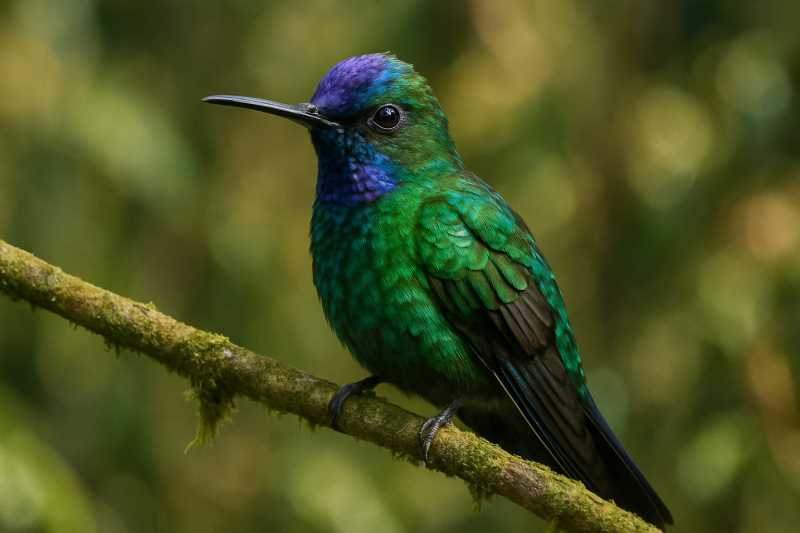
Adult males are mainly bronzy or metallic green above, with an iridescent blue or violet forehead, an emerald-green throat and chest, and darker green underparts. The exact colour of the forehead and other plumage details vary geographically between subspecies.
Females are less brightly coloured. They are green above, with pale or whitish underparts heavily marked with green spots, particularly across the throat and breast. The tail is less deeply forked and usually has noticeable pale or white tips. Young birds and immature males are generally duller and may resemble females until the adult male plumage develops.
Range and Habitat
The Violet-fronted Brilliant is distributed along the eastern and northern slopes of the Andes. Its range includes Venezuela, Colombia, Ecuador, Peru and Bolivia. Several geographic forms are recognised, including birds of the Venezuelan and Colombian Andes, eastern Ecuador and northern Peru, and central and southern Peru extending into north-western Bolivia.
It is a resident rather than a long-distance migrant. The species is associated mainly with humid lowland, foothill and montane forest, including premontane rainforest and cloud forest. It may also occur along forest edges, in secondary woodland, scrub, clearings and some coffee-growing landscapes. BirdLife International gives a broad recorded elevation range of approximately 400–2,400 metres, although local occurrence varies across its distribution.
Where to See This Species
Wildsumaco Wildlife Sanctuary, Napo, Ecuador
Wildsumaco protects foothill forest on the eastern slope of the Andes at approximately 1,200–1,600 metres. The sanctuary and surrounding trails are established birdwatching sites, and Violet-fronted Brilliant has been recorded there during organised birding visits. Look around forest edges, flowering plants and hummingbird-rich clearings, particularly in the early morning.
Nearby accommodation: Wildsumaco Lodge provides on-site accommodation. Additional guesthouses and basic lodging are available in the wider Pacto Sumaco and Loreto area.
Mashpi Amagusa Reserve, Pichincha, Ecuador
Mashpi Amagusa is a private cloud-forest reserve within the Chocó-Andino region and the Mashpi-Pachijal Important Bird Area. The reserve offers forest trails, gardens and guided wildlife viewing, and Violet-fronted Brilliant has been reported during birding visits to the area. Access is generally arranged in advance, making it important to confirm visiting conditions before travelling.
Nearby accommodation: The reserve offers lodge and guest-house accommodation. Pacto is the nearest practical settlement for additional hotels and guesthouses.
Behaviour and Diet
The Violet-fronted Brilliant is active during the day and usually forages alone. Like other hummingbirds, it can hover while taking nectar from flowers and can change direction rapidly during short flights. Individuals often perch quietly between feeding visits.
Its diet consists mainly of nectar from a variety of flowering plants. It also takes small insects and spiders, which provide important protein and other nutrients, particularly during feather growth and breeding. The species may defend productive feeding areas and can behave aggressively towards other hummingbirds near flowers or feeders.
Breeding information for this species is less well documented than its appearance and distribution. As in other hummingbirds, the female is responsible for nest construction, incubation and the care of the young. The small cup-shaped nest is built from fine plant material and bound with spider silk, which allows it to remain flexible as the chicks grow. The nest is usually placed on a branch or other sheltered support, and the young are fed a mixture of regurgitated nectar and small invertebrates.
Identification Tips
- Look for a medium-sized, mostly green hummingbird with a relatively straight black bill and a forked tail.
- In males, the iridescent blue or violet forehead is the most distinctive feature, together with the bright green throat and chest.
- Females show pale underparts densely spotted with green, a white malar stripe and pale tail tips.
- The small white spot behind the eye is useful when viewing the bird closely.
- Plumage colour can change dramatically with the angle of the light, so the forehead may appear blue, violet or greenish.
- Compare carefully with other Heliodoxa species. The Violet-fronted Brilliant is generally identified by the combination of its blue or violet forehead, green throat, white facial markings and moderately forked tail. Regional variation means that photographs or vocal recordings may be helpful when identification is uncertain.
Conservation Status
The Violet-fronted Brilliant is currently assessed as Least Concern on the IUCN Red List. Its global population has not been quantified, but the species is considered fairly common in parts of its range. BirdLife International identifies a decreasing population trend, inferred largely from continuing habitat loss.
Deforestation, agricultural expansion and the degradation of humid forest are the principal concerns. Changes in flowering patterns and plant distributions linked to climate change could also affect local food availability, although the species’ overall response is not yet well understood. Protecting cloud forest, foothill forest and connected secondary habitats remains important for maintaining populations.
Frequently Asked Questions
Where does the Violet-fronted Brilliant live?
It lives in humid forest, cloud forest, forest edge, secondary woodland and some coffee-growing areas on the Andean slopes of Venezuela, Colombia, Ecuador, Peru and Bolivia.
Is the Violet-fronted Brilliant migratory?
No. It is regarded as a resident species, although individuals may make local movements in response to flowering conditions and food availability.
How can the male be identified?
The male is mainly green, with a bright iridescent blue or violet forehead, an emerald-green throat and chest, a small white spot behind the eye and a forked tail.
How can the female be identified?
The female is greener and less brightly coloured than the male. She has pale underparts marked with green spots, a white malar stripe and a less deeply forked tail with pale tips.
What does the Violet-fronted Brilliant eat?
It feeds mainly on nectar, but also captures small insects and spiders. Nectar supplies energy for flight, while invertebrates provide protein and other nutrients.
Is the Violet-fronted Brilliant threatened?
It is currently classified as Least Concern, but its population is considered to be declining because of forest loss and habitat degradation across parts of its range.
References
- BirdLife International
- Birds of the World
- IUCN Red List of Threatened Species
Related posts