Introduction
The Vervain Hummingbird (Mellisuga minima) is a tiny Caribbean hummingbird in the family Trochilidae. It occurs naturally on Jamaica and Hispaniola, including the Dominican Republic and Haiti, and is one of the smallest birds in the world. Unlike the better-known Bee Hummingbird, it is not confined to Cuba.
Physical Description
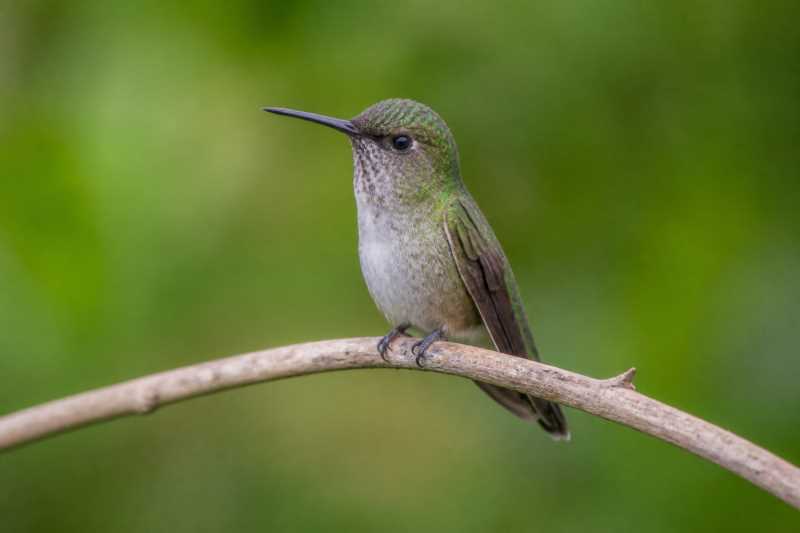
The Vervain Hummingbird is approximately 5–6 centimetres long and weighs just over 2 grams. It has a short, straight, dark bill, narrow wings and a slightly forked tail in the male.
Adults are mainly dull metallic green above, with darker rump and upper-tail feathers. The chin, throat and chest are pale grey with fine darker spotting, while the belly and undertail area are darker green. The wings are dark brown and the tail is largely black.
The sexes are similar, but the female is generally less contrasting below and has a more rounded tail. The male’s tail is slightly forked, whereas the female’s outer tail feathers may show pale or white tips. Juveniles resemble females and acquire adult plumage gradually as they moult.
Range and Habitat
The species is endemic to the Caribbean. The nominate subspecies, Mellisuga minima minima, occurs on Jamaica, while Mellisuga minima vielloti occurs on Hispaniola and some nearby islands.
Vervain Hummingbirds use a wide range of habitats, including dry woodland, moist forest margins, scrub, gardens, plantations, open country and flowering areas near settlements. They are often found wherever suitable nectar-producing plants are available and are not restricted to dense forest. Records extend from lowlands into mountainous areas, although the species is not considered a long-distance migrant. Local or seasonal movements may occur as birds respond to changes in food availability.
Where to See This Species
Stewart Town, Trelawny and St Ann, Jamaica
The public roads and forested hills around Stewart Town in Cockpit Country are documented for Vervain Hummingbird. The area includes woodland, scrub and flowering plants, and is a realistic place to search during daytime birding, particularly around forest edges and gardens. The birding route is accessible by public road, although some roads are narrow and uneven.
Nearby accommodation: Discovery Bay is the nearest practical gateway, with hotels, guest houses and self-catering accommodation available in the wider north-coast area.
Ébano Verde Scientific Reserve, La Vega Province, Dominican Republic
Vervain Hummingbirds are documented along trails in the Ébano Verde Scientific Reserve. The reserve protects broadleaf cloud forest, pine forest, riparian habitat and forest edges, providing a range of flowering habitats. Visitors should follow reserve access arrangements and use the established visitor routes.
Nearby accommodation: Constanza is the principal practical base, with guest houses, small hotels, cabins and other self-catering accommodation in the surrounding mountain area.
National Botanical Garden, Santo Domingo, Dominican Republic
The National Botanical Garden is a publicly accessible urban wildlife site where Vervain Hummingbirds are documented as broadly distributed residents. Wooded paths, stream-side vegetation, open palm areas and planted gardens provide suitable habitat. Early morning visits offer the best opportunity for observing active hummingbirds.
Nearby accommodation: Santo Domingo provides the widest choice of hotels, guest houses and serviced apartments, with the garden accessible from the city.
Behaviour and Diet
Vervain Hummingbirds are active, agile fliers that can hover while feeding and manoeuvre rapidly between flowers. They are often heard before they are seen because their calls include high, squeaky notes and occasional buzzing sounds.
Nectar forms the main part of the diet. The birds visit a variety of flowering plants and use their bills and specialised tongues to obtain liquid food. Small insects and spiders are also taken, providing protein and other nutrients, especially during breeding.
The species is usually encountered singly or in small numbers, although several birds may gather where flowers are abundant. It is not known for conventional long-distance migration, but individuals may move locally or change elevation as flowering conditions vary.
The female builds the small cup-shaped nest, using soft plant material, fibres and spider silk, often with lichen or other material for camouflage. She incubates the eggs and raises the young without assistance from the male. A typical clutch contains two white eggs. Precise information on lifespan in the wild remains limited.
Identification Tips
- Look for a very small hummingbird, about 5–6 centimetres long, with a short, straight, dark bill.
- The plumage is relatively plain compared with many Caribbean hummingbirds: dull green above, pale grey on the throat and chest, and dark below.
- The male usually has a slightly forked black tail, while the female has a rounder tail with pale tips on some outer feathers.
- It often feeds in open or semi-open flowering habitat rather than only in dense woodland.
- On Hispaniola, compare it carefully with the female Hispaniolan Emerald and other small hummingbirds. The Vervain Hummingbird is noticeably smaller, shorter-billed and more plainly coloured.
- Its high, squeaky calls can draw attention to a bird that is difficult to locate visually.
Conservation Status
The Vervain Hummingbird is currently assessed as Least Concern on the IUCN Red List. No reliable global population estimate should be assumed from its small size or local abundance.
The principal concerns are habitat loss and degradation caused by deforestation, agricultural expansion, urban development and changes to flowering vegetation. Maintaining native woodland, forest edges, gardens and other nectar-rich habitats can benefit the species. Protected areas and sustainable land-use practices are important, particularly on islands where the available habitat is naturally limited.
Frequently Asked Questions
Where does the Vervain Hummingbird live?
It occurs on Jamaica and Hispaniola, including the Dominican Republic and Haiti, as well as some nearby islands.
Is the Vervain Hummingbird the smallest bird in the world?
It is one of the smallest birds in the world and is often described as the second-smallest bird after Cuba’s Bee Hummingbird. Several other tiny hummingbirds are similar in size, so exact rankings depend on the measurements used.
What does the Vervain Hummingbird eat?
It mainly feeds on nectar from flowering plants, supplemented by small insects and spiders.
Can Vervain Hummingbirds fly backwards?
Like other hummingbirds, they can hover and manoeuvre in several directions, including brief backward movement while feeding. Their rapid wingbeats allow them to remain stationary in the air.
How can the species be identified in the field?
Look for an exceptionally small, plain green hummingbird with a short dark bill, a pale grey throat and chest, and a dark tail. Its high, squeaky calls are also useful clues.
Is the Vervain Hummingbird endangered?
No. It is currently classified as Least Concern, although habitat loss and degradation remain important conservation concerns across its Caribbean range.
References
- IOC World Bird List
- IUCN Red List of Threatened Species
- Caribbean Birding Trail
Related posts