Introduction
The Green-breasted Pitta, Pitta reichenowi, is a secretive forest bird of Central and East Africa. It belongs to the pitta family, Pittidae, and is one of the few pitta species occurring in Africa. Its recognised range extends from southern Cameroon through parts of the Central African Republic, Republic of the Congo, Gabon and the Democratic Republic of the Congo to western Uganda. The species is best known for its brilliant blue, green, red and black plumage, but it is much more often heard than seen because it spends most of its time in dense forest undergrowth. (aviansystematics.org)
Although the Green-breasted Pitta is currently assessed as Least Concern, its dependence on humid, structurally complex forest makes it sensitive to local habitat clearance, logging and degradation. Much of its distribution lies in regions where field coverage is uneven, so apparently reassuring range-wide assessments should not be interpreted as evidence that every population is secure. (portals.iucn.org)
Physical Description
The Green-breasted Pitta is a compact, short-tailed, long-legged bird measuring approximately 17 to 19 centimetres in length. Like other pittas, it has a relatively heavy body, upright posture and strong legs suited to walking and hopping through leaf litter. Its bill is short and dark, and the feet are generally pale pinkish to greyish white. Sexes are similar in plumage, and there is no well-established, conspicuous sexual dimorphism useful for routine field identification. (birdforum.net)
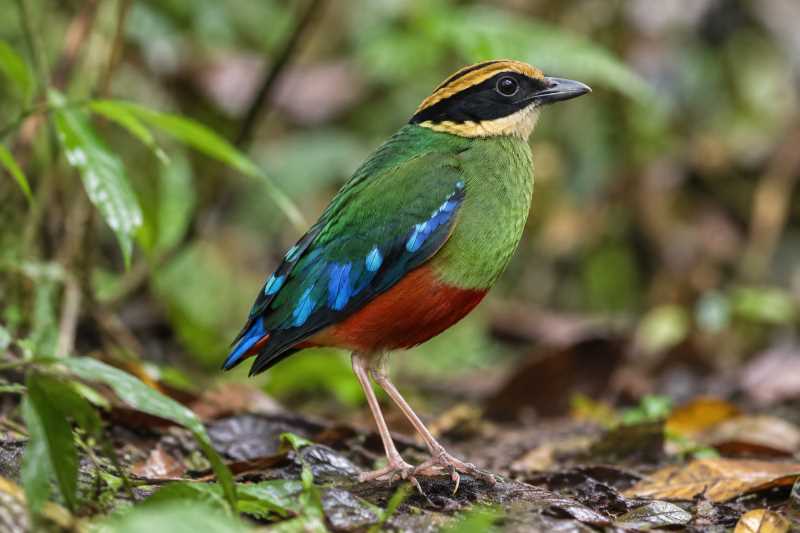
Adults are strikingly patterned. The head is predominantly black, with a broad golden-buff to buff supercilium extending behind the eye. The upperparts are deep green, while the rump and upper tail-coverts show bright sky-blue or blue-green colour. The tail itself is dark. Folded wings appear blackish with a violet or purplish sheen, blue-tipped coverts and a distinctive pale or white patch on the primaries. These wing markings can be difficult to see when the bird is moving beneath closed canopy, but they are conspicuous during a brief display flight or when the bird perches in an opening.
The throat is pale or white, bordered below by a small black mark or narrow black band. This feature is important because it separates the Green-breasted Pitta from the closely related African Pitta, Pitta angolensis, in areas where their distributions or seasonal movements may bring them into proximity. Below the throat, the breast is dull green with a yellowish or golden gloss. The belly and undertail-coverts are vivid red, creating one of the species’ most memorable field characters.
Colour can vary with light, distance and wear. In shadow, the blue rump may appear turquoise or dull green, and the breast may look olive rather than emerald. A wet bird or an individual viewed through dense foliage can appear much less colourful than photographs suggest. Observers should therefore assess the combination of characters rather than relying on a single colour impression.
Juveniles and immatures are considerably duller. Young birds tend to show darker, browner and less sharply contrasting plumage, with the breast appearing brownish olive rather than strongly green. The blue wing and rump markings may be reduced or less saturated, and the red underparts may be less brilliant. These age-related differences can make immature Green-breasted Pittas surprisingly difficult to identify, particularly in poor light. (en.wikipedia.org)
The species’ body shape is also diagnostic. It has a large head, short tail, long legs and a characteristic ground-dwelling stance. When undisturbed, it often moves with deliberate hops, pauses frequently and raises its body slightly while looking around. It is not a slender, branch-perching forest bird, even though adults may climb or fly briefly to low branches during courtship or when alarmed.
Range and Habitat
The Green-breasted Pitta has a geographically broad but discontinuous distribution in the forests of Central Africa and the western Great Lakes region. The accepted range runs from southern Cameroon east and south through northern Gabon, the south-western Central African Republic, the Republic of the Congo and the Democratic Republic of the Congo, reaching western Uganda. Some modern checklist treatments summarise the distribution as extending from southern Cameroon to western Uganda, with the range reaching south into central parts of the Democratic Republic of the Congo. (aviansystematics.org)
It is primarily a bird of humid tropical forest, including mature lowland rainforest, older secondary forest and forest with a dense understorey. The species favours shaded ground with deep leaf litter, fallen branches, tangled vegetation and relatively high humidity. It may occur in forest edges or regenerating forest when the understorey remains thick and the site retains suitable feeding habitat, but it should not be treated as a generalist of open woodland or farmland.
Dense undergrowth appears especially important. Pittas feed on the forest floor and require cover for concealment, nesting and movement. Suitable habitat commonly includes areas near small streams, drainage lines, swamp margins and damp hollows, although the species is not an aquatic bird and does not depend on open wetlands. The most useful habitat description is humid forest with a shaded, well-developed ground layer and abundant leaf-litter invertebrates.
In Uganda, the species is associated with western forest landscapes, including Kibale, Semliki and Budongo. Available records indicate that it can occur in medium-altitude forest as well as lower-lying humid forest. Some summaries give Ugandan records at approximately 1,000 to 1,400 metres, although the species’ wider Central African distribution also includes lower elevations. Elevational limits should therefore be treated as regional rather than absolute. (en.wikipedia.org)
The Green-breasted Pitta is generally regarded as resident rather than a long-distance migrant. There is no well-established regular migration comparable with the seasonal movements of some populations traditionally included within the African Pitta complex. Local movements may occur in response to rainfall, food availability, breeding activity or changes in forest conditions, but evidence for regular large-scale migration in Pitta reichenowi is limited.
Taxonomically, the species has a close relationship with the African Pitta. Older treatments sometimes placed Green-breasted Pitta populations within a broader African Pitta species concept, and some regional identification literature reflects that history. Current global checklists recognise Pitta reichenowi as a separate species. The boundary between the two taxa is therefore relevant when interpreting older specimens, historical publications and records from areas where taxonomic treatments have changed. (aviansystematics.org)
Kibale National Park, Western Region, Uganda
Kibale National Park is the best-documented publicly accessible venue for seeing Green-breasted Pitta. The species is regularly included among the park’s specialist forest birds, and photographic and birding records confirm its occurrence there. The park’s mature rainforest, shaded trails, leaf-litter floor and dense understorey provide appropriate habitat. It remains difficult to see, but experienced birders and local guides specifically search for it in the forest around the Kanyanchu area and in nearby forest habitats associated with Bigodi. (kibalenationalparkuganda.com)
Early starts are sensible, especially during periods of increased calling or breeding activity. A quiet, patient approach is more productive than covering long distances quickly. Visitors should follow park rules and local guide instructions, as playback and repeated disturbance can be harmful to a secretive forest bird.
Nearby accommodation: Fort Portal is the main practical gateway town, while the villages and lodge areas around Kibale and Bigodi provide forest-oriented lodges, guest houses and self-catering options.
Semuliki National Park, Western Region, Uganda
Semuliki National Park has documented records of Green-breasted Pitta in its biodiversity reporting. The park protects lowland and foothill forest in the Albertine Rift and contains a mixture of habitats associated with the Semliki valley, making it particularly valuable for Central African forest species occurring in Uganda. Records are not evidence that the species is easy to find, but they establish the park as a genuine place to look rather than merely a site inferred from its broad range. (wildsolutions.nl)
The most appropriate search areas are likely to be humid forest with dense undergrowth and intact leaf litter. Sightings may be infrequent, and visitors should expect the species to remain concealed. Birding with a guide familiar with the park’s forest birds is strongly preferable.
Nearby accommodation: Bundibugyo is the nearest recognised town for many visits, while the Semuliki area also has park camps, simple campsites and lodge-style accommodation serving wildlife visitors.
Budongo Forest Reserve, Western Region, Uganda
Green-breasted Pitta has been recorded in Budongo Forest, where biodiversity surveys described it as infrequent but noted several recent records. The species was associated with dense understorey vegetation and thick tangles of climbers in medium-altitude forest. Budongo is therefore a credible site for a specialist search, although it is less predictable than a destination specifically known for concentrated pitta-watching. (s3.amazonaws.com)
The reserve’s extensive forest and established research and ecotourism interest make it a useful location for observers seeking Central African forest birds. Access arrangements may vary according to the sector and current management requirements, so visitors should confirm permission and guiding arrangements before travelling.
Nearby accommodation: Masindi is the main gateway town, with hotels, guest houses and other practical accommodation for visits to the Budongo area. Forest camps and research-linked accommodation may also be available where authorised.
Behaviour and Diet
The Green-breasted Pitta is primarily terrestrial. It spends much of its time walking, hopping and pausing on the forest floor, where its green, blue, red and black plumage can be surprisingly difficult to see among leaves, shadows and fallen vegetation. It is secretive outside periods of courtship or display and may remain motionless when approached.
Foraging involves searching through leaf litter and loose surface debris for small animal prey. The diet is expected to consist mainly of invertebrates, including insects and their larvae, termites, beetles, spiders, earthworms, millipedes and other small forest-floor organisms. Snails and other soft-bodied invertebrates may also be taken. Direct observations are limited, and detailed quantitative information on the diet of this species is not available, so the precise importance of different prey groups remains uncertain.
A pitta may pause before rapidly thrusting its bill into leaf litter or flicking aside small leaves. It can also make short lunges or peck at prey exposed on the ground. The bird’s strong legs and compact body are well suited to this method of feeding. Abundant damp leaf litter is likely to be important because it supports many of the invertebrates on which the species depends.
The species is often most detectable by voice. Its advertising call is a clear, carrying whistle, although descriptions and phonetic renderings vary among observers. Calling birds may remain concealed in low vegetation, making it difficult to judge their exact position. During courtship, the male may climb onto a low branch or fallen tree and perform a display involving raised posture, wing movements, short flights or repeated calls. Such behaviour is seasonal and not guaranteed during a visit.
Breeding information is limited compared with that of commoner forest birds. The species builds a domed or roughly spherical nest using plant material, including leaves, twigs and other forest debris. Nest placement is associated with dense vegetation and may be on or close to the ground, or in low vegetation above it. Observations of incubating birds and nests have been reported from Uganda, but the full breeding biology, including clutch size, incubation period and parental roles, is not sufficiently documented for confident generalisation.
Green-breasted Pittas are generally encountered singly or as territorial pairs. They are not flock-forming birds, although several individuals may be detected in the same broad forest tract where habitat is suitable. Their secretive habits mean that apparent scarcity on a trail may reflect detectability rather than true absence.
Identification Tips
Look for the following combination of features:
- A compact, short-tailed, long-legged bird moving on the forest floor.
- A black head with a broad golden-buff supercilium.
- Deep green upperparts.
- A blue or turquoise rump and upper tail-coverts.
- Blackish wings with blue-tipped coverts and a pale wing patch.
- A pale throat bordered below by black.
- A dull green or greenish-gold breast.
- Bright red belly and undertail-coverts.
The most useful field clue is the contrast between the green breast and red belly, combined with the black throat border and blue rump. In poor light, however, the breast may appear olive and the rump may be hidden by the folded wings. A brief view of the bird walking through leaves may show only a dark head, buff eyebrow and flashes of blue or red.
The main potential confusion species is the African Pitta, Pitta angolensis. The Green-breasted Pitta generally has a green breast and a more clearly defined black border below the pale throat, whereas the African Pitta has a buff or brownish breast. The two forms are also associated with different geographic and seasonal patterns, but distribution alone should not replace plumage-based identification where both taxa could be relevant.
Immatures require particular caution. Their plumage is duller and browner, the breast is more olive-brown, and the blue and red areas may be subdued. A young bird can therefore look unlike the richly coloured adult illustrated in many field guides. Size, structure, facial pattern and habitat should be considered together.
Listen before searching visually. A calling bird may be close but invisible in dense undergrowth. Once the call is heard, stop moving, scan the ground and low branches slowly, and watch for a deliberate hop, a head movement or a flash of blue in the tail-coverts. Avoid rushing towards the sound, because the bird may retreat silently before it is seen.
Conservation Status
The Green-breasted Pitta is currently classified as Least Concern on the IUCN Red List. This category reflects its broad geographic range and the absence of evidence that it currently meets the thresholds for a threatened category. A reliable global population estimate is not available, and the species’ abundance is likely to vary substantially between regions and forest blocks. (portals.iucn.org)
The principal conservation concern is the continuing loss and degradation of humid forest. Logging, agricultural expansion, charcoal production, road development, settlement growth and extraction of forest resources can reduce the dense understorey and leaf-litter habitat required by the species. Even where the forest canopy remains partly intact, repeated disturbance, removal of fallen wood and clearing of undergrowth may reduce habitat quality.
The species’ conservation outlook is therefore closely linked to the protection of large forest landscapes and the management of smaller forest reserves. National parks and forest reserves in Uganda, the Democratic Republic of the Congo, Cameroon, Gabon and neighbouring countries are important because they retain habitat that is difficult to replace elsewhere. Effective conservation includes preventing illegal forest clearance, maintaining natural understorey structure, controlling damaging resource extraction and supporting local communities whose livelihoods are connected to forest areas.
More field research would improve understanding of population trends, breeding success, habitat tolerance and the status of populations outside well-known birding destinations. The lack of regular records from some parts of the range should not automatically be interpreted as absence, because the species is quiet, secretive and difficult to detect.
Frequently Asked Questions
What is the scientific name of the Green-breasted Pitta?
The scientific name is Pitta reichenowi. It is a member of the pitta family, Pittidae, within the order Passeriformes. Current international checklists recognise it as a separate species from the African Pitta, Pitta angolensis. (aviansystematics.org)
Where does the Green-breasted Pitta live?
It occurs in humid tropical forest from southern Cameroon through parts of Central Africa to western Uganda. Its habitat includes mature and older secondary forest with dense undergrowth, shaded leaf litter and relatively high humidity.
Is the Green-breasted Pitta migratory?
It is generally treated as a resident forest bird. Local movements may occur, but there is no well-established regular long-distance migration pattern comparable with that of some populations historically included within the African Pitta complex.
What does the Green-breasted Pitta eat?
It mainly searches the forest floor for invertebrates such as insects, larvae, termites, spiders, worms and other small leaf-litter animals. Detailed studies of its diet are limited, so the relative importance of individual prey types is not fully known.
Where is the best place to see a Green-breasted Pitta?
Kibale National Park in western Uganda is the best-documented and most frequently visited site for the species. Semuliki National Park and Budongo Forest Reserve also have documented records, but the bird is secretive and sightings are never guaranteed.
How can the Green-breasted Pitta be identified?
Look for a black head, broad buff eyebrow, green upperparts, blue rump, pale throat with a black border, green breast and red belly. It is usually found walking or hopping through dense forest undergrowth rather than flying high in the canopy.
References
- IOC World Bird List
- IUCN Red List of Threatened Species
- Wildlife Conservation Society, Biodiversity Surveys of Bugoma Forest
Related posts