Introduction
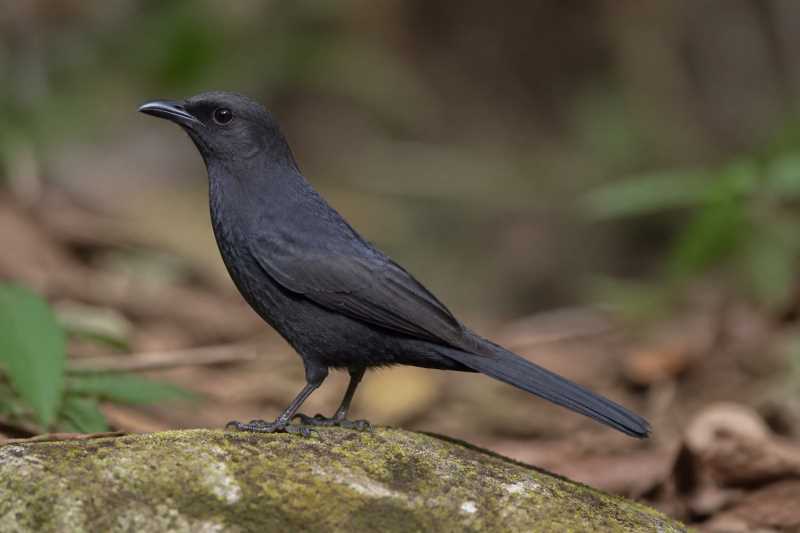
The Square-tailed Drongo-Cuckoo, Surniculus lugubris, is a medium-sized cuckoo of wooded habitats in South and Southeast Asia. Its glossy black plumage and drongo-like shape can make it difficult to detect, but the down-curved bill, white markings beneath the tail and slightly notched tail are useful identification features. It belongs to the family Cuculidae and is treated as a separate species from the Fork-tailed Drongo-Cuckoo, Surniculus dicruroides, by current IOC taxonomy. (worldbirdnames.org)
Physical Description
The Square-tailed Drongo-Cuckoo measures approximately 24 to 30 centimetres in length. Adults are predominantly glossy blue-black, sometimes showing greenish or bluish reflections in strong light. The bill is slender and distinctly down-curved, unlike the straighter bill of a true drongo.
White barring is present on the vent and outer undertail-coverts, while a white wing stripe may be visible from below when the bird is in flight. The tail is relatively short and appears square-tipped or only shallowly notched, with the outer feathers sometimes slightly flared. White feathering on the thighs can also be noticeable at close range.
Young birds are duller and may show irregular white spotting on the plumage. Reliable information on consistent sex differences is limited, so field identification is best based on structure, plumage pattern and voice rather than presumed differences between males and females.
Range and Habitat
The species ranges from the Indian subcontinent through mainland Southeast Asia and the Thai-Malay Peninsula to the Greater Sundas and Palawan. Its distribution includes parts of India, Nepal, Bangladesh, southern China, Myanmar, Thailand, Indochina, Malaysia, Sumatra, Borneo, Java and nearby islands. Historical treatments sometimes included other drongo-cuckoo forms within Surniculus lugubris, so published range descriptions may differ. (worldbirdnames.org)
It is associated mainly with tropical and subtropical forest, including lowland rainforest, secondary woodland, forest edges, scrub and wooded plantations. It may occur in both the canopy and lower levels of vegetation. The species is generally resident or presumed resident in much of its range, although seasonal movements and differences between regional populations are possible.
Where to See This Species
Khao Yai National Park, Nakhon Ratchasima and surrounding provinces, Thailand
Khao Yai supports extensive evergreen and mixed forest, and the Square-tailed Drongo-Cuckoo is included on bird checklists for the park. Look for it in forest edges, clearings and wooded trails, particularly by listening for its sharp, rising whistles and watching exposed perches in the canopy or middle storey. (exoticbirding.com)
Nearby accommodation: The park headquarters area and the gateway settlements around Pak Chong provide hotels, guest houses, campsites and other visitor accommodation.
Taman Negara National Park, Pahang and adjoining states, Malaysia
Taman Negara contains large areas of lowland rainforest and is a documented site for the Square-tailed Drongo-Cuckoo. The species is most likely to be encountered singly or in pairs along forest roads, trails and clearings where suitable babbler habitat and insect-rich vegetation occur. (birdforum.net)
Nearby accommodation: Kuala Tahan is the main gateway settlement, with lodges, guest houses, hotels and campsites serving visitors to the park.
Nameri National Park, Assam, India
Nameri’s forest and riverine habitats support a diverse bird community, and the Square-tailed Drongo-Cuckoo is recorded on local bird checklists. Forest tracks and edges are the most practical places to search, especially during the warmer months when vocal activity may make the species easier to locate. (exoticbirding.com)
Nearby accommodation: The park area is served by forest lodges, eco-camps and guest houses near the Bhalukpong and Nameri gateway area.
Behaviour and Diet
The Square-tailed Drongo-Cuckoo is usually encountered alone or in pairs. It may sit quietly in the canopy or middle storey before making a short flight between perches. Its movement can resemble that of a drongo, but it generally lacks the long, deeply forked tail and more robust bill of many Dicrurus species.
It feeds mainly on insects and other small invertebrates, which it takes from foliage or catches during short sallies. Detailed dietary studies are limited.
Like other cuckoos, it is a brood parasite. Documented and suspected hosts include babblers and other small woodland birds, but the full host range remains incompletely known. Records from Indonesia include probable parasitism involving the Chestnut-winged Babbler and Bold-striped Tit-Babbler. Claims that the adult routinely imitates the calls of host species should be treated cautiously because the evidence is limited and the taxonomy of the drongo-cuckoo group has changed. (kukila.org)
Identification Tips
- Look for a glossy black cuckoo with a slender, down-curved bill.
- Check the underside for white bars on the vent and outer undertail-coverts.
- In flight, a white stripe may be visible on the underside of the wing.
- The tail is relatively short and only shallowly notched, rather than deeply forked.
- The bird may show white feathering on the thighs and a faintly blue or green sheen to the black plumage.
- Do not rely on the bird’s drongo-like silhouette alone. True drongos generally have a straighter bill and a more obviously forked tail.
- The Square-tailed Drongo-Cuckoo should also be separated from the Fork-tailed Drongo-Cuckoo, which is treated as a different species in current IOC classifications and usually has a more distinctly forked tail.
Conservation Status
The Square-tailed Drongo-Cuckoo is currently assessed as Least Concern on the IUCN Red List. A reliable global population estimate is not available. Its broad distribution supports the current low-risk assessment, although clearance and degradation of forest habitat may affect local populations, particularly where suitable host birds are also declining. Protecting forests, maintaining habitat connectivity and conserving common host species are important conservation measures. (inaturalist.org)
Frequently Asked Questions
Where is the Square-tailed Drongo-Cuckoo found?
It occurs from the Indian subcontinent through mainland Southeast Asia and Malaysia to the Greater Sundas and Palawan, with regional variation in its precise distribution.
What does the Square-tailed Drongo-Cuckoo look like?
It is a glossy black cuckoo with a slender down-curved bill, white barring beneath the tail, a possible white wing stripe in flight and a short, shallowly notched tail.
Is the Square-tailed Drongo-Cuckoo a drongo?
No. It is a cuckoo in the family Cuculidae. Its drongo-like shape and dark plumage account for its common name.
What does the Square-tailed Drongo-Cuckoo eat?
It feeds mainly on insects and other small invertebrates, which it gathers from vegetation or catches during short flights.
Does the Square-tailed Drongo-Cuckoo lay its eggs in other birds’ nests?
Yes. It is a brood parasite, and documented or suspected hosts include babblers and other small woodland birds. The complete host list is not yet well established.
Is the Square-tailed Drongo-Cuckoo endangered?
No. It is currently classified as Least Concern, although habitat loss and degradation remain potential local threats.
References
- IOC World Bird List
- IUCN Red List of Threatened Species
- Thai National Parks
Related posts