Understanding the Red Crossbill (Loxia curvirostra): A Unique Avian Marvel
The Red Crossbill (Loxia curvirostra) stands out as a fascinating avian species, celebrated not only for its vibrant plumage but also for its distinctive bill, which has evolved to exploit a very specialized niche in nature. This article delves into the various aspects of the Red Crossbill’s biology, behavior, and habitat, providing a comprehensive overview of this remarkable bird.
Taxonomy and Morphology
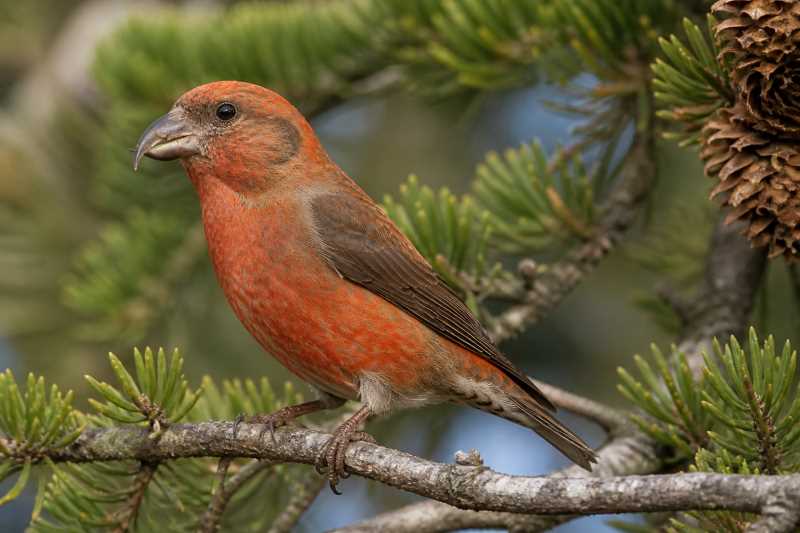
The Red Crossbill belongs to the family Fringillidae, which includes finches, grosbeaks, and allies. Its scientific name, Loxia curvirostra, aptly describes its most striking feature: the crossed tips of its bill. This adaptation is a remarkable example of evolutionary specialization, allowing the bird to extract seeds from conifer cones with remarkable efficiency.
Physically, Red Crossbills are medium-sized finches, measuring approximately 16 to 20 centimeters in length with a wingspan of about 27 to 30 centimeters. Males typically exhibit a bright red or orange plumage, while females are more subdued, often displaying olive or yellowish hues. This sexual dimorphism not only aids in identification but also plays a role in mating dynamics.
Distribution and Habitat
Red Crossbills are found across the Northern Hemisphere, with populations in North America, Europe, and Asia. They are highly nomadic, with movements largely dictated by the availability of conifer seeds, their primary food source. This adaptability has allowed them to occupy a wide range of habitats, from boreal forests to montane regions and even into temperate zones during irruptive years.
Their preferred habitats are dense coniferous forests where spruce, pine, and fir trees abound. The birds are often seen in mixed-species flocks, especially during winter, when they can be observed foraging alongside other finches and small passerines.
Feeding Ecology
The Red Crossbill’s feeding habits are intimately tied to its unique bill morphology. The crossed mandibles are perfectly adapted for prying open conifer cones to access the seeds within. This specialization allows them to thrive in areas and during times when other food sources may be scarce.
Interestingly, different populations of Red Crossbills have developed subtle variations in bill size and shape, corresponding to the specific conifer species they exploit. This phenomenon, known as ecological speciation, has led to the identification of distinct "call types" among Red Crossbills, each adapted to particular habitats and food sources.
Breeding and Life Cycle
The breeding season for Red Crossbills is notably flexible, often coinciding with peaks in seed availability rather than specific times of the year. This opportunistic approach to reproduction enables them to take advantage of optimal feeding conditions to rear their young.
Nests are typically constructed high in conifer trees, using twigs, moss, and lichen. The female lays a clutch of 3 to 4 eggs, which she incubates for about two weeks. Both parents participate in feeding the chicks, which fledge approximately three weeks after hatching.
Vocalizations and Communication
Red Crossbills are known for their distinctive vocalizations, which play a crucial role in maintaining flock cohesion and facilitating mate selection. Their calls, described as sharp and metallic, vary between different call types, reflecting the species’ complex social structure and ecological adaptations.
Research has shown that these call variations are not merely incidental but are tied to specific foraging strategies and the birds’ ability to exploit particular conifer species. This acoustic diversity within the species is a fascinating example of how environmental factors can shape communication in birds.
Conservation Status
Currently, the Red Crossbill is not considered globally threatened, largely due to its wide distribution and adaptability. However, certain populations may be at risk due to habitat loss and changes in forest management practices.
Conservation efforts for Red Crossbills focus on preserving their natural habitats and ensuring the sustainability of coniferous forests. This includes promoting responsible forestry practices and protecting key breeding and foraging areas from development and degradation.
Research and Observational Studies
The Red Crossbill has been the subject of extensive research, particularly in the fields of evolutionary biology and ecology. Studies on their foraging behavior, vocalizations, and genetic diversity continue to provide valuable insights into the processes of adaptation and speciation.
Birdwatchers and ornithologists alike are drawn to the Red Crossbill, not only for its beauty but also for the challenge of identifying the various call types and subspecies. Field studies and citizen science initiatives contribute significantly to our understanding of these birds and their interactions with the ecosystem.
Conclusion
The Red Crossbill is a testament to nature’s ability to adapt and specialize, showcasing a unique evolutionary path among birds. Its intriguing morphology, diverse vocalizations, and nomadic lifestyle make it a subject of endless fascination for scientists and bird enthusiasts. As we continue to study and protect these birds, we gain not only insights into their world but also a deeper appreciation for the complexity and beauty of the natural world.
In conclusion, the Red Crossbill serves as a reminder of the delicate balance within ecosystems and the importance of conserving biodiversity. Through continued research and conservation efforts, we can ensure that this remarkable species continues to thrive in the wild, enriching our understanding of avian life and the intricate web of nature.
Related posts