Introduction
The Rufous-webbed Brilliant (Heliodoxa branickii) is a medium-sized hummingbird of the eastern Andean foothills. It is found mainly in Peru, with a small number of records from north-western Bolivia. The species inhabits humid montane forest and forest edges, where it searches for nectar and small invertebrates among flowering plants and foliage.
Physical Description
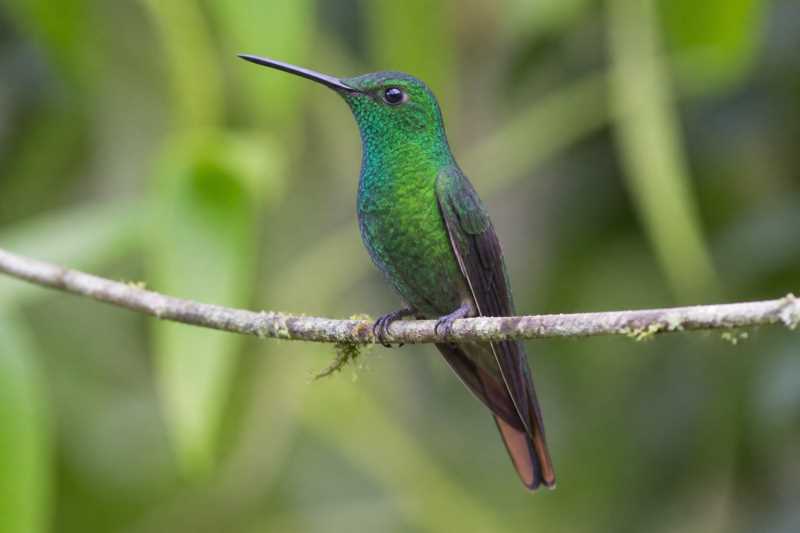
The Rufous-webbed Brilliant is approximately 11–12 centimetres long. Both sexes have predominantly dark green upperparts, a slightly notched blue tail and conspicuous white undertail coverts. The rufous bases or inner webs of the flight feathers are most noticeable when the bird is in flight or when it is preening.
The adult male has a brilliant pink to rose-iridescent gorget, which may appear dark or subdued in poor light. The female is less brightly marked. She has green upperparts, a whitish throat and central breast, green feather tips on the sides of the throat and breast, and white tips to the outer tail feathers. A small, incomplete or poorly developed gorget may be present in females.
Juveniles and immature birds are less well documented, but young birds generally show duller plumage and less developed iridescent throat feathers than adults.
Range and Habitat
The species occurs along the eastern Andean foothills of Peru, from northern and central regions southwards into south-eastern Peru. It has also been recorded in north-western Bolivia, although records there are limited. It is not known as a long-distance migrant and is generally considered resident, although local movements may occur in response to flowering conditions.
The Rufous-webbed Brilliant occupies humid montane forest, forest edges, riparian woodland and other densely vegetated foothill habitats. In Peru, it is usually recorded between approximately 650 and 1,700 metres above sea level. The species has a patchy distribution and is locally uncommon, particularly where suitable forest is isolated.
Cordillera Azul and the Huallaga region
The Cordillera Azul is an important northern range area. It is geographically separated from the main eastern Andean slope and supports a distinctive assemblage of foothill and montane birds. The Rufous-webbed Brilliant reaches the northern limit of its known distribution in this region.
Where to See This Species
Manu National Park, Cusco and Madre de Dios, Peru
Manu National Park and the surrounding Manu Biosphere Reserve are among the most reliable documented areas for this species. It has been recorded in humid foothill and cloud-forest habitats along the Manu road and at birding sites associated with the reserve. Look for it around forest edges, flowering vegetation and lodge gardens, particularly in the lower montane zone.
Nearby accommodation: Pillcopata and Salvación provide practical bases with guesthouses, lodges and small hotels. Accommodation within or near the reserve is also available, but access should be arranged in advance.
Cordillera Azul National Park, San Martín and Huánuco, Peru
The Rufous-webbed Brilliant is documented from the Cordillera Azul region, including humid forest on the park’s eastern Andean foothills. The area is remote, and access is more difficult than at established birding sites in Manu, but it is significant for the species because it represents the northern edge of its known range.
Nearby accommodation: Tarapoto is the principal practical gateway, with hotels, guesthouses and lodges. Travel beyond the accessible settlements normally requires local permits, transport and specialist guidance.
Yanachaga-Chemillén National Park, Pasco, Peru
Bird surveys in the Yanachaga-Chemillén area have documented the Rufous-webbed Brilliant in the humid montane forests of the central Peruvian Andes. Forest trails, edges and flowering plants in the park’s lower and middle elevations offer the most suitable habitat, although sightings may be infrequent because the species is local and easily overlooked.
Nearby accommodation: Oxapampa is the main gateway and offers hotels, guesthouses, lodges and self-catering accommodation.
Behaviour and Diet
The Rufous-webbed Brilliant is usually encountered alone while feeding or perching. It may sit openly on exposed branches before making short flights to flowers or returning to a regular perch. It can forage through several forest levels, from lower vegetation to the sub-canopy.
Nectar forms the main part of its diet, especially from tubular or otherwise nectar-rich flowers. Small insects and spiders are also taken and provide important protein and other nutrients. As with other hummingbirds, its feeding visits can transfer pollen between flowers, although the importance of this species as a pollinator has not been quantified in detail.
Detailed information about courtship, nesting and breeding timing remains limited. The species is generally considered solitary outside the breeding context, and there is no evidence that it undertakes regular long-distance migration.
Identification Tips
- Look for a dark green hummingbird with a blue, slightly notched tail and white undertail coverts.
- The male’s pink or rose-iridescent gorget is the most obvious feature, although it may appear dark when the bird is not facing the light.
- Rufous colouring at the bases or inner webs of the flight feathers can flash during flight or become visible while the bird is preening.
- Females are paler below, with a whitish throat and breast, green feather tips on the sides of the throat and breast, and white tips to the outer tail feathers.
- The closely related Pink-throated Brilliant can be difficult to separate by appearance alone. Geographic range is useful: the two species are broadly separated in Peru by the Huallaga region, with the Rufous-webbed Brilliant occurring mainly to the south and east in the documented range.
Conservation Status
The Rufous-webbed Brilliant is currently assessed as Least Concern on the IUCN Red List. Its total population has not been measured reliably, and some conservation summaries describe the population trend as decreasing. The species is locally uncommon and has a geographically patchy distribution.
The principal concern is the loss and degradation of humid foothill and montane forest through agricultural expansion, logging, road development and settlement. Forest clearance can remove flowering resources and isolate local populations. Protection of remaining forest in national parks and other reserves, together with the maintenance of connected habitat and responsible land-use practices, is important for the species and the wider Andean bird community.
Frequently Asked Questions
Where can the Rufous-webbed Brilliant be found?
It occurs mainly in humid montane forests on the eastern slopes and foothills of the Peruvian Andes, with limited records from north-western Bolivia.
Is the Rufous-webbed Brilliant found in Colombia or Ecuador?
The species is not currently regarded as a regular bird of Colombia or Ecuador. Its documented range is centred on Peru, with a small number of records from Bolivia.
What does the Rufous-webbed Brilliant look like?
It is a dark green hummingbird with a blue, slightly notched tail, white undertail coverts and rufous colouring in the flight feathers. Adult males have a pink or rose-iridescent throat patch, while females are paler below.
What does the Rufous-webbed Brilliant eat?
It feeds mainly on nectar from flowering plants and also takes small insects and spiders.
Is the Rufous-webbed Brilliant migratory?
It is generally considered resident rather than migratory. Local movements may occur when birds follow changing supplies of flowers.
Is the Rufous-webbed Brilliant endangered?
No. The species is currently classified as Least Concern, although habitat clearance and degradation may cause local declines, and its population size is not well known.
References
- IOC World Bird List
- IUCN Red List of Threatened Species
- Neotropical Bird Club
Related posts