Introduction
The Black-necked Swan, Cygnus melancoryphus, is a South American waterfowl species of the family Anatidae. It occurs mainly in wetlands across southern South America, where its white body, black head and neck, and red bill knob make it one of the region’s most distinctive swans. The species is an important herbivore in freshwater and coastal wetland ecosystems.
Physical Description
The Black-necked Swan is the smallest member of the genus Cygnus. Adults measure approximately 102–124 centimetres in length and have a wingspan of about 135–177 centimetres. Males are generally larger and heavier than females, with reported masses of approximately 4.5–6.7 kilograms for males and 3.5–4.4 kilograms for females.
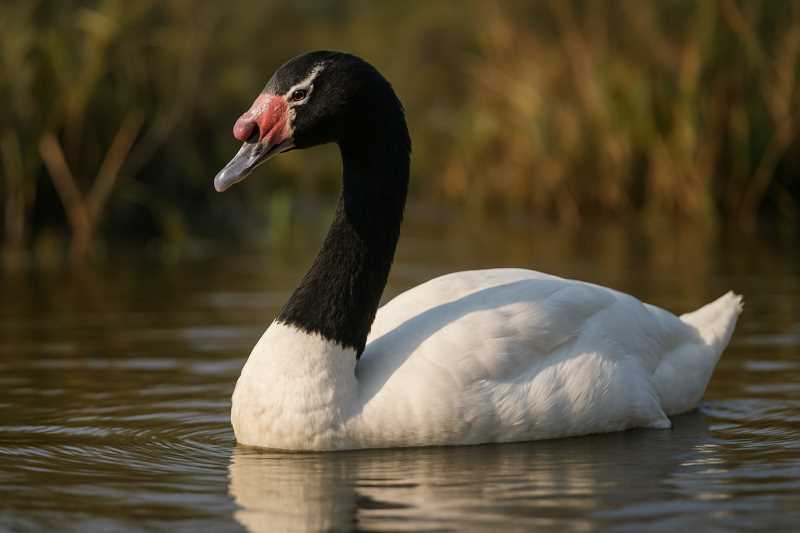
Adults have predominantly white plumage, contrasting sharply with a black head and neck. A narrow white line usually extends behind the eye. The bill is bluish-grey with a conspicuous red basal knob, which may become more prominent during the breeding season. The legs and feet are pinkish.
The sexes are similar in colour and pattern, although males are larger. Downy chicks are pale greyish or whitish, while growing juveniles develop darker grey-brown plumage before gradually acquiring the adult black-and-white pattern. The red bill knob is absent or poorly developed in young birds.
Range and Habitat
The Black-necked Swan is native to southern South America. Its range extends from southern Brazil and Uruguay through Argentina and Chile to Tierra del Fuego, with additional populations in the Falkland Islands. It is associated with shallow freshwater lakes, marshes, lagoons, river basins, estuaries, coastal wetlands, harbours, and other sheltered waters with abundant aquatic vegetation.
The species is not a long-distance migrant in the usual sense, but it can make substantial local and regional movements. Seasonal movements are influenced by rainfall, water levels, food availability, breeding conditions, and wider climatic patterns. Populations may move nomadically between wetlands during drought or when aquatic vegetation declines.
Important habitats include wetlands dominated by submerged and floating plants, including areas where pondweeds, stoneworts, milfoils, waterweed, and other macrophytes are abundant. The species can occur close to human settlements, although breeding sites remain vulnerable to disturbance and habitat change.
Behaviour and Diet
Black-necked Swans are primarily herbivorous. They feed mainly on submerged aquatic plants and algae, often reaching below the water surface with their long necks. Their diet may include pondweeds, stoneworts, milfoils, waterweed, wild celery, and other wetland vegetation. Small aquatic invertebrates and other animal material may be taken occasionally, but these are not the main component of the diet.
They are strong swimmers and spend much of their time on the water. Pairs may remain together for long periods, and courtship includes coordinated swimming, head movements, calling, and mutual display. Outside the breeding season, they may gather in groups, particularly where food is concentrated.
Breeding behaviour varies geographically and seasonally. Nests are constructed from reeds, grasses, aquatic plants, and other available vegetation, usually close to water, on small islands, or within dense emergent vegetation. A study in Chile recorded nests built directly on the ground using plant material and other locally available items.
Clutch size varies between sites, but studies in Chile have recorded a typical clutch of about three eggs, with larger or smaller clutches also occurring. Incubation lasts approximately 34–37 days. The female performs most or all of the incubation, while the male commonly guards the nest and surrounding territory. Both parents protect and care for the cygnets after hatching, and young birds may remain associated with their parents for many months.
Identification Tips
- Look for a large, white-bodied swan with a completely black head and neck.
- Check for the thin white line behind the eye, bluish-grey bill, red basal knob, and pink legs.
- The species is readily distinguished from the white-headed Coscoroba Swan, Coscoroba coscoroba, and from introduced or escaped Mute Swans, Cygnus olor.
- Juveniles are less striking, with grey-brown plumage and a less developed bill knob, but the dark head and neck begin to appear as they mature.
- In flight, the bird shows an overwhelmingly white body and wings, contrasting with the black head and neck.
Conservation Status
The Black-necked Swan is currently assessed as Least Concern on the IUCN Red List. This global category does not mean that all populations are secure. Local declines and sudden population changes have been documented, especially where wetlands lose their aquatic vegetation or are affected by pollution and other major disturbances.
Important threats include wetland drainage, agricultural and urban development, water pollution, disturbance at breeding sites, changes in water levels, and the loss of submerged macrophytes. Severe ecological disruption in the Río Cruces wetland in southern Chile demonstrated how the loss of key food plants can be followed by swan displacement and mortality. Climate variability may also affect wetland conditions and regional movements.
Conservation measures include protecting wetlands and their surrounding catchments, maintaining water quality and natural water regimes, safeguarding breeding colonies, monitoring population movements, and reducing disturbance during nesting. Coordinated surveys are particularly valuable because numbers can fluctuate substantially between wetlands and seasons.
Frequently Asked Questions
Where can the Black-necked Swan be found?
It occurs across southern South America, including Chile, Argentina, Uruguay, southern Brazil, Tierra del Fuego, and the Falkland Islands. It uses freshwater and coastal wetlands such as lakes, marshes, lagoons, estuaries, and sheltered bays.
What does the Black-necked Swan eat?
It feeds mainly on submerged aquatic plants and algae. Pondweeds, stoneworts, milfoils, waterweed, and other macrophytes are important food sources, while small aquatic invertebrates may be eaten occasionally.
How can the Black-necked Swan be identified?
Adults have a white body, black head and neck, a bluish-grey bill with a red basal knob, and pinkish legs. A narrow white line behind the eye is also a useful field mark.
Is the Black-necked Swan migratory?
It is better described as locally mobile or partly nomadic than as a regular long-distance migrant. Individuals and groups may move between wetlands in response to rainfall, water levels, food availability, and climatic conditions.
How many eggs does it lay?
Clutch size varies, but studies in Chile found a typical clutch of about three eggs. Larger clutches also occur, and the recorded range differs between locations and studies.
What is the conservation status of the Black-necked Swan?
The species is assessed globally as Least Concern. Nevertheless, local populations can be affected by wetland degradation, pollution, disturbance, altered water regimes, and the loss of aquatic vegetation.
References
- BirdLife International. 2026. Black-necked Swan Cygnus melancoryphus. Species Factsheet and IUCN Red List assessment. BirdLife Data Zone. https://datazone.birdlife.org/species/factsheet/black-necked-swan-cygnus-melancoryphus (accessed 8 September 2026).
- Gill, F., Donsker, D. and Rasmussen, P., eds. 2026. IOC World Bird List, version 15.2. International Ornithologists’ Union. https://www.worldbirdnames.org/ (accessed 8 September 2026).
- Silva, C. P., Schlatter, R. P. and Soto-Gamboa, M. 2012. Reproductive biology and pair behavior during incubation of the Black-necked Swan (Cygnus melancoryphus). Ornitología Neotropical, 23(4), 555–567. https://digitalcommons.usf.edu/ornitologia_neotropical/vol23/iss4/8/.
- Cursach, J. A., Rau, J. R., Tobar, C. N., Vilugrón, J. and Brañas, F. 2021. Reproductive ecology of the Black-necked Swan Cygnus melancoryphus in a marine wetland of southern Chile. Marine Ornithology, 49(2), 205–209. https://doi.org/10.5038/2074-1235.49.2.1425.
- González, A. L. and Fariña, J. M. 2013. Changes in the abundance and distribution of Black-necked Swans (Cygnus melancoryphus) in the Carlos Anwandter Nature Sanctuary and adjacent wetlands, Valdivia, Chile. Waterbirds, 36(4), 423–434. https://doi.org/10.1675/063.036.0408.
- Jaramillo, E., Schlatter, R., Contreras, H., Duarte, C., Lagos, N., Paredes, E. et al. 2007. Emigration and mortality of Black-necked Swans (Cygnus melancoryphus) and disappearance of the macrophyte Egeria densa in a Ramsar wetland site of southern Chile. Ambio, 36, 607–610. https://doi.org/10.1579/0044-7447(2007)36[607:EAMOBS]2.0.CO;2.
- Schlatter, R. P., Navarro, R. A. and Corti, P. 2002. Effects of El Niño Southern Oscillation on numbers of Black-necked Swans at Río Cruces Sanctuary, Chile. Waterbirds, 25, 114–122.
- United States Fish and Wildlife Service. 2022. Black-necked Swan (Cygnus melancoryphus) Ecological Risk Screening Summary. U.S. Department of the Interior. https://www.fws.gov/sites/default/files/documents/Ecological-Risk-Screening-Summary-Black-necked-Swan.pdf (accessed 8 September 2026).
Related posts