Introduction
Bates’s Swift, Apus batesi, is a small forest swift in the family Apodidae. It occurs in the humid forests of western and Central Africa, where it is usually encountered high above the canopy and is easily overlooked among other dark, fast-flying swifts. The species was named after the naturalist George Latimer Bates.
Physical Description
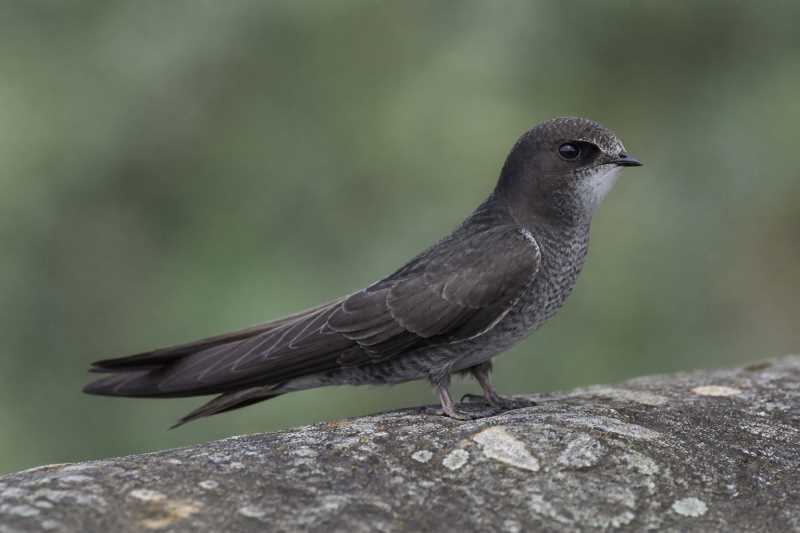
Bates’s Swift is approximately 14 centimetres long. It has a slender body, long, narrow, sickle-shaped wings and a deeply forked tail that may appear pointed when closed. The plumage is predominantly glossy black, with a subtle paler area on the throat.
Males and females are not known to show obvious differences in plumage, and reliable age-related distinctions are poorly documented. Identification is therefore based mainly on overall structure, plumage sheen, tail shape, flight style and habitat. The species is a relatively light swift, but published measurements are limited and should be treated cautiously.
Range and Habitat
Bates’s Swift has a patchy distribution in humid tropical Africa. Its range extends from parts of Liberia and Guinea eastwards through Ghana, Nigeria and Cameroon, and southwards through Equatorial Guinea, Gabon and the Republic of the Congo. Records from the Central African Republic and the Democratic Republic of the Congo are also reported in regional sources, although the distribution is uneven and some local records require careful identification.
It is primarily associated with lowland rainforest and other humid forest habitats, particularly where clearings, forest edges, rocky outcrops, cliffs or crags provide suitable aerial feeding areas and potential nesting sites. It may forage over primary forest, secondary growth and nearby open areas, but it is not a typical open-country swift.
Bates’s Swift is generally treated as a resident species rather than a regular long-distance migrant. Local movements may occur in response to weather, insect availability and breeding activity, but detailed information about seasonal movements remains limited.
Where to See This Species
Korup National Park, Southwest Region, Cameroon
Bates’s Swift has been documented in Korup National Park and the surrounding Korup Project Area. The park’s extensive lowland rainforest, clearings and forest margins provide suitable habitat, although the species is considered uncommon and can be difficult to separate from other Apus swifts in flight. Records from the park include observations in both northern and southern areas, with sightings near the park’s access area at Mana Bridge and around Mundemba.
The best approach is to scan the sky above forest clearings, roads, rivers and canopy edges, especially during periods of active insect movement. Identification should be made cautiously, as several forest swifts can occur in the same region.
Nearby accommodation: Mundemba is the practical gateway, with basic hotels, guest houses and local lodges. Simple campsites and basic forest camps may also be available inside or near the park, subject to local arrangements and guiding requirements.
Behaviour and Diet
Bates’s Swift feeds on flying insects caught in the air. It usually forages above the forest canopy, using rapid wingbeats interrupted by short glides. It may hunt alone, in small groups or in mixed feeding flocks with other swifts and hirundines.
The species is not usually conspicuous by voice. A high-pitched trill has been associated with birds near nesting sites, but it is generally more likely to be detected visually than acoustically.
Breeding information is limited. Bates’s Swift is believed to nest solitarily, often using old nests constructed by swallows or other swifts. Egg-laying has been reported in Cameroon during May and June, while breeding activity in Gabon has been recorded from September to March. These dates may reflect regional differences or limited observation rather than a complete picture of the breeding season.
Identification Tips
- Look for a small, sleek, glossy-black swift with long sickle-shaped wings.
- The deeply forked tail may look pointed when closed.
- Search above rainforest canopy, forest clearings, rocky areas and forest edges rather than over open farmland alone.
- The flight is usually fast and fluttering, with occasional glides.
- A faint pale throat area may be visible in good light, but it is not always obvious.
- Distinguishing Bates’s Swift from other dark Apus swifts can be difficult. Compare several features together, including size, glossiness, tail shape, flight style, habitat and any visible pale throat marking.
- Do not rely on a single distant sighting, because some historical records may have involved confusion with other forest swifts.
Conservation Status
Bates’s Swift is currently classified as Least Concern on the IUCN Red List. A reliable global population estimate is not available, and the species is difficult to survey because it spends much of its time above the forest canopy and can be confused with similar swifts.
Forest clearance, logging, agricultural expansion and the degradation of humid forest remain conservation concerns across its range. Protecting large areas of intact rainforest, maintaining forest corridors and improving field identification are important measures for the species and for the wider forest bird community. Further surveys are needed to clarify its distribution, abundance, breeding biology and population trend.
Frequently Asked Questions
Where does Bates’s Swift live?
Bates’s Swift lives mainly in humid tropical forests of western and Central Africa, with records from countries including Liberia, Ghana, Nigeria, Cameroon, Equatorial Guinea, Gabon, the Republic of the Congo and parts of the Democratic Republic of the Congo.
Is Bates’s Swift a migratory bird?
It is generally regarded as a resident species. Local movements may occur, but there is no well-established pattern of regular long-distance migration.
What does Bates’s Swift eat?
It feeds mainly on flying insects, which it catches in the air while hunting above the forest canopy and around clearings or forest edges.
How can Bates’s Swift be identified?
Look for a small glossy-black swift with long curved wings, a deeply forked tail and a fast fluttering flight. A subtle pale throat patch may be visible, but identification should also take habitat and comparison with other forest swifts into account.
Where is Bates’s Swift easiest to look for?
Korup National Park in southwestern Cameroon is a documented location. Forest clearings, roads, rivers and canopy edges around the park provide suitable places to scan for the species, although sightings are not guaranteed.
Is Bates’s Swift endangered?
No. It is currently assessed as Least Concern, although habitat loss and degradation remain potential threats and the species is not well studied.
References
- IUCN Red List of Threatened Species
- IOC World Bird List
- The Birds of Korup National Park and Korup Project Area, Southwest Province, Cameroon
Related posts