Introduction
The Montane Nightjar, Caprimulgus poliocephalus, is a nocturnal member of the nightjar family, Caprimulgidae. It occurs mainly in the uplands of eastern and central Africa, with an additional population in south-western Saudi Arabia. Also known as the Mountain or Abyssinian Nightjar, it is adapted to open montane woodland, forest edges and other highland habitats where its mottled plumage provides effective camouflage.
Physical Description
The Montane Nightjar is a medium-sized nightjar, measuring about 23 cm in length. Museum measurements give a wing length of approximately 139–162 mm, although size varies geographically and between individuals.
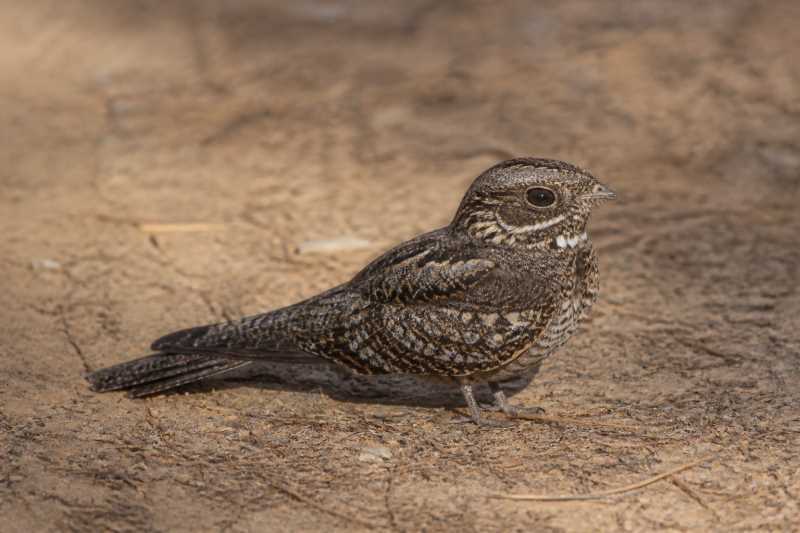
Its plumage is generally dark grey-brown, finely mottled and streaked with buff, brown and whitish markings. This pattern helps the bird blend into leaf litter, bare ground, rocks and woodland debris while it rests during the day. The wings are long and pointed, the bill is short but broad at the gape, and the eyes are large, reflecting its nocturnal lifestyle.
Sexes differ in the colour and extent of their wing and tail markings. Males usually show distinct white spots on the outer primary feathers and more white on the outer tail feathers. Females generally have buff-coloured rather than white wing spots, with less white in the tail. Immature birds are reported to be paler and often more rufous than adults.
Several geographic forms have been described. Their plumage, measurements and vocalisations vary across the range, and some were formerly treated as separate species. Current classifications, including the IOC World Bird List, generally treat these forms as part of a single, polytypic species.
Range and Habitat
The Montane Nightjar has a discontinuous distribution in highland areas of eastern and central Africa. Its range extends from Ethiopia, Eritrea and south-western Saudi Arabia through Kenya, Uganda, eastern Democratic Republic of the Congo, Rwanda and Burundi to Tanzania, Malawi, Zambia and the highlands of Angola.
It is associated with montane forest, woodland edges, open woodland, juniper forest, rocky slopes and clearings. It may also use plantations, cultivated areas close to forest and large wooded gardens where suitable open ground and insect-rich foraging areas remain. Reported elevations range from roughly 1,000 to 3,350 metres, although the upper and lower limits vary between regions.
The species is generally regarded as resident, but local movements and changes in altitude may occur. Its distribution and taxonomy are complicated by regional variation, particularly among the forms historically called Ruwenzori, Usambara and Benguela Nightjars.
Behaviour and Diet
The Montane Nightjar is mainly nocturnal and is most active from dusk through the night and again before dawn. It typically spends daylight hours resting on the ground or among low vegetation, relying on its cryptic plumage to avoid detection.
It feeds mainly on flying insects, including moths, beetles and grasshoppers. Prey is usually caught in flight as the bird makes rapid sallies from a low perch or hunts over open ground, woodland clearings, fields and pastures. Artificial lights and fires may attract insects and can provide additional feeding opportunities.
Males advertise from territories using a distinctive song or series of calls. Descriptions vary between populations, but the vocalisations may include repeated nasal or whistled notes. Vocal differences have contributed to past disagreements about whether some regional forms should be recognised as separate species.
Breeding information remains limited. The species is considered territorial, and available observations indicate that it lays its eggs directly on bare ground or leaf litter, often in a small clearing near a tree or bush. No constructed nest is made, and a clutch normally consists of two eggs. The eggs and chicks depend on camouflage and parental behaviour for protection from predators. Claims about a fixed breeding season should be treated cautiously because timing varies across the species’ large and geographically fragmented range.
Identification Tips
- Look for a medium-sized, dark, grey-brown nightjar in upland woodland, forest edges, rocky clearings or nearby open ground.
- At rest, the bird is difficult to detect because its mottled plumage resembles leaf litter, soil and broken vegetation.
- In flight, note the long pointed wings and the white markings on the outer primaries and tail, especially in males.
- Females usually show buff rather than bright white wing spots and have less white in the tail.
- Listen at dusk and before dawn for the species’ repeated nasal or whistled vocalisations, as it is often heard before it is seen.
- Regional forms can be difficult to separate by sight. In areas where Fiery-necked Nightjars occur, the Montane Nightjar is generally darker and has different wing and tail markings, but vocalisations and locality should also be considered.
Conservation Status
The Montane Nightjar is currently assessed as Least Concern on the IUCN Red List through the BirdLife International assessment process. It has a broad distribution and is locally common in parts of its range, but a precise global population estimate is not available.
No major species-wide threat is clearly established in the sources consulted. Nevertheless, the species may be affected locally by the loss, degradation and fragmentation of montane woodland, forest edges and open highland habitat. Agricultural expansion, intensive development, inappropriate fire regimes and changes in insect abundance could reduce habitat quality in some areas, although the scale of these effects is not well quantified.
Maintaining protected highland habitats, conserving mosaics of woodland and open ground, and improving knowledge of population trends, breeding ecology and regional movements would support the species’ long-term conservation.
Frequently Asked Questions
Where does the Montane Nightjar live?
It occurs in upland regions of eastern and central Africa, from Ethiopia and Kenya southwards through Uganda, Tanzania, Malawi and Zambia, with additional populations in parts of the Democratic Republic of the Congo, Rwanda, Burundi, Angola and south-western Saudi Arabia.
What habitat does the Montane Nightjar prefer?
It uses montane forest and woodland edges, open woodland, rocky clearings, juniper forest, plantations and wooded areas near cultivation. It is usually found between about 1,000 and 3,350 metres above sea level.
What does the Montane Nightjar eat?
Its diet consists mainly of flying insects, especially moths, beetles and grasshoppers. It catches prey in the air during nocturnal hunting flights.
How can the Montane Nightjar be identified?
It is a dark, mottled nightjar with long pointed wings and contrasting white or buff markings on the outer primaries and tail. It is most easily detected by its calls at dusk or before dawn.
Does the Montane Nightjar build a nest?
No. Like many nightjars, it lays its eggs directly on bare ground or leaf litter, usually in a small clearing or beside low vegetation. A normal clutch is reported to contain two eggs.
Is the Montane Nightjar endangered?
No. It is currently classified as Least Concern, although local habitat loss and degradation may affect some populations and important aspects of its ecology remain poorly documented.
References
- BirdLife International. 2026. Montane Nightjar Caprimulgus poliocephalus Species Factsheet. BirdLife DataZone. Available at: https://datazone.birdlife.org/species/factsheet/montane-nightjar-caprimulgus-poliocephalus. Accessed 8 September 2026.
- Gill, F., Donsker, D. and Rasmussen, P. (eds.). 2026. IOC World Bird List, version 15.2. International Ornithologists’ Union. Available at: https://www.worldbirdnames.org/. Accessed 8 September 2026.
- Jackson, H. D. 2014. The taxonomic status of Rwenzori Nightjar Caprimulgus ruwenzorii Ogilvie-Grant, 1909, and Benguela Nightjar C. koesteri Neumann, 1931. Bulletin of the British Ornithologists’ Club 134(1): 62–72. Available at: https://boc-online.org/bulletins/downloads/BBOC1341-PDFa.pdf.
- Cleere, N., Kirwan, G. M. and Boesman, P. F. D. 2022. Montane Nightjar (Caprimulgus poliocephalus), version 1.0. In: Keeney, B. K. (ed.), Birds of the World. Cornell Lab of Ornithology, Ithaca, New York. https://doi.org/10.2173/bow.monnig1.01.
- Dickinson, E. C. and Remsen, J. V. Jr. (eds.). 2013. The Howard and Moore Complete Checklist of the Birds of the World, 4th edition, volume 1. Eastbourne: Aves Press. Current taxon and subspecies information consulted through the Trust for Avian Systematics checklist: https://www.aviansystematics.org/checklist?viewfamilies=76. Accessed 8 September 2026.
- Tobias, J. A., Sheard, C., Aleixo, A., et al. 2022. AVONET: morphological, ecological and geographical data for all birds. Ecology Letters 25(3): 581–597. https://doi.org/10.1111/ele.13898.
Related posts