Introduction
The quokka (Setonix brachyurus) is a small marsupial native to Australia, known for its friendly and curious nature. Often called "the world’s happiest animal," the quokka has gained international fame through social media, where its seemingly smiling face has charmed millions. Despite its popularity, the quokka remains a vulnerable species, facing several environmental challenges. This article delves into the fascinating world of the quokka, exploring its physical traits, habitat, and behavior, as well as the conservation efforts necessary to protect this iconic species.
Physical Description
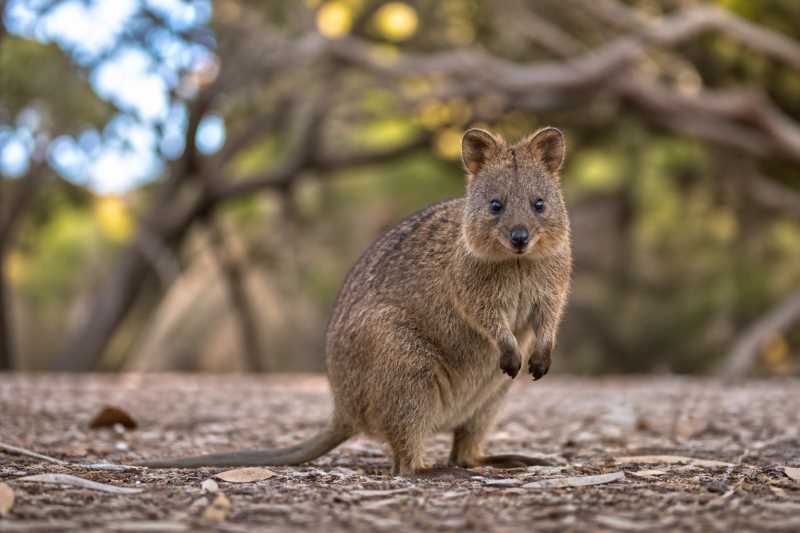
The quokka is a small wallaby-like marsupial, with adults typically weighing between 2.5 to 5 kilograms (5.5 to 11 pounds) and standing around 40 to 54 centimeters (16 to 21 inches) tall. Its tail adds an additional 25 to 30 centimeters (10 to 12 inches) in length. The quokka’s fur is a coarse, brownish-gray color with lighter underparts, providing excellent camouflage in its natural habitat.
One of the most distinctive features of the quokka is its rounded, compact body, which is well-suited for its hopping mode of locomotion. Quokkas possess strong hind legs, enabling them to cover ground quickly when necessary. Their forelimbs are shorter and are used for grasping food and climbing small trees and shrubs. The quokka’s face is characterized by a short snout and rounded ears, with a perpetual "smile" that has contributed to its reputation as a cheerful animal.
Range and Habitat
Quokkas are primarily found in a small range within the southwestern region of Western Australia. They are especially prevalent on Rottnest Island, where they are protected from many mainland predators. Quokkas also inhabit parts of the mainland, particularly in areas like the Jarrah forests, but their populations there are more sparse.
Quokkas prefer dense vegetation and scrublands, which provide ample cover and food resources. They are also known to inhabit areas with a reliable water source, as they require regular hydration. Their habitat on islands like Rottnest is typically more open, with a mix of grasslands and coastal scrub.
Behavior and Diet
Quokkas are primarily nocturnal animals, although they can occasionally be seen during daylight hours, particularly on overcast days or in the cooler parts of their habitat. They are social creatures, often living in small groups, which provides safety in numbers against predators.
Their diet consists mainly of grasses, leaves, stems, and bark. Quokkas are herbivores, and their digestive system is adapted to efficiently process fibrous plant material. They have a unique method of obtaining moisture from their food, which allows them to thrive in arid conditions where water is scarce.
Quokkas are known for their curious and fearless nature. Unlike many other wild animals, they are not particularly afraid of humans, which makes them popular with visitors to places like Rottnest Island. However, it is important to remember that feeding quokkas is discouraged as human food can harm their health and alter their natural behavior.
Identification Tips (Field Recognition Cues)
- Size and Shape: Look for a small, wallaby-like marsupial with a rounded, compact body.
- Fur Color: Quokkas have coarse, brownish-gray fur with lighter underparts.
- Facial Features: Note the short snout and rounded ears, and the characteristic "smile."
- Tail: Observe the short, muscular tail, which is about 25 to 30 centimeters long.
- Behavior: Look for quokkas in groups, especially during dusk or dawn when they are most active.
Conservation Status (with Threats and Protections)
The quokka is currently classified as "Vulnerable" by the International Union for Conservation of Nature (IUCN). This status reflects the numerous threats the species faces, including habitat loss, predation by introduced species such as foxes and cats, and climate change, which affects their food and water availability.
Conservation efforts have been implemented to protect the quokka, particularly on Rottnest Island, where they are free from many mainland threats. Efforts include habitat restoration, predator control, and public education programs to raise awareness about the species and the importance of not feeding them. Additionally, research into the quokka’s ecology and behavior helps inform conservation strategies.
Frequently Asked Questions
1. What is a quokka’s natural habitat? Quokkas are native to the southwestern region of Western Australia and thrive in dense vegetation and scrublands, often near water sources. They are especially abundant on Rottnest Island.
2. Why are quokkas considered vulnerable? Quokkas face threats from habitat loss, predation by introduced species like foxes and cats, and the impacts of climate change, leading to their classification as "Vulnerable" by the IUCN.
3. Can you interact with quokkas on Rottnest Island? While quokkas are friendly and approachable, it is important to observe them from a distance and avoid feeding them, as human food can be harmful to their health.
4. What do quokkas eat? Quokkas are herbivores, primarily eating grasses, leaves, and stems. They have adapted to extract moisture from their food, which helps them survive in arid environments.
5. How do quokkas adapt to their environment? Quokkas have strong hind legs for hopping, a digestive system suited for fibrous plant material, and behavioral adaptations like nocturnality to avoid heat and predators.
Related posts