Introduction
The Magenta-throated Woodstar (Philodice bryantae) is a very small hummingbird of the Talamanca highlands of Costa Rica and western Panama. It is especially associated with montane forest edges, clearings, secondary growth and other semi-open habitats. The species was formerly often placed in the genus Calliphlox, but Philodice bryantae is the currently accepted name in the IOC World Bird List.
Physical Description
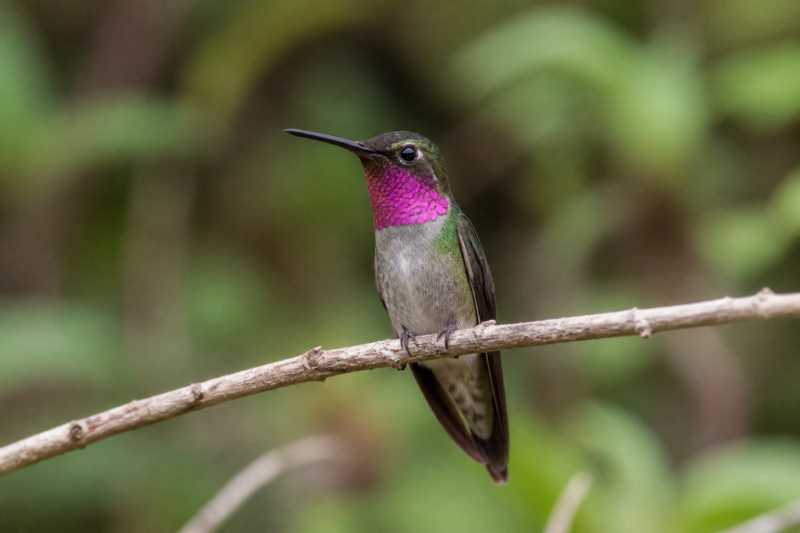
The Magenta-throated Woodstar is a tiny hummingbird, measuring approximately 7.5 to 9 cm in length and weighing about 3.3 to 3.5 g. It has a short, straight, black bill and a small white mark behind the eye.
The sexes are markedly different. The adult male has bronzy-green upperparts, a brilliant metallic magenta to reddish-purple throat, a pale band across the upper chest, green breast and flanks, rufous tones on the lower body, and pale patches at either side of the rump. Its tail is relatively long and graduated, with dark feathers and rufous colouring on the inner webs of the outer feathers. The tail is often held cocked while the bird feeds.
The female is less brightly coloured. She has bronzy-green upperparts, a pale greyish or buffy throat, green and rufous underparts, and a shorter, rounded tail with rufous outer feathers, a dark subterminal band and pale tips. Immature birds resemble females but are generally paler below and may show buff edging on the upperparts. These differences are useful when identifying the species in the field.
Range and Habitat
The Magenta-throated Woodstar is restricted to Costa Rica and western Panama, with most records from the Pacific side of the Talamanca mountain region. It is a regional endemic rather than a widespread migrant.
It occurs in montane habitats from approximately 700 m to around 1,900 m in Costa Rica, although its elevation varies locally. Suitable habitats include forest edges, clearings, secondary forest, thinned woodland, shrubby pastures and flowering gardens near intact montane forest. Although often associated with cloud-forest landscapes, it is not confined to closed-canopy forest and may benefit from a mixture of woodland and open flowering vegetation.
The species appears to make local movements, and its presence may vary seasonally at some sites. Long-distance migration has not been established.
Where to See This Species
Cloudbridge Nature Reserve, San Gerardo de Rivas, San José Province, Costa Rica
Cloudbridge Nature Reserve is a publicly accessible montane cloud-forest reserve in the Talamanca mountains, extending from approximately 1,550 m to 2,600 m. The reserve’s bird inventory documents Magenta-throated Woodstar, and the species has also been recorded around flowering areas and forest trails. Visitors can look along forest edges, secondary growth, gardens and flowering plants, particularly during quiet morning walks.
Nearby accommodation: San Gerardo de Rivas provides guest houses, small lodges, cabins and other rural accommodation, while San Isidro de El General offers a wider choice of hotels and services.
Behaviour and Diet
The Magenta-throated Woodstar is active during the day and feeds mainly on nectar from a variety of flowering shrubs, trees and other plants. By moving between flowers, it can transfer pollen and contribute to the pollination of montane vegetation.
Both sexes may defend local feeding areas and chase other hummingbirds near productive flowers. The male may perform a steep, diving display flight, either alone or in loose groups. When feeding, it commonly perches briefly or hovers close to flowers, with the long tail often raised.
Small insects and other arthropods supplement the nectar-based diet. The bird may capture them in the air from a perch or glean them from foliage. These animal foods provide nutrients that nectar alone does not supply.
Breeding information is limited. In Costa Rica, breeding activity has been recorded mainly from November through March or April. Males perform display flights, but the nest, incubation period and fledging period have not been adequately described. The female is presumed to undertake most or all nest construction and parental care, as in other hummingbirds, but detailed species-specific information should be treated cautiously.
Identification Tips
- Look for a very small hummingbird with a short black bill and a white mark behind the eye.
- Adult males are distinctive because of the glittering magenta throat, pale upper-chest band, bronzy-green back and long dark-and-rufous tail.
- Females lack the bright magenta throat. Their shorter, rounded tail, pale throat, rufous flanks and pale tail tips are useful identification features.
- The species is most likely to be encountered at forest edges, clearings, flowering gardens and secondary vegetation rather than in dense, dark forest interiors.
- Female Magenta-throated Woodstars can resemble female Volcano Hummingbirds and female Scintillant Hummingbirds. Careful attention to the pale throat, bronzy-green upperparts, rufous colouring and distinctive rounded tail pattern is important, especially where these species occur together.
Conservation Status
The Magenta-throated Woodstar is currently assessed as Least Concern on the IUCN Red List. It has a restricted geographic range, and its population is thought to be declining, although it remains locally common in some areas and can tolerate a degree of habitat alteration.
The principal conservation concerns are the loss and degradation of montane forest, agricultural expansion, development and possible changes to flowering patterns and suitable elevation zones caused by climate change. Protecting remaining Talamanca forests, maintaining connected habitat and conserving forest edges and secondary vegetation can help support the species.
Frequently Asked Questions
Where is the Magenta-throated Woodstar found?
It is found in Costa Rica and western Panama, mainly in the Talamanca highlands and associated montane habitats.
What does a male Magenta-throated Woodstar look like?
The male is a tiny bronzy-green hummingbird with a brilliant metallic magenta throat, a pale chest band, rufous lower body and a relatively long dark-and-rufous tail.
How can a female Magenta-throated Woodstar be identified?
The female lacks the male’s magenta throat and has a pale throat, bronzy-green upperparts, rufous tones on the flanks and a shorter rounded tail with pale-tipped outer feathers.
What does the Magenta-throated Woodstar eat?
It feeds mainly on nectar from flowering plants and also captures small insects and other arthropods.
Is the Magenta-throated Woodstar migratory?
It is not known to undertake long-distance migration. Local or seasonal movements may occur, and some sites appear to have the species only during part of the year.
Where can visitors look for this species?
Cloudbridge Nature Reserve in the Talamanca mountains of Costa Rica is a documented, publicly accessible site. Forest edges, flowering gardens, clearings and secondary growth are productive places to search.
References
- IOC World Bird List
- IUCN Red List of Threatened Species
- Cloudbridge Nature Reserve and Check List bird inventory
Related posts