Abbott’s Duiker (Cephalophus spadix)
Introduction
Abbott’s Duiker (Cephalophus spadix) is a rare and elusive species of forest antelope found primarily in the East African region. Named after W. L. Abbott, the American naturalist who first documented the species in the early 20th century, this duiker is one of the lesser-known members of the genus Cephalophus. Despite its obscurity in the scientific community, Abbott’s Duiker plays a vital role in its ecosystem, primarily through seed dispersal and as a prey species for larger predators.
The species faces numerous challenges, including habitat loss and hunting pressure, which have led to its classification as Endangered on the IUCN Red List. This article delves into the fascinating world of Abbott’s Duiker, exploring its physical characteristics, habitat preferences, behaviors, and the conservation efforts aimed at ensuring its survival.
Physical Description
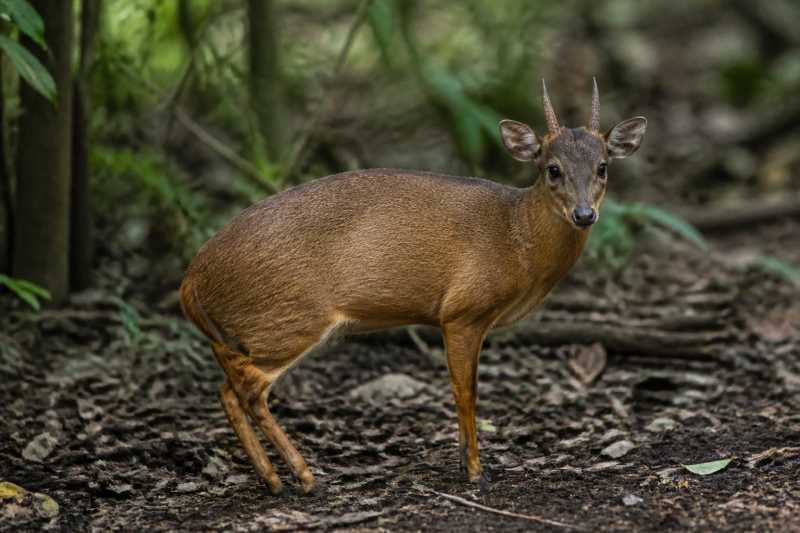
Abbott’s Duiker is a medium-sized antelope, with adults typically weighing between 55 to 80 kilograms (121 to 176 pounds) and standing about 75 to 87 centimeters (29 to 34 inches) at the shoulder. The species exhibits sexual dimorphism, with males generally being slightly larger than females.
The coat of Abbott’s Duiker is a rich, dark brown, providing excellent camouflage in the dense forest undergrowth. Its back is noticeably arched, a characteristic feature of the duiker family, and it possesses a short, bushy tail with a white underside. The duiker’s face is marked by a distinctive pair of white spots above the eyes, adding to its unique appearance.
Abbott’s Duiker has short, pointed horns that are present in both sexes, although they are more prominent in males. These horns can measure up to 11 centimeters (about 4.3 inches) in length. The ears are long and rounded, aiding in acute hearing, which is crucial for detecting predators in the dense forest.
Range and Habitat
Abbott’s Duiker is endemic to the montane and submontane forests of Tanzania, with its range primarily restricted to the Eastern Arc Mountains. This includes notable locations such as the Udzungwa Mountains, the Uluguru Mountains, and the Usambara Mountains. The species favors altitudes ranging from 1,000 to 2,500 meters (3,280 to 8,200 feet), where it inhabits dense, moist forests.
These forests provide the necessary cover and resources that Abbott’s Duiker requires for survival. The species is highly dependent on the availability of thick vegetation, not only for forage but also for protection against predators and human encroachment. Unfortunately, its limited range and specific habitat requirements make Abbott’s Duiker particularly vulnerable to environmental changes and human activities.
Behavior and Diet
Abbott’s Duiker is primarily crepuscular, meaning it is most active during the early morning and late afternoon. This behavioral adaptation helps it avoid the heat of the day and reduces the risk of encountering predators.
In terms of diet, Abbott’s Duiker is both a browser and a grazer, feeding on a variety of plant materials. Its diet includes leaves, shoots, fruits, and seeds. It plays a critical role in seed dispersal, aiding in the regeneration of its forest habitat. The duiker’s foraging behavior is typically solitary, although pairs have been occasionally observed.
The species communicates through a range of vocalizations, including alarm calls that serve to warn other duikers of potential threats. It also exhibits a unique behavior known as ‘stotting’ or ‘pronking,’ where it jumps with all four feet off the ground, possibly as a display of fitness or to confuse predators.
Identification Tips
Field recognition of Abbott’s Duiker can be challenging due to its elusive nature and dense forest habitat. However, there are several key identification tips that can aid in its detection:
- Coloration: Look for the distinctive dark brown coat and white facial spots.
- Size and Shape: Note the arched back and relatively large size compared to other duikers.
- Horns: Observe the short, pointed horns, which are more prominent in males.
- Behavior: Watch for crepuscular activity and listen for vocalizations or rustling in the undergrowth.
Spotting Abbott’s Duiker often requires patience and a keen eye, as it is adept at blending into its surroundings.
Conservation Status
Abbott’s Duiker is currently classified as Endangered on the IUCN Red List. The primary threats to its survival include habitat loss due to logging, agricultural expansion, and human settlement. Additionally, hunting for bushmeat poses a significant threat, despite the species’ elusive nature.
Conservation efforts are underway to protect Abbott’s Duiker and its habitat. These include the establishment of protected areas within its range and community-based conservation programs aimed at reducing human-wildlife conflict. Research and monitoring programs are also essential for gathering data on the species’ population size, distribution, and ecological requirements.
International cooperation and funding are crucial for the implementation of effective conservation strategies, ensuring the survival of Abbott’s Duiker for future generations.
Frequently Asked Questions
What is the scientific name of Abbott’s Duiker?
Abbott’s Duiker is scientifically known as Cephalophus spadix. It belongs to the family Bovidae and is closely related to other duiker species.
Where can Abbott’s Duiker be found?
Abbott’s Duiker is primarily found in the montane and submontane forests of Tanzania, particularly in the Eastern Arc Mountains.
What does Abbott’s Duiker eat?
Abbott’s Duiker is a browser and grazer, feeding on leaves, shoots, fruits, and seeds. It plays a role in seed dispersal within its ecosystem.
Why is Abbott’s Duiker endangered?
The species is endangered due to habitat loss from logging and agriculture, as well as hunting pressure for bushmeat.
How can I help in the conservation of Abbott’s Duiker?
Support conservation organizations working in Tanzania, promote sustainable forestry practices, and raise awareness about the plight of this endangered species.
Related posts