
Introduction
The Golden-crowned Emerald (Cynanthus auriceps) is a small hummingbird endemic to western Mexico. It is a resident species of the Pacific lowlands and adjacent interior valleys, where it uses dry forest, scrub, forest edges, clearings and other partly open habitats. The species was formerly placed in the genus Chlorostilbon, but current taxonomic treatments place it in Cynanthus.
Physical Description
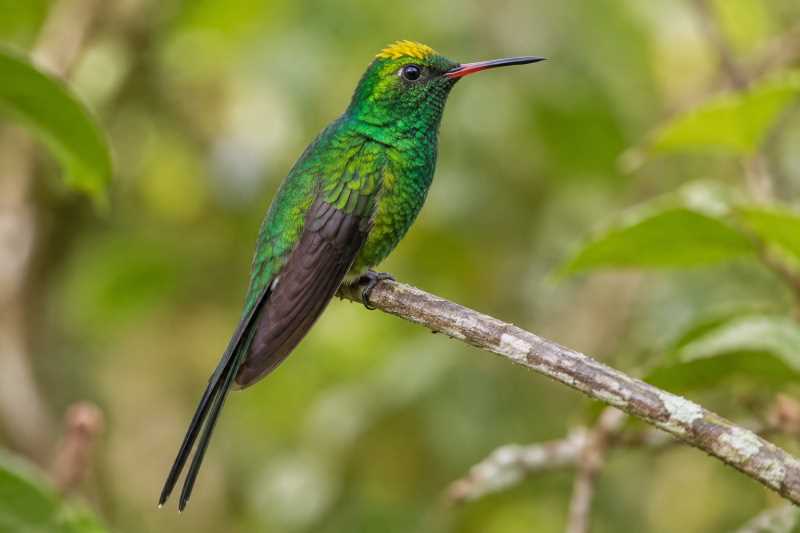
The Golden-crowned Emerald is a small hummingbird, about 9 cm long. Adult males are predominantly emerald-green, with golden-green to bronzy tones on the crown and upperparts. Their tail is relatively long and deeply forked, and the bill is reddish with a darker tip.
Females are less brightly coloured. They lack the male’s conspicuous golden crown and have paler, greyish or dusky underparts, a pale line behind the eye and a shorter, forked tail. Juvenile males resemble females until the adult plumage develops. The deeply forked tail, reddish bill, green body and restricted Mexican range are useful identification features.
Range and Habitat
The Golden-crowned Emerald is endemic to Mexico. Its range extends along the Pacific slope from southern Sinaloa through Nayarit, Jalisco, Colima, Michoacán and Guerrero, with records reaching Oaxaca. It also occurs inland in parts of the Balsas drainage and adjacent valleys.
It is associated mainly with tropical dry forest, deciduous woodland, thorn scrub, secondary vegetation, forest edges, overgrown clearings and gardens with flowering plants. It can use degraded and human-modified habitats when suitable cover and nectar sources remain. It has been recorded from near sea level to approximately 1,800 metres, although local elevation limits vary across its range.
The species is considered resident rather than migratory. Its distribution is uneven, and local abundance may change with flowering conditions, rainfall and habitat quality.
Where to See This Species
Chamela-Cuixmala Biosphere Reserve, Jalisco, Mexico
The Chamela-Cuixmala Reserve supports tropical deciduous forest, woodland edges and regenerating vegetation in coastal western Mexico. The species is documented in the reserve’s bird guide, making the area a well-supported location for searching suitable habitat. Look along forest edges, flowering shrubs and lightly wooded clearings, particularly during periods of active flowering.
Nearby accommodation: La Huerta, San Patricio-Melaque and other coastal settlements provide hotels, guest houses, cabins and self-catering accommodation. Access to some reserve areas may require prior permission or a local guide.
Vallarta Botanical Garden, Jalisco, Mexico
The Vallarta Botanical Garden lies within the species’ known range and has documented Golden-crowned Emerald records. Its gardens, surrounding tropical forest and flowering plants provide suitable habitat for hummingbirds. Early morning visits are likely to offer the best viewing conditions, especially around flowering areas and forest margins.
Nearby accommodation: Puerto Vallarta is the main accommodation base, with a wide range of hotels, guest houses, lodges and self-catering accommodation.
Cascada del Cora, Nayarit, Mexico
Cascada del Cora near San Blas is a documented birding location for the Golden-crowned Emerald. The surrounding tropical woodland, streamside vegetation and forest edges provide appropriate habitat, although sightings may be irregular and dependent on local flowering conditions.
Nearby accommodation: San Blas is the practical gateway, with hotels, guest houses, small lodges, campsites and self-catering accommodation.
Behaviour and Diet
The Golden-crowned Emerald is active and agile, with the hovering flight typical of hummingbirds. It usually forages alone, visiting flowers at different heights and moving rapidly between feeding sites. Males may defend favoured flowers or small feeding areas, although the degree of territorial behaviour can vary with food availability.
Its diet consists mainly of nectar from flowering plants. It also takes small insects and spiders, which provide protein and other nutrients, particularly during the breeding season. By transferring pollen between flowers, it contributes to the reproduction of many plants in dry-forest and scrub ecosystems.
Breeding information for this species is less extensively documented than for some widespread hummingbirds. As in other hummingbirds, the female is expected to build the nest, incubate the eggs and feed the young without assistance from the male. Reports of a small cup-shaped nest, two white eggs and a nestling period of several weeks are consistent with the breeding pattern of related hummingbirds, but precise dates and measurements should be treated cautiously because published species-specific data are limited.
Identification Tips
- Look for a small, bright-green hummingbird with a reddish bill and a long, deeply forked tail.
- Adult males may show a golden or bronzy crown, although the colour can be difficult to see in poor light.
- Females are duller, with greyish or dusky underparts, a pale post-ocular line and a shorter forked tail.
- The species often occurs in dry forest, scrub, forest edge and flowering gardens rather than only in dense forest.
- Range is important for identification. In western Mexico, compare it carefully with other green hummingbirds, including Broad-billed Hummingbird and, in appropriate coastal areas, Tres Marias Hummingbird.
- The golden crown is not always obvious, so shape, tail structure, bill colour and location should be considered together.
Conservation Status
The Golden-crowned Emerald is currently assessed as Least Concern on the IUCN Red List. It is endemic to Mexico and remains distributed across a substantial area, but habitat loss and degradation are continuing concerns. Conversion of tropical dry forest for agriculture, grazing, settlement and other land uses can reduce nesting cover and the availability of flowering plants.
Climate variability may also affect flowering cycles, water availability and the condition of dry-forest habitats. Protection of remaining tropical dry forest, maintenance of native flowering vegetation and sustainable land management are important conservation measures. The species’ status does not remove the need to protect local populations, particularly in areas where habitat is becoming fragmented.
Frequently Asked Questions
Where is the Golden-crowned Emerald found?
It is endemic to western Mexico, ranging from southern Sinaloa southwards through the Pacific-slope states to Guerrero and Oaxaca, with additional inland records in the Balsas region.
What habitat does the Golden-crowned Emerald prefer?
It mainly uses tropical dry forest, thorn scrub, woodland edges, secondary vegetation, overgrown clearings and flowering gardens. It can tolerate some habitat disturbance when food and cover remain available.
How can the Golden-crowned Emerald be identified?
Look for a small emerald-green hummingbird with a reddish bill and a deeply forked tail. Adult males have golden-green crown feathers, while females are duller and have greyish underparts and a pale line behind the eye.
Is the Golden-crowned Emerald migratory?
No. It is generally regarded as a resident species, although individuals may move locally in response to flowering conditions, rainfall and food availability.
What does the Golden-crowned Emerald eat?
It feeds mainly on nectar and supplements its diet with small insects and spiders. The species also acts as a pollinator when it visits flowers.
What is the conservation status of this species?
The Golden-crowned Emerald is listed as Least Concern by the IUCN. Habitat loss and degradation remain the main conservation concerns, especially in tropical dry forests and other lowland habitats.
References
- IOC World Bird List
- IUCN Red List of Threatened Species
- Field Museum, Birds of the Chamela-Cuixmala Reserve
Related posts


