Introduction
The Sunda Brush Cuckoo (Cacomantis sepulcralis) is a medium-sized cuckoo of the Malay Peninsula, the Greater Sundas, parts of the Philippines and several islands of the western and central Lesser Sundas. It is also known in some regional sources as the Rusty-breasted Cuckoo. The species is generally secretive, and its distinctive call is often detected before the bird is seen.
Physical Description
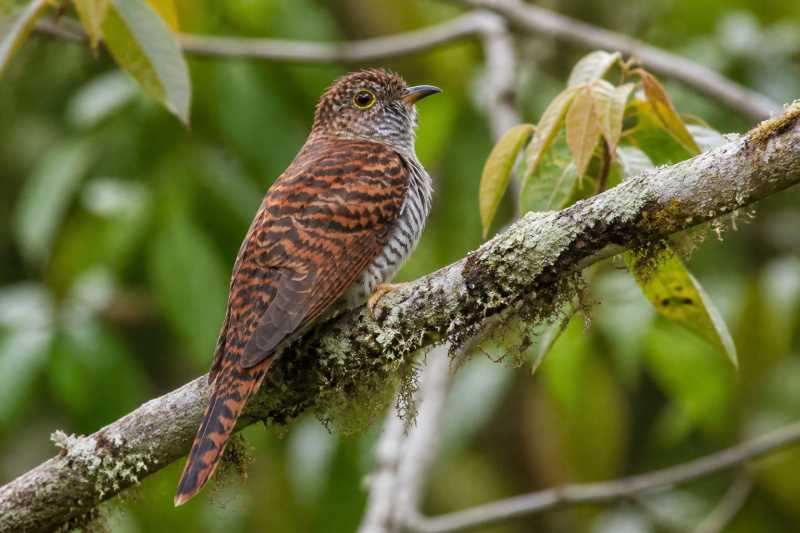
The Sunda Brush Cuckoo measures approximately 21.5 to 24 centimetres in length. It has a grey head, greyish-brown upperparts, a relatively long tail and warm peachy-rufous or rusty underparts. The wings are rounded, and the long tail helps it manoeuvre through dense vegetation.
A yellow eye-ring is an important identification feature. The bill is dark and slightly curved, while the legs and feet are generally yellowish to orange. The exact tones vary between individuals and geographic forms.
Females may occur in a barred, or hepatic, plumage that can resemble the juvenile plumage of the Plaintive Cuckoo. Juveniles are more strongly barred, with rufous-brown upperparts, whitish or buff underparts and dark barring. They may also show a yellowish eye-ring.
Range and Habitat
The Sunda Brush Cuckoo occurs from the Malay Peninsula through the Greater Sundas, including Sumatra, Borneo and Java, and eastwards through parts of the Philippines and the western and central Lesser Sundas. Current taxonomic treatments separate it from several related brush cuckoo forms that were formerly included in a wider Rusty-breasted or Brush Cuckoo complex.
It is mainly associated with moist lowland forest, forest edges, secondary woodland, mangroves, plantations and well-vegetated parks and gardens. In suitable areas it can occur in human-modified habitats, although dense cover is usually important. The species is generally regarded as resident or presumed resident rather than a long-distance migrant.
Where to See This Species
Bukit Timah Nature Reserve, Singapore
The Sunda Brush Cuckoo has been recorded in Bukit Timah Nature Reserve, where mature rainforest, shaded trails and dense understorey provide suitable habitat. It is more likely to be heard than seen, so quiet observation along forest paths is useful.
Nearby accommodation: Singapore provides a wide range of hotels, guest houses, serviced apartments and other accommodation, with the Bukit Timah and central areas offering practical bases.
Sungei Buloh Wetland Reserve, Singapore
Sungei Buloh Wetland Reserve has documented records of the species. Although best known for mangroves and wetland birds, its wooded margins and dense vegetation can support forest-edge species such as the Sunda Brush Cuckoo. Early morning visits offer the best chance of detecting calls and movement.
Nearby accommodation: Useful accommodation is available in northern and western Singapore, while the wider city offers hotels, guest houses and serviced apartments.
Pulau Ubin, Singapore
The Sunda Brush Cuckoo has been reported from Pulau Ubin. The island’s secondary woodland, forest edges, scrub and village vegetation provide a varied landscape in which the species may be encountered. Birders should check shaded edges and listen from quiet tracks rather than expecting open views.
Nearby accommodation: Most visitors stay in Singapore, particularly around Changi, Pasir Ris or the eastern suburbs, where hotels, guest houses and self-catering accommodation are available before travelling to the island.
Behaviour and Diet
The Sunda Brush Cuckoo is usually solitary or encountered in pairs. It spends much of its time concealed in foliage and is often located by its call. It forages through the understorey and lower canopy, taking insects and other small invertebrates, including caterpillars where available.
Its flight is generally direct and purposeful over short distances, followed by a return to dense cover. The species is a brood parasite. In Singapore, the Malaysian Pied Fantail has been documented as a host, although host associations can vary across the species’ wide range.
The call is a repeated, clearly phrased series of notes that may carry some distance through forest. Vocal activity is particularly useful for locating birds that remain hidden in thick vegetation.
Identification Tips
- Look for a medium-sized cuckoo with a grey head, greyish-brown back, long tail and rusty or peach-coloured underparts.
- Check for the contrasting yellow eye-ring, especially when separating it from other brown or grey cuckoos.
- Females in barred hepatic plumage and juveniles require closer attention because they can resemble the Plaintive Cuckoo.
- Compared with the Plaintive Cuckoo, the Sunda Brush Cuckoo generally has a more noticeable yellow eye-ring and broader, darker barring in barred plumages. The call and habitat can also help with identification.
- The bird is frequently detected by voice before it appears, so listening from forest edges and shaded paths is often more productive than scanning open ground.
Conservation Status
The Sunda Brush Cuckoo is generally assessed as Least Concern at the global level. It has a broad distribution and occurs in a range of forest and forest-edge habitats. However, continued deforestation, habitat fragmentation and the degradation of lowland forest remain potential local pressures, particularly where suitable cover and host species decline.
Protecting remaining lowland forest, maintaining connected secondary vegetation and conserving mangroves and other wooded habitats can benefit the species. Local population trends are not sufficiently documented across the whole range to support a reliable global population estimate.
Frequently Asked Questions
Where can the Sunda Brush Cuckoo be found?
It occurs across the Malay Peninsula, the Greater Sundas, parts of the Philippines and several islands of the western and central Lesser Sundas. It is especially associated with moist forest and forest-edge habitats.
Is the Sunda Brush Cuckoo the same as the Rusty-breasted Cuckoo?
The names have often been used for the same species or for a wider group of related brush cuckoos. Current taxonomic lists generally use Sunda Brush Cuckoo for Cacomantis sepulcralis, while Rusty-breasted Cuckoo remains a widely used regional name.
What does the Sunda Brush Cuckoo eat?
Its diet consists mainly of insects and other small invertebrates. Caterpillars and similar soft-bodied prey are likely to be important when available.
Is the Sunda Brush Cuckoo a brood parasite?
Yes. It lays its eggs in the nests of other birds. The Malaysian Pied Fantail is a documented host in Singapore, but the full range of host relationships is not equally well known throughout its distribution.
How can the Sunda Brush Cuckoo be identified?
Listen for its repeated call and look for a medium-sized cuckoo with a grey head, rusty underparts, a long tail and a yellow eye-ring. Barred females and juveniles need careful comparison with the Plaintive Cuckoo.
Is the Sunda Brush Cuckoo endangered?
No. It is generally classified as Least Concern globally, although habitat loss and fragmentation may affect local populations.
References
- IOC World Bird List
- IUCN Red List of Threatened Species
- National Parks Board Singapore
Related posts