Introduction
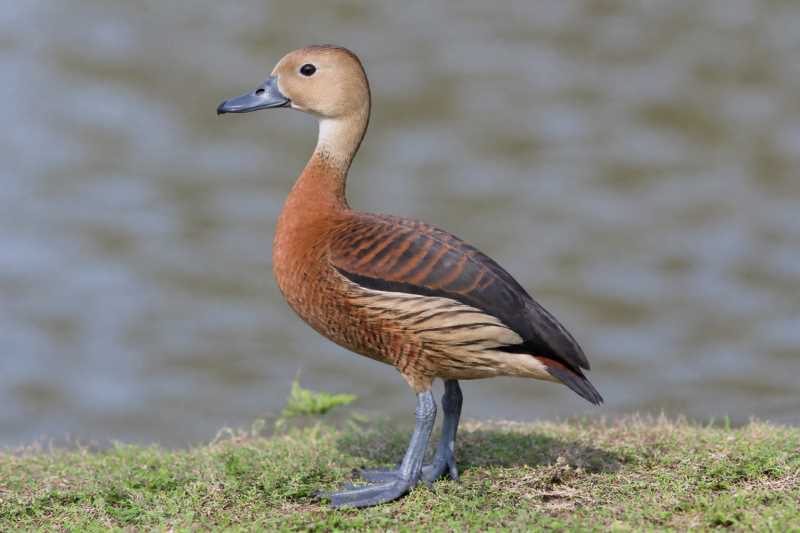
The Fulvous Whistling Duck (Dendrocygna bicolor) is a medium-sized waterfowl species of tropical and subtropical wetlands. It is recognised by its warm cinnamon-buff plumage, long neck and legs, dark wings, pale rump markings and distinctive whistling calls. It belongs to the whistling-duck group within the family Anatidae. (allaboutbirds.org)
Physical Description
The Fulvous Whistling Duck measures approximately 42–51 centimetres in length. It has a long neck, long legs, a short tail and a relatively long bill, giving it a more upright, goose-like profile than many typical ducks. Adults are mainly rich cinnamon, buff and brown, with darker back and wings, paler underparts, grey-blue bill and legs, and conspicuous pale streaks on the flanks. In flight, the dark wings contrast with the pale rump and upper-tail area. (allaboutbirds.org)
Males and females are broadly similar, although females may show more blackish colouring on the crown and the rear of the neck. Juveniles are duller and show a more strongly contrasting black-and-white pattern on the head and neck. (allaboutbirds.org)
Range and Habitat
The species has a broad, discontinuous distribution across tropical and subtropical regions of the Americas, sub-Saharan Africa and southern Asia. In the Americas, it occurs from the southern United States and Mexico through Central America, the Caribbean and much of South America. In the United States, breeding populations are concentrated mainly in Texas, Louisiana, Florida and parts of California, while birds may occur more widely as migrants or vagrants. (lib.usf.edu)
Fulvous Whistling Ducks favour shallow freshwater wetlands with emergent vegetation. Important habitats include freshwater marshes, ponds, slow-moving rivers, flooded pastures, rice fields and other seasonally flooded agricultural areas. Outside the breeding season, they may also use coastal lagoons, flooded savannas, mangrove swamps, brackish marshes and wet woodland margins. They generally occur in lowland habitats, and no distinctive high-elevation association is recognised in the sources used here. (allaboutbirds.org)
Movements vary geographically. Some populations are largely sedentary, while birds breeding in the southern United States and northern Mexico commonly move southwards after the breeding season and return in spring. The species can also make opportunistic movements when changing water levels reduce the availability of feeding or breeding habitat. (allaboutbirds.org)
Behaviour and Diet
Fulvous Whistling Ducks are social and are often seen in flocks, particularly outside the breeding season. They are frequently active at night or around dawn and dusk, when groups may fly between roosting and feeding sites while giving repeated whistling calls. They forage by swimming or wading in shallow water, dabbling, tipping up and occasionally diving. They may also feed in damp fields and among wetland vegetation. (allaboutbirds.org)
The diet consists mainly of seeds and other plant material from aquatic plants, grasses and wetland vegetation. Aquatic invertebrates, including insects and other small animal foods, are eaten in smaller quantities and may be more important at some stages of the breeding cycle. (audubon.org)
Breeding timing varies across the range. Pairs usually nest in dense marsh vegetation, flooded fields or other sites close to water. The nest is a platform or bowl made from surrounding plant material and may be placed on the ground, slightly above the water, or among flooded vegetation. A typical clutch contains about 6–16 eggs, although egg dumping and brood parasitism can produce much larger groups of eggs in a single nest. Both parents incubate the eggs for approximately 24–26 days and help care for the downy young, which leave the nest soon after hatching and can swim and feed themselves. (allaboutbirds.org)
Identification Tips
Look for the following combination of features:
- Warm cinnamon or butterscotch head, neck, breast and underparts.
- Dark back and wings, with pale streaking along the flanks.
- Long neck and legs, short tail and upright posture.
- Grey-blue bill, legs and feet.
- Pale rump and upper-tail markings contrasting with the dark wings in flight.
- Repeated whistling calls, especially when birds are flying between wetlands.
The Black-bellied Whistling Duck (Dendrocygna autumnalis) is the most important comparison species in the Americas. It has a much darker, blackish belly and a different overall colour pattern, whereas the Fulvous Whistling Duck has a largely buff or cinnamon underbody and dark wings. In southern Asia, the smaller Lesser Whistling Duck (Dendrocygna javanica) can also cause confusion, but the Fulvous Whistling Duck is generally larger and shows a more strongly contrasting dark back, pale flank streaks and cinnamon underparts. (allaboutbirds.org)
Conservation Status
The Fulvous Whistling Duck is classified as Least Concern on the IUCN Red List. This status reflects its very broad distribution and substantial global population, but it does not mean that all regional populations are secure. (birdlife.org.za)
The principal conservation concern is the loss and degradation of wetlands through drainage, agricultural conversion, river modification and development. Hunting occurs across parts of the species’ range, although its overall effect on global numbers is not well quantified. Conservation measures include protecting freshwater marshes and floodplain habitats, maintaining suitable water levels, conserving rice-field and other wetland mosaics, and monitoring regional populations. In North America, survey evidence indicates that populations were broadly stable or increased slightly between 1966 and 2015, although some local populations have declined or disappeared. (allaboutbirds.org)
Frequently Asked Questions
Where does the Fulvous Whistling Duck live?
It occurs in tropical and subtropical parts of the Americas, sub-Saharan Africa and southern Asia. It favours shallow freshwater wetlands, flooded fields, rice fields, ponds, marshes and slow-moving rivers.
What does the Fulvous Whistling Duck eat?
Its diet consists mainly of seeds and other plant material from aquatic plants, grasses and wetland vegetation. It also eats smaller amounts of aquatic invertebrates such as insects.
How can the Fulvous Whistling Duck be identified?
Identify it by its cinnamon-buff body, dark back and wings, pale flank streaks, long neck and legs, grey-blue bill and pale rump markings. Its repeated whistling calls are also useful in the field.
Do Fulvous Whistling Ducks migrate?
Movement varies by region. Some populations remain in the same general area year-round, while birds breeding in the southern United States and northern Mexico commonly migrate south after breeding and return in spring.
How many eggs does it lay?
A usual clutch contains approximately 6–16 eggs, although egg dumping and brood parasitism can result in much larger numbers of eggs in one nest.
Are Fulvous Whistling Ducks endangered?
No. The species is currently assessed as Least Concern globally. Nevertheless, wetland loss, habitat degradation and hunting remain important regional concerns.
References
- BirdLife International. 2016. Fulvous Whistling Duck Dendrocygna bicolor. IUCN Red List assessment, species factsheet. BirdLife International Data Zone. https://datazone.birdlife.org/species/factsheet/fulvous-whistling-duck-dendrocygna-bicolor. Accessed 8 September 2026.
- Cornell Lab of Ornithology. n.d. Fulvous Whistling-Duck: Identification. All About Birds. https://www.allaboutbirds.org/guide/Fulvous_Whistling-Duck/id. Accessed 8 September 2026.
- Cornell Lab of Ornithology. n.d. Fulvous Whistling-Duck: Life History. All About Birds. https://www.allaboutbirds.org/guide/Fulvous_Whistling-Duck/lifehistory. Accessed 8 September 2026.
- Gill, F., Donsker, D. and Rasmussen, P. eds. 2025. IOC World Bird List, version 15.2. International Ornithologists’ Union. https://www.worldbirdnames.org/new/. Accessed 8 September 2026.
- Holmes, Z. B. 2023. Fulvous Whistling-Duck (Dendrocygna bicolor). In A. B. Hodgson ed., Florida Breeding Bird Atlas II, pp. 69–73. Florida Ornithological Society, Tampa, USA. https://lib.usf.edu/breeding-bird-atlas/species-accounts/fulvous-whistling-duck/.
- Hohman, W. L. and Lee, S. A. 2001. Fulvous Whistling-Duck (Dendrocygna bicolor), version 2.0. In P. G. Rodewald ed., The Birds of North America. Cornell Lab of Ornithology, Ithaca, New York, USA. https://www.allaboutbirds.org/guide/Fulvous_Whistling-Duck/lifehistory.
- Texas Breeding Bird Atlas. n.d. Fulvous Whistling-Duck: Dendrocygna bicolor. Texas A&M University. https://txtbba.tamu.edu/species-accounts/fulvous-whistling-duck/. Accessed 8 September 2026.
- National Audubon Society. n.d. Fulvous Whistling-Duck. Audubon Field Guide. https://www.audubon.org/field-guide/bird/fulvous-whistling-duck. Accessed 8 September 2026.
Related posts