The Elusive Chinese Crested Tern: A Conservation Marvel
The Chinese Crested Tern (Thalasseus bernsteini) is a bird that has captured the attention and imagination of ornithologists and conservationists alike. Once thought to be extinct, this elusive seabird has made a remarkable comeback, though it remains one of the world’s rarest birds. This article delves into the characteristics, habitat, conservation efforts, and challenges faced by the Chinese Crested Tern.
Taxonomy and Physical Description
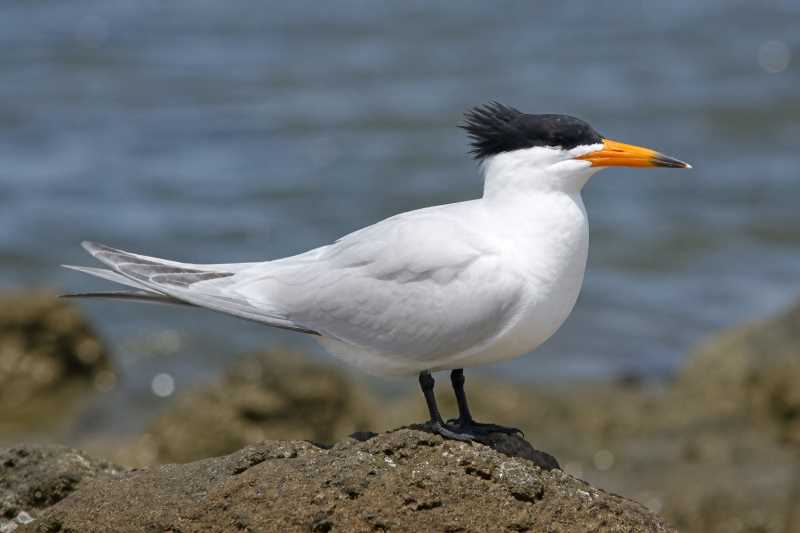
The Chinese Crested Tern belongs to the family Laridae and is a member of the genus Thalasseus, which includes other large terns. It was first described in 1863 by German ornithologist Hermann Schlegel. The bird is characterized by its striking appearance: a slender body, long narrow wings, and a distinctive black crest on its head during the breeding season. Its plumage is primarily white, with a pale grey back and wings. The bill is yellow with a black tip, distinguishing it from other terns.
Adult Chinese Crested Terns measure between 40 to 43 cm in length, with a wingspan extending up to 85 cm. Both sexes look similar, making it difficult to differentiate between males and females in the field. The bird’s call is a harsh, grating sound, often described as "kree-ak," which it uses for communication during breeding and feeding.
Habitat and Distribution
Historically, the Chinese Crested Tern was found along the eastern coast of China, with records extending to the Korean Peninsula and Japan. However, due to habitat loss and other anthropogenic factors, its range has significantly diminished.
Today, the species is primarily found on small islands in the East China Sea, notably in the Matsu Islands of Taiwan, the Jiushan Islands, and the Wuzhishan Islands in Zhejiang Province, China. These islands provide the ideal habitat for breeding, with sandy beaches and rocky outcrops for nesting, as well as rich coastal waters teeming with fish, the primary diet of the terns.
Rediscovery and Conservation Status
The Chinese Crested Tern was presumed extinct for much of the 20th century, with no confirmed sightings between the 1930s and the late 1990s. However, in 2000, a small breeding colony was rediscovered in the Matsu Islands, reigniting hope for the species’ survival.
Currently, the Chinese Crested Tern is listed as Critically Endangered on the IUCN Red List, with an estimated population of fewer than 100 individuals. The species faces numerous threats, including habitat destruction, human disturbance, climate change, and predation by invasive species.
Conservation Efforts
Efforts to conserve the Chinese Crested Tern have been multi-faceted and collaborative, involving governments, NGOs, and local communities. Key strategies include:
- Habitat Protection and Restoration: Protecting the breeding islands from development and disturbance is crucial. Conservationists are working to restore degraded habitats and control invasive species such as rats and cats, which threaten eggs and chicks.
- Community Engagement: Educating and involving local communities in conservation efforts helps reduce disturbances and promotes sustainable practices. Ecotourism is being developed to provide economic incentives for conservation.
- Research and Monitoring: Continuous monitoring of populations and breeding success is vital. Satellite tracking and banding programs help gather data on migration patterns and feeding behavior.
- International Cooperation: Since the tern’s range extends across national boundaries, international cooperation is essential. Joint conservation initiatives between China, Taiwan, and other neighboring countries are ongoing.
Challenges and Future Outlook
Despite significant efforts, the Chinese Crested Tern faces an uncertain future. Climate change poses a substantial threat, potentially altering sea levels and weather patterns, which could impact breeding sites and food availability.
Pollution, particularly plastic waste and oil spills, also threatens the marine environment crucial for the tern’s survival. Continued vigilance and adaptive management strategies are required to address these challenges.
However, the rediscovery of the Chinese Crested Tern and subsequent conservation successes offer a glimmer of hope. The species serves as a flagship for coastal and marine conservation, highlighting the importance of biodiversity and ecosystem health.
In conclusion, the story of the Chinese Crested Tern is one of resilience and recovery. It underscores the power of conservation to bring species back from the brink of extinction. With continued effort and collaboration, there is hope that future generations will witness the flight of this extraordinary bird across its native waters.
References
- BirdLife International. (2021). Thalasseus bernsteini. The IUCN Red List of Threatened Species 2021.
- Chen, S. H., & Fang, W. H. (2017). Conservation Action of the Critically Endangered Chinese Crested Tern in Taiwan. Journal of Coastal Conservation, 21(3), 345-354.
- Zuo, H., & Zhang, Y. (2018). Rediscovery and Conservation of Chinese Crested Tern in Zhejiang Province, China. Avian Research, 9(1), 12.
Related posts