Introduction
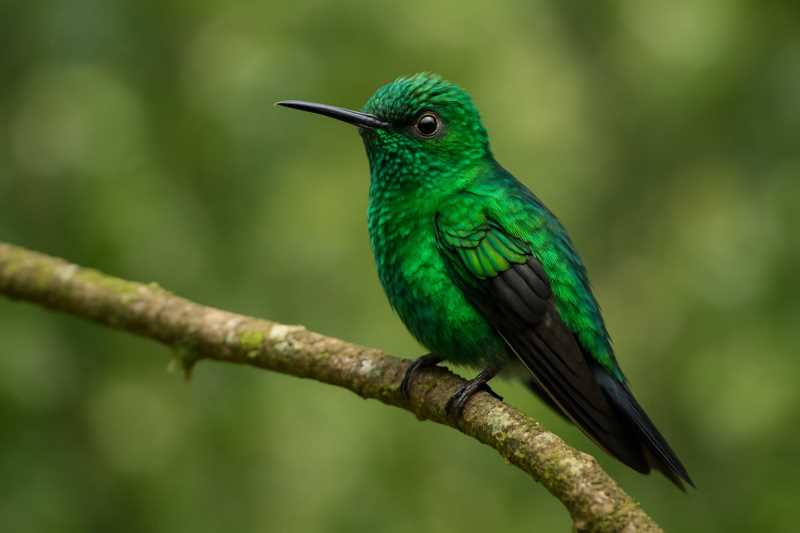
Canivet’s Emerald (Cynanthus canivetii) is a small resident hummingbird of Mexico and Central America. It is recognised by its brilliant green plumage, strongly forked tail and rapid, agile flight. Older sources may place the species in the genus Chlorostilbon, but the current IOC treatment uses Cynanthus canivetii.
Physical Description
Canivet’s Emerald is approximately 7.5–9.3 cm long and weighs about 2.1–2.8 g. It has a slender, slightly curved bill and a long, deeply forked tail.
The adult male is predominantly bright golden-green to emerald-green, with a golden sheen on the crown and upperparts. The throat and underparts are vividly iridescent green, while the wings are dusky brownish and the tail is dark, often with a blue or blue-black gloss. In the nominate form, the bill is reddish with a dark tip, and small white feather tufts may be visible on the thighs.
The female is less brightly coloured. She has green upperparts, pale greyish to whitish underparts, a pale stripe behind the eye and a dusky facial mask. Her tail is shorter and less deeply forked than the male’s, with pale or whitish tips on the outer feathers. Immature birds generally resemble females and may show less distinct or slightly spotted underparts.
Several geographic forms have been described, and plumage details such as bill colour, tail shape and the amount of golden colour can vary across the range.
Range and Habitat
Canivet’s Emerald occurs from eastern and southern Mexico through Belize, Guatemala, Honduras, El Salvador, Nicaragua and Costa Rica. It is a non-migratory resident, although local movements may occur in response to flowering conditions and changes in food availability.
The species uses a broad range of relatively open habitats, including tropical dry forest, semi-humid woodland, forest edges, clearings, secondary growth, scrubby savanna, plantations and gardens with flowering plants. It is often associated with disturbed or semi-open landscapes rather than the darkest parts of mature forest.
Across much of its range it occurs from sea level to approximately 1,900 metres, although its upper elevational limit is lower in parts of Costa Rica. Three commonly recognised subspecies are associated with different parts of the distribution: the nominate form in eastern Mexico and northern Central America, C. c. osberti farther south and west, and C. c. salvini in western Costa Rica.
Where to See This Species
Calakmul Biosphere Reserve, Campeche, Mexico
Canivet’s Emerald is included in the official bird list for the Calakmul Biosphere Reserve. The reserve’s extensive lowland forest, woodland edges and clearings provide suitable habitat, particularly where flowering plants occur along roads, trails and disturbed margins. The species is resident, so it may be searched for throughout the year.
Nearby accommodation: Xpujil is the main gateway settlement, with hotels, guest houses, cabins and other basic accommodation suitable for visits to the reserve.
Tulum National Park, Quintana Roo, Mexico
The species is documented in the management planning material for Tulum National Park. Coastal scrub, lowland woodland, forest margins and flowering vegetation around open areas offer realistic places to look. Early morning is generally the most productive time for observing hummingbirds before heat and visitor activity increase.
Nearby accommodation: Tulum provides a wide range of hotels, guest houses, hostels and self-catering accommodation.
Área de Protección de Flora y Fauna Felipe Carrillo Puerto, Quintana Roo, Mexico
Canivet’s Emerald is listed among the resident birds of this protected area. The reserve’s lowland forests, secondary growth and open habitats with flowering plants are appropriate places to search, especially along accessible roads and vegetation edges.
Nearby accommodation: Felipe Carrillo Puerto is the nearest practical town, offering hotels, guest houses and other small-scale accommodation.
Behaviour and Diet
Canivet’s Emerald is usually seen alone, although several individuals may gather where flowering plants or artificial feeders provide concentrated food. It forages at different heights, from low shrubs to the edges of the forest canopy, and often perches quietly between feeding flights.
Nectar forms the main part of its diet. The bird visits a range of tubular or otherwise nectar-rich flowers and may defend productive feeding patches from other hummingbirds. It also takes small insects and spiders, either by making short sallies from a perch or by picking prey from vegetation. These animal foods provide protein, particularly for growing young.
Breeding behaviour varies geographically. Males may perform rapid display flights and pursue females, but they do not take part in nest building or the main parental duties. The female builds a small cup-shaped nest from plant fibres, fine vegetation and spider silk, often attaching it to a slender branch or shrub. She incubates the eggs and feeds the nestlings, which remain dependent until they are fully feathered and capable of sustained flight.
Identification Tips
- Look for a very small hummingbird with bright green plumage and a noticeably forked tail.
- Adult males show a golden-green crown, brilliant green throat and underparts, and a reddish bill with a dark tip.
- Females are paler below and show a pale stripe behind the eye, a dusky face and a less deeply forked tail with pale outer tips.
- The strongly forked tail is one of the best field marks, especially on a perched male.
- The species often favours forest edges, scrub, gardens and clearings, where it may be easier to observe than in dense forest.
- Do not confuse the species with the closely related Cozumel Emerald, which is restricted to Cozumel Island. Canivet’s Emerald occurs on the Yucatán mainland and in mainland Central America.
Conservation Status
Canivet’s Emerald is currently assessed as Least Concern. It has a broad geographic range and uses a variety of natural, semi-natural and modified habitats. A reliable global population estimate and a confirmed population trend are not provided here.
Habitat loss and degradation caused by deforestation, agricultural expansion, development and the removal of flowering vegetation may affect local populations. Changes in rainfall and flowering periods could also influence food availability. Maintaining forest edges, secondary vegetation, native flowering plants and connected habitat is likely to benefit the species.
Frequently Asked Questions
Where does Canivet’s Emerald live?
It occurs from eastern and southern Mexico through Belize and much of Central America, including Guatemala, Honduras, El Salvador, Nicaragua and Costa Rica.
Is Canivet’s Emerald migratory?
No. It is generally regarded as a resident species, although individuals may make local movements when flowering conditions or food supplies change.
What does Canivet’s Emerald eat?
It mainly feeds on nectar from flowering plants and supplements this diet with small insects and spiders.
How can Canivet’s Emerald be identified?
The most useful features are its small size, brilliant green plumage, strongly forked tail and, in adult males, a reddish bill with a dark tip and a golden-green crown.
Where is the best place to see Canivet’s Emerald?
It can be searched for in suitable forest edges, scrub, gardens and clearings. Protected areas in the Yucatán Peninsula, including Calakmul Biosphere Reserve, Tulum National Park and Felipe Carrillo Puerto Flora and Fauna Protection Area, document its occurrence.
Is Canivet’s Emerald threatened?
It is currently classified as Least Concern. Local threats include habitat loss and degradation, but the species remains widespread and adaptable.
References
- IOC World Bird List
- BirdLife International
- Comisión Nacional de Áreas Naturales Protegidas, Mexico
Related posts