Introduction
The Brazilian Tinamou, Crypturellus strigulosus, is a secretive, ground-dwelling bird of the tinamou family, Tinamidae. It is a resident of lowland forests in southern Amazonian Brazil, eastern Peru and north-western Bolivia. Like other tinamous, it can fly despite its mainly terrestrial habits, but it is more often detected by its distinctive call than seen. (ww.worldbirdnames.org)
Physical Description
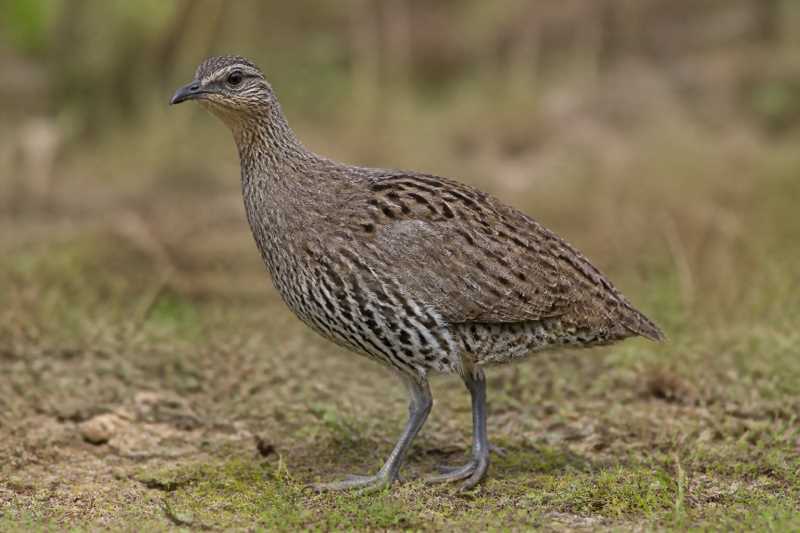
The Brazilian Tinamou is approximately 28–29 cm long. Adults have reddish-brown upperparts, a rufous throat, a greyish neck and breast, and a pale or whitish belly. The wings and lower back show darker barring or mottling, while the legs are brown. This subdued colour pattern provides effective camouflage in leaf litter and dense understorey. (peruaves.org)
Females are similar to males but are generally brighter or more reddish, with less distinct barring in some descriptions. Reliable information on juvenile plumage and age-related variation is limited, so these characters should be treated cautiously in the field. (birdsofcolombia.org)
Range and Habitat
The Brazilian Tinamou occurs in southern Amazonian Brazil, adjacent eastern Peru and north-western Bolivia. It is generally associated with humid tropical lowland forest, especially dense terra firme forest and shaded understorey. Its recorded elevational range is low, extending to approximately 500 m above sea level. (avibase.bsc-eoc.org)
The species is non-migratory and is thought to remain within suitable forest habitat throughout the year. Although the original article referred broadly to rainforest, secondary forest and savanna, the best-supported habitat descriptions emphasise humid lowland forest rather than open savanna. (avibase.bsc-eoc.org)
Behaviour and Diet
Brazilian Tinamous are primarily terrestrial and usually occur alone or in pairs. They move quietly through leaf litter and dense vegetation, using their camouflage and secretive behaviour to avoid detection. Their low, far-carrying call is often the first indication that one is nearby. The species is generally diurnal, although detailed field studies remain limited. (peruaves.org)
The diet is omnivorous, with fruit and other plant material forming an important part of it. Seeds, buds, tender vegetation and small invertebrates may also be taken. As with other forest tinamous, feeding usually takes place on or close to the forest floor. (es.wikipedia.org)
Breeding information for this species is incomplete. Available tinamou accounts indicate that the male normally incubates the eggs and cares for the young, while the nest is a shallow depression on the ground, often concealed among dense vegetation or near the roots of a tree. Reports of clutch size and egg colour vary among sources, so precise details should not be generalised without species-specific confirmation. (academic.oup.com)
Identification Tips
Look for the following combination of features:
- A medium-sized, compact tinamou moving quietly on the forest floor.
- Reddish-brown head and upperparts.
- Rufous throat, grey neck and breast, and pale belly.
- Brown legs and dark barring or mottling on the wings and lower back.
- A strong tendency to remain hidden in dense understorey.
- A distinctive call that is often easier to hear than the bird is to see.
In parts of its range, the Brazilian Tinamou may be confused with other Crypturellus tinamous. The grey neck and breast, reddish-brown head, pale belly and preference for terra firme forest are useful clues, but vocalisations and location are often more reliable than plumage alone. Comparisons with Bartlett’s Tinamou and Variegated Tinamou should be made carefully because local ranges and habitat preferences differ. (peruaves.org)
Conservation Status
The Brazilian Tinamou is currently assessed as Least Concern on the IUCN Red List. This global category does not mean that every population is secure. The principal potential threats are the loss, fragmentation and degradation of lowland forest through agricultural expansion, logging, infrastructure development and other land-use changes. (wiki.sizzltek.com)
There is insufficient reliable information to state a precise global population size or a confirmed population trend here. Conservation priorities include protecting remaining lowland forest, maintaining habitat connectivity and improving knowledge of local abundance, vocal activity and distribution. Isolated regional populations may require particular attention because habitat loss can affect them more severely than the global assessment suggests. (datazone.birdlife.org)
Frequently Asked Questions
Where does the Brazilian Tinamou live?
It occurs mainly in southern Amazonian Brazil, eastern Peru and north-western Bolivia, where it inhabits humid lowland forest, particularly dense terra firme forest.
How large is a Brazilian Tinamou?
It is approximately 28–29 cm long. Its compact body, short rounded wings and strong legs reflect its mainly terrestrial lifestyle. (peruaves.org)
What does the Brazilian Tinamou eat?
Its diet is omnivorous and includes fruit, seeds, buds, tender plant material and small invertebrates. It usually feeds on or near the forest floor. (es.wikipedia.org)
Is the Brazilian Tinamou able to fly?
Yes. Although it spends most of its time walking through dense vegetation, it can make short, powerful flights when flushed or threatened.
Why is the Brazilian Tinamou difficult to see?
Its brown, grey and rufous plumage blends with leaf litter and shadowed understorey. It also moves quietly and tends to remain concealed, so observers often hear its call before seeing it.
Is the Brazilian Tinamou endangered?
It is currently classified as Least Concern globally by the IUCN. Nevertheless, forest clearance and fragmentation remain important local conservation concerns, particularly where populations are isolated. (wiki.sizzltek.com)
References
- BirdLife International. 2016. Crypturellus strigulosus. The IUCN Red List of Threatened Species 2016: e.T22678188A92760653. https://doi.org/10.2305/IUCN.UK.2016-3.RLTS.T22678188A92760653.en. Accessed 8 September 2026.
- Gill, F., Donsker, D. and Rasmussen, P. (eds.). 2026. IOC World Bird List, version 15.2. International Ornithologists’ Union. https://www.worldbirdnames.org/. Accessed 8 September 2026.
- Davies, S. J. J. F. 2002. Bird Families of the World: Ratites and Tinamous: Tinamidae, Rheidae, Dromaiidae, Casuariidae, Apterygidae, Struthionidae. Oxford University Press. https://doi.org/10.1093/oso/9780198549963.001.0001.
- Piacentini, V. Q., et al. 2015. Annotated checklist of the birds of Brazil by the Brazilian Ornithological Records Committee, second edition. Revista Brasileira de Ornitologia 23(2): 91–298. https://www.cbro.org.br/wp-content/uploads/2020/06/Piacentini-et-al-2015-RBO.pdf.
- Lepage, D. n.d. Crypturellus strigulosus, Brazilian Tinamou. Avibase, the World Bird Database. https://avibase.bsc-eoc.org/species.jsp?avibaseid=FE2B5A6B8855A570. Accessed 8 September 2026.
- PeruAves. n.d. Brazilian Tinamou, Crypturellus strigulosus. https://www.peruaves.org/tinamidae/brazilian-tinamou-crypturellus-strigulosus/. Accessed 8 September 2026.
Related posts