Introduction
The Blue-winged Pitta, Pitta moluccensis, is a colourful, ground-feeding passerine in the pitta family, Pittidae. It breeds mainly across mainland South-east Asia and southern China, with many individuals moving south during the non-breeding season. Although it is brightly marked, this pitta is often difficult to see because it keeps to leaf litter, dense undergrowth and shaded woodland edges.
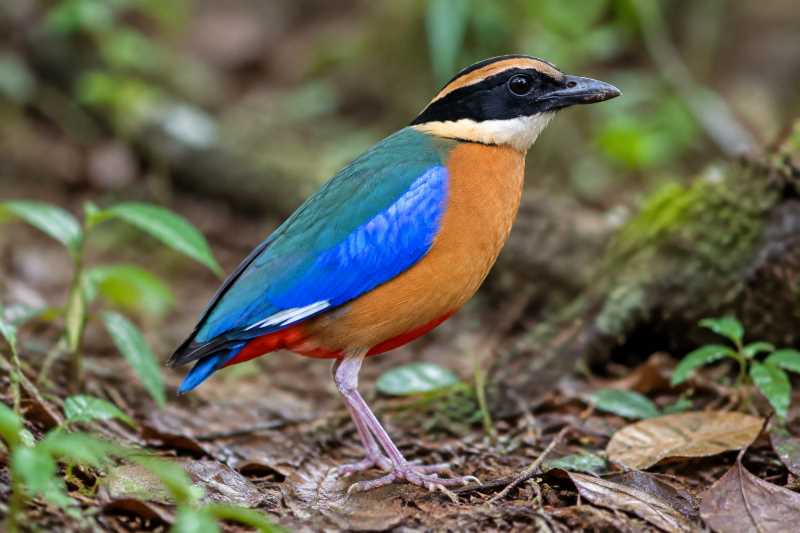
The species is recognised by its compact body, very short tail, green upperparts, vivid blue wing coverts, white throat, warm buff underparts and red undertail area. It is a regular seasonal visitor in parts of the Malay Peninsula and Singapore, where it may appear in forest fragments, quiet gardens, parks and wetland margins. The Blue-winged Pitta is currently assessed as Least Concern, although habitat loss and degradation remain relevant local concerns across its range. (birdsoftheworld.org)
Physical Description
The Blue-winged Pitta is a medium-sized, compact pitta measuring about 20 centimetres in length. It has the characteristic pitta shape: a relatively large head, strong slightly hooked bill, short tail, long legs and a rounded body. The short tail is particularly noticeable when the bird is walking or hopping across the forest floor.
Adults are strikingly coloured. The crown and nape are dark, usually blackish or deep brown, with a narrow warm buff or orange-brown stripe above the eye. The cheeks and ear-coverts are dark, while the throat is clean white. The mantle and back are green, sometimes appearing olive-green in subdued forest light. The wing coverts and much of the folded wing are bright blue to blue-violet, producing the feature that gives the species its common name.
The lower body is generally buff, ochre or warm brown, becoming richer towards the undertail. The vent and undertail coverts are red or reddish-orange. The bill is black, the eyes are dark brown and the legs are usually pale pinkish, flesh-coloured or buff. In the field, the combination of a dark head, white throat, green back, vivid blue wing panel and red vent is highly distinctive.
Male and female Blue-winged Pittas are not known to show strong, consistent sexual dimorphism. Both sexes have broadly similar plumage, and field identification normally depends on colour pattern, behaviour, habitat and call rather than on sex-specific markings. This is useful when observing a pair, because the two birds may look almost identical at a distance.
Juveniles resemble adults in their overall pattern but are duller and less sharply contrasted. Young birds may show paler or whiter areas on the chin and throat, while the blue of the wings and the red of the vent are usually less intense. Their upperparts may appear browner or more olive than those of mature birds. As with many pittas, wear, moult, lighting and wet plumage can alter the apparent brightness of the colours.
The species does not have the heavy spotting or strongly contrasting breast pattern seen in some other pittas. Its plain buff underparts, white throat and blue wing coverts are among the most useful features to check. A bird that is seen only briefly may appear mainly dark and blue, especially when it moves quickly through shadow, so observers should look for the green back and reddish rear when it pauses or turns.
Range and Habitat
The Blue-winged Pitta has a broad distribution in South-east Asia. Its breeding range extends through parts of Myanmar, Thailand, Laos, Cambodia and Vietnam, with populations also occurring in southern China and the northern Malay Peninsula. Outside the breeding season, birds move southwards into areas including Singapore, Sumatra and Borneo. The exact pattern varies between regions, and the species is resident in some parts of its range while being a migrant or seasonal visitor in others. (mybis.gov.my)
In the Malay Peninsula, the species was historically treated mainly as a non-breeding visitor in the south, but breeding has been documented farther north, including Perlis and adjacent Langkawi. Local records have also demonstrated that the species can breed in Singapore, showing that its seasonal movements are more flexible than a simple north-to-south migration model would suggest.
The Blue-winged Pitta is primarily associated with lowland habitats. It occurs in broadleaved woodland, secondary forest, forest edges, scrub, plantations with dense ground cover, parks and large gardens. It may also use freshwater wetland margins, mangrove-associated woodland and other places where shaded vegetation meets open leaf litter. In Singapore, the species is described as a winter visitor and passage migrant that may forage in quiet wooded areas, parks and gardens. (nparks.gov.sg)
Dense, closed-canopy rainforest is not necessarily its preferred habitat. The species often selects areas with a mixture of trees, shrubs, fallen leaves, low vegetation and open patches suitable for ground foraging. Regrowth, lightly disturbed woodland and well-vegetated urban reserves can therefore be important, particularly where they retain a moist leaf-litter layer and a plentiful supply of invertebrates.
Records are generally concentrated at low elevations, although the species can occur to around 800 metres in suitable parts of its range. Altitudinal limits vary geographically, and the bird is best regarded as primarily a lowland and foothill species rather than a montane specialist.
Geographic variation is not usually emphasised in modern species accounts, and the Blue-winged Pitta is commonly treated as a single species. However, regional differences in migration, breeding timing, habitat use and plumage brightness can be apparent. Records from the northern Malay Peninsula, Singapore, Sumatra and Borneo do not all represent the same seasonal status, so local field guides and regional checklists remain important when interpreting sightings.
Where to See This Species
Sungei Buloh Wetland Reserve, Singapore
Sungei Buloh Wetland Reserve is one of the most reliable publicly accessible places in Singapore to look for a Blue-winged Pitta. Singapore’s National Parks Board specifically records the species from the reserve and notes that it is associated with the freshwater pond area and visitor-centre surroundings, where it may hop and forage among leaf litter and low undergrowth. The reserve contains freshwater ponds, mangroves, woodland, trails and sheltered edges, providing several suitable habitats within a compact site. (nparks.gov.sg)
The best period is generally during the cooler and wetter-season months when migrant birds are present, although local records can occur outside a strict seasonal window. Walk quietly, check shaded paths and scan the edges of ponds and forest patches rather than concentrating only on open mudflats. A Blue-winged Pitta may remain concealed for long periods before suddenly crossing a path.
Nearby accommodation: The nearest practical bases are Kranji, Woodlands and the wider northern Singapore area, with hotels, guest houses and self-catering accommodation available on the mainland.
Central Catchment Nature Reserve, Singapore
Central Catchment Nature Reserve is another officially listed Singapore location for the Blue-winged Pitta. Its extensive forest, reservoirs, shaded trails and surrounding nature parks offer the quiet woodland and leaf-litter habitat favoured by this ground-foraging species. The reserve is much larger and more forested than many urban birding sites, so observations may require patient searching along accessible trails and edges rather than a short visit to one fixed viewpoint. (nparks.gov.sg)
The bird is likely to be easier to detect when it is moving through open patches beneath the canopy, particularly after rain when invertebrate prey may be active. Because the reserve includes sensitive habitats and regulated access areas, visitors should remain on permitted paths and follow all site rules.
Nearby accommodation: The most practical accommodation base is Singapore, particularly the central and northern districts, where hotels, serviced apartments and guest houses provide access to the reserve and other birding sites.
Pulau Ubin, Singapore
Pulau Ubin is listed by Singapore’s National Parks Board as a nature area where the Blue-winged Pitta occurs. The island retains a more rural landscape than much of mainland Singapore, including secondary woodland, scrub, abandoned village vegetation, freshwater habitats and forest edges. These varied habitats can provide suitable foraging conditions for a seasonal pitta, especially where dense cover meets clear paths or patches of leaf litter. (nparks.gov.sg)
Pulau Ubin is best approached as a site for patient island birding rather than a guaranteed single-species stop. Search quiet tracks, shaded woodland margins and areas around freshwater vegetation, while listening for movement in the undergrowth. The species may be easier to find during its seasonal movements than during periods when it is absent from the island.
Nearby accommodation: Most visitors stay on the Singapore mainland, using hotels and guest houses around Changi, Tampines or the wider eastern Singapore area. Camping may be possible only where permitted and subject to current site regulations.
Behaviour and Diet
The Blue-winged Pitta is primarily terrestrial. It usually walks, hops or makes short runs across the ground, frequently pausing with its head lowered while inspecting leaf litter. It can also use low branches, roots, logs and fallen trunks as short perches. Flight is generally direct and powerful over short distances, but the species usually prefers to remain within cover.
It is shy and can be surprisingly difficult to approach. A bird may freeze beneath vegetation, move silently through leaves or retreat into dense cover after a brief view. Even when several people are present, it may be detected only by rustling leaves, a sudden flash of blue or a soft call from thick undergrowth.
Activity is often concentrated during the cooler parts of the day, particularly early morning and late afternoon, although the species can forage at other times in shaded habitat. After rain, moist leaf litter may provide productive feeding conditions. The pitta’s long legs and strong bill are well suited to turning leaves, probing soft ground and seizing prey from the surface.
Its diet consists mainly of invertebrates. Earthworms, insects and their larvae are important foods, and the bird may also take other arthropods and hard-shelled prey such as snails. It forages mostly on the ground, but may make short movements to low vegetation or branches to obtain prey. Invertebrate availability is likely to influence its use of woodland edges, gardens and wetland margins.
The species is generally encountered alone or in pairs. It is not a flock-forming bird in the manner of many migrant passerines, although several individuals may use the same productive habitat during migration. Territoriality is most relevant during the breeding season, when pairs defend areas around a nest and may become more vocal.
Migration appears to be influenced by geography and season. Birds breeding in mainland South-east Asia and southern China may move south after the breeding season, while some populations in the Malay Peninsula and farther south may be resident or only partly migratory. Movement can include passage through Singapore, where the species is often recorded during the non-breeding season.
Breeding behaviour is not equally well documented across the entire range. The species builds a bulky, rounded or domed nest from twigs, roots, grasses, leaves and other plant material. Nests may be placed on or close to the ground, in dense vegetation, among roots or in low structural cover. In Singapore, breeding has been recorded in secondary forest using dead rattan fronds as nesting material.
The clutch contains several eggs, and both adults are believed to contribute to incubation and care of the young. As with other pittas, the nesting period is vulnerable to disturbance, predation and trampling because the nest can be close to ground level. Observers should never approach a suspected nest closely or use playback repeatedly near breeding birds.
Identification Tips
Look for the following combination of features:
- A compact, short-tailed bird about 20 centimetres long.
- A dark crown, nape and facial area.
- A narrow buff or orange-brown stripe above the eye.
- A clean white throat.
- Green or olive-green back and mantle.
- Bright blue to blue-violet wing coverts.
- Buff or ochre underparts.
- A red or reddish-orange vent and undertail area.
- A black bill and pale pinkish legs.
- Ground-hopping behaviour in shaded undergrowth.
The most useful field clue is often the flash of blue followed by a glimpse of red at the rear. Do not rely on the blue wing alone, because several other pittas have blue in the wing or shoulder area. Confirm the identification with the white throat, green back, dark head and buff lower body.
The Mangrove Pitta can be a relevant comparison in coastal and wetland habitats. It is generally associated more closely with mangroves and has a noticeably heavier, longer-looking bill. Habitat is helpful, but not conclusive, because Blue-winged Pittas may also occur near wetland vegetation and mangrove edges.
The Hooded Pitta may overlap with Blue-winged Pitta in parts of South-east Asia and can also appear in gardens, woodland edges and forest undergrowth. It has a different overall colour balance and head pattern, so observers should compare the exact arrangement of the throat, crown, wing patch, underparts and undertail rather than identifying a briefly seen blue-and-green bird by impression alone.
The safest approach is to obtain several features if possible. Note the habitat, direction of movement, body shape, call, head pattern and colour of the rear body. A photograph taken from a respectful distance can be particularly valuable because the bird’s colours may be difficult to judge in shade.
Conservation Status
The Blue-winged Pitta is currently assessed as Least Concern on the global conservation scale. This reflects its broad distribution and relatively large overall range, not an absence of local threats. Available assessments indicate that the population trend may be decreasing, although a precise global population estimate should not be assumed without a current, reliable survey basis. (birdsoftheworld.org)
The principal conservation concern is the continuing loss and degradation of suitable lowland habitat. Conversion of woodland, wetland margins and secondary vegetation can remove the leaf litter, cover and invertebrate-rich ground required by the species. Fragmentation may be especially important in areas where birds depend on small forest patches during migration or where breeding pairs use isolated woodland remnants.
Ground-nesting or low-nesting birds are also exposed to disturbance, domestic animals, predators and accidental trampling. In urban reserves, excessive pruning, removal of leaf litter and intensive management of undergrowth may reduce the value of otherwise suitable habitat. Pesticide use can further affect the invertebrate prey on which pittas depend, although the importance of this factor varies between localities.
Conservation measures should focus on retaining connected lowland forest, scrub and wetland-edge vegetation; protecting migrant stopover sites; maintaining natural leaf litter and ground cover; and limiting disturbance near active nests. Publicly accessible reserves such as those in Singapore are valuable because they protect habitat while also allowing seasonal records to be monitored. Responsible birdwatching, including avoiding playback and keeping away from nests, is an important part of local species protection.
Frequently Asked Questions
Where does the Blue-winged Pitta live?
The Blue-winged Pitta occurs across mainland South-east Asia and southern China, with seasonal movements into the Malay Peninsula, Singapore, Sumatra and Borneo. It uses lowland forest, secondary woodland, scrub, parks, gardens and wetland margins with dense undergrowth.
Is the Blue-winged Pitta a migratory bird?
It is migratory or seasonally mobile in parts of its range, but not all populations follow the same pattern. Many birds move south after breeding, while some populations in the Malay Peninsula and nearby areas may remain year-round or breed locally.
What does the Blue-winged Pitta eat?
Its diet consists mainly of ground-dwelling invertebrates, including earthworms, insects, larvae and other arthropods. It may also take snails and other hard-shelled prey. Most food is obtained by walking and probing through leaf litter.
How can you identify a Blue-winged Pitta?
Look for a short-tailed, ground-foraging bird with a dark head, white throat, green back, brilliant blue wing coverts, buff underparts and a red vent. The species often reveals itself through a brief flash of blue as it crosses a shaded path.
Where can I see a Blue-winged Pitta in Singapore?
The National Parks Board lists Sungei Buloh Wetland Reserve, Central Catchment Nature Reserve and Pulau Ubin as places where the species occurs. Sungei Buloh is especially suitable because the reserve includes wooded areas and freshwater habitats used by the pitta for foraging.
Is the Blue-winged Pitta endangered?
No. The species is currently classified as Least Concern globally. Nevertheless, local populations may be affected by habitat loss, fragmentation, disturbance and declines in the quality of lowland forest and wetland-edge habitat.
References
- BirdLife International
- Cornell Lab of Ornithology, Birds of the World
- National Parks Board Singapore
Related posts