Introduction
The Mangrove Pitta, Pitta megarhyncha, is a specialised coastal bird of mangrove forests and associated nipa-palm habitat in the eastern Indian subcontinent and western Southeast Asia. It belongs to the pitta family, Pittidae, and is recognised as a distinct species by major modern bird taxonomies, including the IOC World Bird List. Unlike several better-known pittas that use inland forest, the Mangrove Pitta is closely associated with tidal wetlands, muddy creeks and dense mangrove understorey.
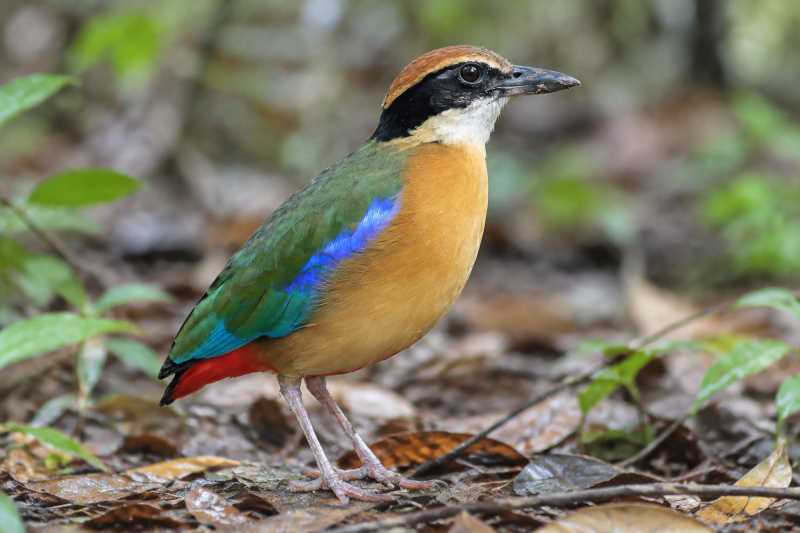
This is a colourful but elusive bird. It spends much of its time on or close to the forest floor, where it searches among leaf litter, exposed roots and soft mud for invertebrate prey. Its green upperparts, buff underparts, dark head pattern, blue wing panel and reddish vent are often seen only briefly as the bird moves through tangled vegetation. The species is generally treated as resident rather than migratory, although local movements and dispersal may occur where coastal habitats are fragmented.
The Mangrove Pitta has a restricted ecological niche, which makes the protection of remaining mangrove systems particularly important. The IUCN Red List currently classifies it as Near Threatened. Its global population has not been reliably quantified, but habitat loss and degradation are considered the principal conservation concerns. (nc.iucnredlist.org)
Physical Description
The Mangrove Pitta is a compact, long-legged, short-tailed bird measuring approximately 18–21 centimetres in length. As in other pittas, the body is relatively chunky, the wings are rounded and the legs are strong, reflecting a largely terrestrial lifestyle. The bill is one of its most useful structural features: it is conspicuously broad and heavy, especially when compared with the slimmer bill of the similar Blue-winged Pitta.
Adults have greenish upperparts, including the mantle and shoulders. The wings show a blue to blue-green panel that can appear vivid when the bird takes flight, although it may be difficult to see when the bird is standing in shade. The underparts are mainly warm buff or ochre, becoming richer towards the lower belly and vent. The undertail and vent are reddish or rufous, providing a strong contrast with the otherwise green, brown and buff plumage.
The head is dark, with a blackish facial area and a brownish or buff crown. A pale or whitish throat and chin are characteristic. The crown is generally less sharply marked than that of the Blue-winged Pitta, and the overall appearance is often somewhat duller and more uniform. The combination of a pale throat, large bill, green back, blue wing panel and reddish vent is useful when the bird is viewed at close range.
There is no well-established pattern of obvious sexual dimorphism. Male and female Mangrove Pittas are generally alike in plumage, and sex is not normally determined reliably in the field from appearance alone. Available descriptions indicate that juveniles resemble adults in their general pattern but are duller, less saturated and less sharply contrasted. Young birds may also show less vivid blue in the wings and less strongly developed reddish colour in the vent region.
The bill is usually dark or blackish, while the legs are pinkish, flesh-coloured or greyish depending on age, lighting and individual variation. As with many forest-floor birds, posture can alter the apparent proportions. A bird standing alert may look short-tailed and upright, whereas one moving through roots and leaf litter can appear longer-bodied.
Although the Mangrove Pitta is brightly coloured by woodland standards, it is not always easy to see. Its green, brown and buff plumage blends surprisingly well with mangrove shade, fallen leaves, pneumatophores and tangled roots. The blue wing patch is most obvious during a short flight, when the bird may cross a creek or disappear into dense vegetation.
Range and Habitat
The Mangrove Pitta has a discontinuous distribution along tropical and subtropical coasts of the eastern Indian subcontinent and western Southeast Asia. Its range includes parts of Bangladesh and eastern India, Myanmar, Thailand, Peninsular Malaysia, Singapore and Sumatra. Records are concentrated in suitable coastal wetlands rather than being evenly distributed across these countries.
In Bangladesh and India, the species is strongly associated with the Sundarbans and other major mangrove systems. In India, it has also been documented in Bhitarkanika and related coastal wetlands in Odisha. In mainland Southeast Asia, it occurs mainly in coastal areas, particularly around the Andaman Sea and the Malay Peninsula. In Malaysia it is chiefly associated with remaining mangrove blocks along the west coast, although records from freshwater swamp forest and other wetland habitats show that it is not restricted to saltwater mangroves in every locality. (lkcnhm.nus.edu.sg)
The preferred habitat is mature or reasonably intact mangrove forest, especially where dense understorey vegetation occurs beside tidal channels, creeks, mudflats and shaded pools. Nipa-palm stands are also used in parts of the range. The ground beneath these habitats can provide soft mud, leaf litter, fallen branches, exposed roots and small pools, all of which support the invertebrates on which the bird feeds.
Mangrove Pittas are generally found at low elevations, usually close to sea level. They may use estuarine forest, coastal marshes, river mouths and wetland edges, but records away from mangrove vegetation should be interpreted carefully. Some observations involve freshwater swamp forest or mixed coastal wetland, particularly where such habitats are adjacent to mangrove systems.
The species is not normally regarded as a long-distance migrant. It is best treated as a resident or local disperser, with movements likely influenced by tidal wetlands, breeding territories, seasonal water conditions and the availability of suitable habitat. This contrasts with several other pittas in the region, including the Blue-winged Pitta, which is migratory in parts of its range.
No widely recognised subspecies are currently accepted in standard global taxonomic treatments. Nevertheless, the species occupies a fragmented coastal range, and populations separated by large areas of unsuitable habitat may experience limited interchange. Recent genetic and ecological research has highlighted the strong ecological distinction between the Mangrove Pitta and the closely related Blue-winged Pitta, with mangrove specialisation playing an important role in their divergence. (ww.worldbirdnames.org)
Important habitat characteristics
The most useful habitat features for locating a Mangrove Pitta are:
- Dense mangrove understorey with shaded ground cover.
- Tidal creeks, muddy banks and small channels.
- Nipa palms or mixed mangrove vegetation.
- Leaf litter and exposed roots where invertebrates can be found.
- Relatively low levels of disturbance, particularly during the breeding season.
Mangrove conversion for aquaculture, coastal development, roads, ports and other infrastructure can remove or isolate habitat. Even where the trees remain, hydrological changes, erosion, pollution, excessive cutting and heavy human use can reduce the quality of the forest floor on which the species depends.
Where to See This Species
The Mangrove Pitta is difficult to find, and presence at a site does not guarantee a sighting. Early morning visits, quiet observation beside mangrove edges and attention to calls or brief movements on the ground are generally more productive than walking quickly through open areas. Access may depend on tides, permits, boat arrangements or local conservation rules.
Pulau Ubin, Singapore
Pulau Ubin is one of the most reliable publicly accessible places in Singapore to look for the Mangrove Pitta. Singapore’s National Parks Board records known breeding populations on Pulau Ubin and identifies the island’s mangroves as important habitat for the species. The island includes extensive mangrove areas, coastal forest and the Chek Jawa Wetlands, where boardwalks and viewing structures provide access to suitable coastal habitat without requiring visitors to enter sensitive mudflats. (nparks.gov.sg)
The bird is still uncommon and secretive, so it should be regarded as a specialist target rather than a guaranteed sighting. Quietly checking shaded mangrove edges and listening for the species is more appropriate than expecting it to appear in exposed areas. Local conservation guidance should be followed, especially around breeding habitat and intertidal zones.
Nearby accommodation: Singapore city provides the widest choice of hotels, guest houses, hostels and serviced accommodation, while camping facilities are available on Pulau Ubin subject to current regulations and permissions.
Bhitarkanika National Park, Odisha, India
Bhitarkanika National Park protects a large tidal mangrove and estuarine system in Odisha’s Brahmani–Baitarani delta. The area contains dense mangrove forest, creeks and wetlands that match the Mangrove Pitta’s known habitat requirements. The species has been documented as a breeding resident in Bhitarkanika, making the park a credible destination for observers seeking it in eastern India rather than merely a site selected because it lies within the broad national range. (indianbirds.in)
Access is typically organised through permitted entry points and boat-based routes. The bird may be encountered along quiet forest margins, creek edges and shaded wetland channels, but conditions vary with tides, weather and seasonal access restrictions. Visitors should check current forest-department arrangements before travelling, as some areas may close during sensitive wildlife periods.
Nearby accommodation: Rajnagar and Gupti are practical gateway areas, with forest rest houses, eco-tourism accommodation, guest houses and small hotels available in the wider Kendrapara region.
Sundarbans, Bangladesh
The Bangladesh Sundarbans is another well-documented location for Mangrove Pitta. Bangladesh’s national bird red-list material records the species from the Sundarbans, and the government’s birdwatching programme lists it among the highlighted birds of the mangrove forest. The extensive network of tidal channels, mudbanks and dense mangrove vegetation provides the right conditions, although sightings remain unpredictable because much of the habitat is difficult to access and the bird is highly secretive. (sundarbantourism.bforest.gov.bd)
Boat-based wildlife trips are the usual way to explore the Bangladeshi Sundarbans. Quiet creek margins and shaded forest edges are more promising than open river channels. Visitors should use authorised operators, respect protected-area rules and avoid approaching wildlife too closely, particularly in narrow channels where disturbance can be concentrated.
Nearby accommodation: The main gateway is Mongla, with hotels and guest houses, while organised Sundarbans trips commonly use eco-lodges, camps or vessel-based accommodation within approved tourism areas.
Behaviour and Diet
The Mangrove Pitta is primarily a ground-foraging bird. It moves through leaf litter, mud, roots and low vegetation by walking or hopping, often pausing before making a short dash to seize prey. Its strong legs are well suited to this habitat, while the large bill is useful for handling hard-bodied or slippery food.
The diet includes molluscs, crustaceans and a range of terrestrial and aquatic invertebrates. Crabs and other small crustaceans are especially plausible prey in tidal habitats, while insects, beetles, ants, termites and larvae may be taken among leaf litter and decaying vegetation. Earthworms and other soft-bodied invertebrates may also be consumed where the substrate permits foraging. The exact composition of the diet is likely to vary according to locality, tidal conditions and seasonal prey availability.
A Mangrove Pitta may forage on exposed mud or among mangrove roots when the tide is low. During high water, it may retreat into denser vegetation or rest above the wet ground. It is capable of short, direct flights between patches of cover, but it generally avoids prolonged flight in open country. The bird’s tendency to disappear into tangled vegetation is a major reason it is often heard or glimpsed rather than seen well.
The species is generally solitary or encountered as a pair. It is not known for large flocks, although individuals may occur close together where suitable habitat is concentrated. During the breeding season, pairs may become more vocal and territorial. The call has been described in transcriptions such as a repeated, slurred “wieuw-wieuw”, but call quality can vary with distance, habitat acoustics and individual delivery.
Breeding information remains limited compared with that available for some better-studied pittas. Documented observations in Peninsular Malaysia indicate that the species builds a domed or enclosed nest using materials such as roots and other plant matter. The nest is associated with low vegetation or the ground layer, where it can be difficult to detect among roots, leaf litter and semi-decaying material. Both adults may participate in nest-building, incubation and the feeding of young, but detailed information on clutch size, incubation length and fledging success is sparse. (birdinginmalaysia.com)
Breeding records from the Indian subcontinent and Southeast Asia suggest that nesting may occur during the wetter part of the year or during periods when food is abundant, but timing varies geographically. It is safer to describe the breeding season as regionally variable than to apply one fixed period across the entire range.
Identification Tips
Look for the following combination of features:
- A compact, short-tailed bird about 18–21 cm long.
- Greenish mantle and shoulders.
- A blue or blue-green wing panel, most obvious in flight.
- Buff or ochre underparts.
- A reddish or rufous vent.
- A pale or whitish chin and throat.
- A dark head with a brownish or buff crown.
- A notably large, heavy bill.
- Behaviour concentrated on the ground in mangrove understorey.
The most important comparison is with the Blue-winged Pitta. Both species can show green upperparts, blue wing markings, buff underparts and a reddish vent, and they may occur in the same broad region. The Mangrove Pitta is usually more closely tied to mangroves and has a heavier, broader bill. It tends to look duller and more uniformly brown on the crown, with a less strongly defined central crown stripe and a whitish chin. The Blue-winged Pitta generally has a slimmer bill and often shows cleaner, more contrasting head markings.
Habitat is an important supporting clue, but it should not be used alone. A pitta seen in mangrove forest is a strong candidate for Mangrove Pitta, while a pitta in inland forest, gardens or woodland is more likely to be another species. However, habitat boundaries can be imperfect, and careful attention to bill shape, throat colour, crown pattern and wing colour remains necessary.
The bird’s movement can also help. A Mangrove Pitta often keeps low, walks or hops through shade and vanishes quickly into roots or low vegetation. A sudden flash of blue and green followed by a low, direct flight across a creek may be the only view available. Recordings and photographs should be checked carefully because lighting can make the crown, wing panel and underparts appear more saturated than they are.
Conservation Status
The Mangrove Pitta is currently assessed as Near Threatened on the IUCN Red List. Its global population has not been quantified, and the assessment does not provide a dependable total number of mature individuals. The species is considered to be affected primarily by the continuing loss and degradation of mangrove habitat. (nc.iucnredlist.org)
The main threats include conversion of mangroves for aquaculture, coastal development, transport infrastructure, agriculture and settlements. Cutting of mangrove trees, alteration of tidal flows, erosion, pollution and disturbance can further reduce habitat quality even where a forest remains nominally intact. Fragmentation is particularly important for a habitat specialist whose populations may be separated by unsuitable coastlines or heavily modified estuaries.
Climate-related pressures may add to these existing threats. Sea-level rise, stronger storms, changing sediment movement, coastal erosion and increased salinity can alter mangrove structure and reduce the availability of suitable forest-floor habitat. The effects will differ among regions and will depend partly on whether mangroves can migrate inland or remain connected to functioning estuarine systems.
Conservation measures should focus on protecting large, connected mangrove landscapes; maintaining natural tidal exchange; preventing further conversion; controlling pollution; and ensuring that remaining patches are managed for ecological quality rather than tree cover alone. Protection of low understorey, creek margins and undisturbed forest floor is relevant because the species forages and probably nests close to the ground.
Protected areas such as Pulau Ubin, Bhitarkanika National Park and the Sundarbans provide important safeguards, but formal protection does not remove all threats. Effective management also requires enforcement, careful tourism planning, mangrove restoration based on natural hydrology and monitoring of population trends. In Singapore, the Mangrove Pitta is locally much rarer than its global category suggests, and National Parks Board records it as a locally threatened resident associated with the remaining mangroves of Pulau Ubin and Pulau Tekong. (nparks.gov.sg)
Frequently Asked Questions
Where does the Mangrove Pitta live?
The Mangrove Pitta lives mainly in tropical and subtropical mangrove forests, nipa-palm stands, estuaries and associated coastal wetlands. Its range extends from Bangladesh and eastern India through Myanmar and Thailand to Peninsular Malaysia, Singapore and Sumatra.
Is the Mangrove Pitta migratory?
It is generally regarded as a resident species rather than a long-distance migrant. Local movements and dispersal may occur, particularly where coastal wetlands are fragmented or conditions change, but it does not follow the regular long-distance migration pattern associated with some other Asian pittas.
How can the Mangrove Pitta be distinguished from the Blue-winged Pitta?
The Mangrove Pitta usually has a heavier bill, a less sharply marked brownish crown, a whitish chin and a stronger association with mangrove habitat. The Blue-winged Pitta generally has a slimmer bill and more contrasting head markings, although lighting and viewing conditions can make identification difficult.
What does the Mangrove Pitta eat?
Its diet includes molluscs, small crustaceans, crabs and terrestrial invertebrates such as beetles, ants, termites and larvae. It usually searches for food on the mangrove floor, among leaf litter, mud, roots and low vegetation.
Is the Mangrove Pitta endangered?
The species is currently classified as Near Threatened globally by the IUCN. It is not globally listed as Endangered, but its specialised mangrove habitat is being lost and degraded in many parts of its range. Some local populations, including those in Singapore, have a considerably higher level of local concern.
Where are good places to look for a Mangrove Pitta?
Documented publicly accessible locations include Pulau Ubin in Singapore, Bhitarkanika National Park in Odisha, India, and the Sundarbans of Bangladesh. Sightings are never guaranteed, so quiet observation in dense mangrove understorey and the use of authorised access routes are important.
References
- IUCN Red List of Threatened Species
- National Parks Board, Singapore
- BirdingASIA
Related posts