The Greater Flameback: A Vibrant Jewel of Asian Woodlands
The Greater Flameback (Chrysocolaptes guttacristatus) is a strikingly beautiful bird that graces the woodlands of South and Southeast Asia with its vibrant colors and distinctive calls. This woodpecker species is not only an essential component of its ecosystem but also a delight to birdwatchers and nature enthusiasts worldwide. In this article, we delve into the fascinating world of the Greater Flameback, exploring its habitat, behavior, diet, and the conservation efforts in place to protect this remarkable avian species.
Habitat and Distribution
The Greater Flameback is widely distributed across a range of countries in South and Southeast Asia, including India, Nepal, Bangladesh, Myanmar, Thailand, Laos, Cambodia, Vietnam, and Malaysia. Its habitat primarily consists of tropical and subtropical forests, mangroves, and even plantations, where it can find ample food and suitable nesting sites.
These woodpeckers are particularly fond of lowland forests but can also be spotted in hilly regions up to an elevation of approximately 1,500 meters. Their adaptability to various forest types, including secondary growth forests, makes them resilient to some degree of habitat disturbance, a trait that is increasingly important in the face of ongoing deforestation in parts of their range.
Physical Characteristics
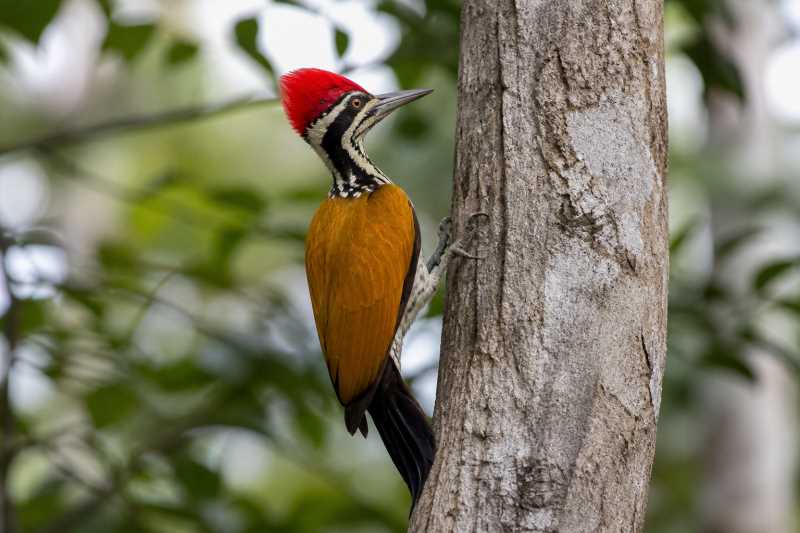
The Greater Flameback is renowned for its vibrant plumage, which serves both as a means of communication and a defense mechanism against predators. Measuring about 33 to 38 centimeters in length, this woodpecker exhibits a striking combination of colors. The males and females are similar in appearance, with both sexes having a glossy black crown, a red nape, and a striking golden-yellow back that gives the bird its name.
The underparts are a contrasting white, speckled with black, adding to the bird’s visual appeal. One of the most distinctive features of the Greater Flameback is its elongated bill, specially adapted for chiseling into wood in search of insects, its primary food source.
Behavior and Diet
Greater Flamebacks are diurnal birds, most active during the early morning and late afternoon when they forage for food. Their diet consists mainly of insects and larvae, which they extract from tree bark using their powerful beaks. They are also known to consume fruits and berries, making them omnivorous to some extent.
These woodpeckers are often seen in pairs or small family groups. They communicate through a series of loud calls and drumming sounds produced by pecking on resonant wood, a behavior that serves both to establish territory and attract mates. The drumming is not random; it is a highly structured activity, with each bird having its own rhythm and tempo.
Reproduction and Lifespan
The breeding season for the Greater Flameback varies across its range but generally falls between February and June. During this period, the male engages in elaborate displays to attract a mate, including drumming, calling, and showcasing its vibrant plumage.
Once a pair is formed, they work together to excavate a nest cavity in a tree trunk, a process that can take several weeks. The female typically lays between two to four eggs, which both parents incubate. After about two weeks, the eggs hatch, and the chicks are fed by both parents until they are ready to fledge, usually within a month.
The lifespan of a Greater Flameback in the wild is not well-documented, but it is estimated to be around 5 to 10 years, depending on factors such as habitat quality and predation pressures.
Conservation Status and Threats
The Greater Flameback is currently listed as a species of Least Concern by the International Union for Conservation of Nature (IUCN), due to its widespread distribution and relatively stable population numbers. However, this status does not mean the species is free from threats.
Habitat loss due to deforestation and land-use changes poses a significant risk to the Greater Flameback, as it does to many forest-dwelling species in Asia. Additionally, the bird is sometimes captured for the pet trade, although this is not considered a major threat at this time.
Conservation efforts are focused on habitat preservation and restoration, as well as raising awareness about the ecological importance of woodpeckers. Protected areas and national parks play a crucial role in safeguarding the habitats of the Greater Flameback and ensuring its continued survival.
Conclusion
The Greater Flameback is a vivid reminder of the natural beauty and biodiversity found in Asian forests. Its striking appearance and behaviors make it a favorite among birdwatchers, while its ecological role as an insect predator and tree cavity creator underscores its importance in maintaining forest health. By continuing to support conservation initiatives and sustainable forestry practices, we can help ensure that this vibrant woodpecker continues to thrive for generations to come.
Related posts