Introduction
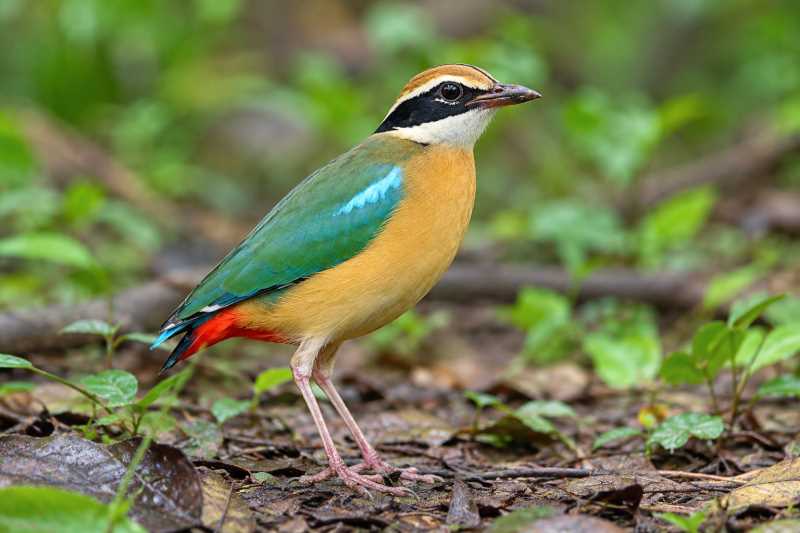
The Indian Pitta, Pitta brachyura, is a compact, brightly coloured ground-dwelling passerine of the Indian subcontinent and Sri Lanka. It is one of the most recognisable birds of South Asian woodland, combining a green back, blue wing panels, buff underparts, a black eye-stripe and vivid red undertail coverts. In several Indian languages it is known by names referring to its many colours, including “navrang”, meaning nine-coloured.
Despite its striking appearance, the Indian Pitta can be difficult to see. It spends much of its time in leaf litter and dense undergrowth, moving with quick hops and short runs rather than remaining in exposed branches. Its loud, repeated whistle is often the first indication of its presence. Populations differ in their movements: some are resident or locally dispersive, while others migrate seasonally between northern breeding areas and wintering grounds in peninsular India and Sri Lanka. The species is currently assessed globally as Least Concern, although the IUCN reports a decreasing population trend and habitat quality remains important for its long-term security. (doi.org)
Physical Description
The Indian Pitta is a short-tailed, stoutly built bird measuring about 19 centimetres in length. It has the characteristic pitta shape: a large head, broad bill, rounded wings, strong legs and a short, square-ended or slightly blunt tail. This structure is well suited to life on the forest floor, where the bird walks, hops and turns over leaves while searching for prey.
Adults are vividly patterned. The crown is buff or warm brown with a dark central stripe, while a broad black stripe runs through the eye. A pale buff or whitish supercilium extends above the eye, and the throat is pale, often appearing white or creamy in good light. The upperparts are mainly green, with brighter turquoise or blue markings on the wing coverts. The flight feathers are dark, and the tail is short with blue or turquoise tones that may be most visible when the bird moves or flicks its wings.
The underparts are buff to yellowish, becoming more strongly coloured towards the lower belly and undertail. The undertail coverts are bright red or crimson, a particularly useful feature when the bird is seen from behind or when it raises its tail. The bill is dark, the eyes are dark and the legs are pinkish, brownish or flesh-coloured depending on age, lighting and individual variation.
There is little obvious sexual dimorphism. Males and females are generally alike in colour and pattern, although some older literature has suggested that the width or prominence of the crown stripe may vary between the sexes. This is not a dependable field character, and sex should not normally be assigned from appearance alone. (indianbirds.in)
Juveniles and recently fledged birds are usually duller than adults. Their plumage tends to show less saturated blue and green, and the head and underparts may appear more subdued. The red undertail can also be less conspicuous. As with many colourful birds, wear, moult, shade and viewing distance can affect how bright an individual appears, so structure and pattern are more reliable than colour intensity alone.
The Indian Pitta is often called a nine-coloured bird, but the exact number of colours is not biologically significant. The name reflects the combination of green, blue, black, white, buff, yellow, brown and red visible across the plumage. The bold eye-stripe, short tail and red undertail together provide a more useful identification combination than any single colour.
Range and Habitat
The Indian Pitta is distributed across much of the Indian subcontinent. Its range includes India, Pakistan, Nepal, Bangladesh and Sri Lanka, with the strongest and best-documented seasonal pattern occurring between northern and southern parts of the range. It breeds in parts of the Himalayan foothills, central India, western India and the Western Ghats, while many individuals move southwards after the breeding season. The species is also recorded as a summer breeding migrant in Bangladesh and parts of Nepal. (indiabiodiversity.org)
Breeding populations occur from the Margalla Hills and adjoining parts of northern Pakistan eastwards through the Himalayan foothills, at least as far as Nepal and possibly southern Sikkim. In India, the breeding range extends through suitable wooded areas of the north, central highlands, Gujarat, Maharashtra and parts of the Western Ghats. The precise limits of breeding distribution are not uniform and can vary locally with rainfall, forest cover and the availability of dense ground vegetation.
During the non-breeding season, Indian Pittas may occur across much of peninsular India and in Sri Lanka. Northern birds generally move south after the monsoon breeding period, although the species’ movements are not identical in every region. Some populations may remain in suitable habitat year-round, while others undertake substantial seasonal movements. Exhausted migrants have occasionally been found in gardens, buildings and other unexpected places, particularly during passage.
The species is associated primarily with broad-leaved woodland, deciduous and semi-evergreen forest, forest edges, scrub and shaded gardens. It favours places with a relatively open forest floor covered by leaf litter but with enough dense undergrowth to provide concealment. Bamboo, thorny bushes, young woodland, ravines and stream-side vegetation can all provide suitable conditions. It is less dependent on closed-canopy forest than some specialist pittas and may use fragmented woodland if cover and feeding opportunities remain available.
Moisture is often important. The onset of the monsoon increases the availability of earthworms, insects and other invertebrates, while damp leaf litter provides productive feeding habitat. Nevertheless, Indian Pittas are not restricted to wet evergreen forest. They also occur in dry deciduous landscapes, including areas where seasonal streams, woodland patches and dense scrub provide local refuges.
The species is mainly a lowland and foothill bird. It is commonly recorded below about 1,200 metres in its Himalayan breeding range, while wintering birds in southern India may occur at elevations approaching 1,700 metres. Higher records are possible in suitable local conditions, but the bird is most often encountered in warm, wooded lowlands, foothills and lower hill country. (researchgate.net)
Where to See This Species
Gir National Park and Wildlife Sanctuary, Gujarat, India
Gir is a well-documented location for Indian Pitta in western India. The protected area contains extensive dry deciduous forest, woodland edges, seasonal streams and dense undergrowth, all of which can provide feeding habitat. The official Gir protected-area information lists Indian Pitta among the typical birds of the forest. Look for it on quiet tracks, near leaf-littered clearings and around thicker vegetation, particularly during the monsoon and in the periods when seasonal movements bring birds into the region. (girlion.gujarat.gov.in)
Nearby accommodation: Sasan Gir is the main gateway settlement, with forest lodges, guest houses, hotels and other visitor accommodation. Park access is regulated, so visitors should check current safari, guide and seasonal arrangements before travelling.
Tadoba-Andhari Tiger Reserve, Maharashtra, India
Indian Pitta is documented from Tadoba-Andhari Tiger Reserve, where dry deciduous woodland, bamboo, stream margins and leaf-littered forest provide suitable habitat. The reserve’s official biodiversity information specifically highlights the species, making it a credible place to include on a wider birding itinerary. Early morning drives and walks in quieter forest sections offer the best chance of hearing its repeated whistle or seeing it cross a track. (mytadoba.mahaforest.gov.in)
Nearby accommodation: Moharli and the other reserve gateway areas provide forest lodges, guest houses, camps and small hotels. Chandrapur is the principal larger town for additional hotels and travel services.
Betla National Park, Jharkhand, India
Betla National Park supports a varied mosaic of tropical forest, grassland, wetland and stream-side habitat, and the Government of India’s tourism information identifies Indian Pitta among its recorded birdlife. The species is most likely to be encountered in dense, leafy forest and undergrowth rather than in open grassland. November to March is a practical general wildlife-viewing period for the park, although local bird activity and seasonal movement can vary. (incredibleindia.gov.in)
Nearby accommodation: Betla village is the closest practical base, with forest accommodation, guest houses and small lodges. Daltonganj, also known as Medininagar, offers a broader choice of hotels and transport connections.
Behaviour and Diet
Indian Pittas are primarily terrestrial. They spend much of the day on the ground, moving through leaf litter with short hops, pauses and quick runs. A feeding bird may stand still for several seconds before suddenly flicking aside a leaf or probing the soil with its bill. It sometimes perches on a low branch, stump, bamboo stem or exposed root, but these perches are generally used for calling, resting or scanning rather than prolonged feeding.
The species is often solitary or seen in pairs. Outside the breeding season, several birds may occur in the same woodland patch, especially where food is abundant, but this does not necessarily represent a tightly coordinated flock. Individuals may defend a breeding territory with repeated calls, while migrants can appear concentrated in suitable stopover or wintering habitat.
The call is a loud, clear, repeated whistle commonly rendered in field guides as a two- or four-syllable phrase. It may sound like a ringing “wheeet-tew” or “peeu-pee-yo”, although the exact impression depends on distance, habitat and the caller’s rhythm. The bird often calls from a concealed position and may throw back its head while vocalising. Calling is particularly noticeable during the breeding season and after rain.
The diet is dominated by ground-living invertebrates. Recorded prey includes beetles, ants, termites, crickets, caterpillars, grubs, earthworms, millipedes and centipedes. Small frogs and other small vertebrates may also be taken. The relative importance of each item changes with season and local availability. In a detailed breeding observation from Gujarat, parents carried a range of invertebrate prey to nestlings, including earthworms, crickets, millipedes and centipedes, as well as small frogs and other food items. (indianbirds.in)
Indian Pittas generally forage alone or as a pair rather than using cooperative feeding groups. They may pause beneath shrubs or bamboo clumps, where fallen leaves retain moisture and invertebrates are plentiful. Their strong legs and broad bill are useful for scratching, turning and probing through the litter layer.
Breeding is linked closely with the monsoon or the local wet season. The breeding period varies geographically but is broadly reported from May to August. The nest is a large, roughly globular structure with a side entrance. It may be built in the fork of a small tree, in a bush, bamboo clump or other concealed position, usually only a few metres above the ground. Nests are made from dry leaves, grasses, roots, twigs and other plant material, with some observations recording unusual material incorporated into the structure.
Both parents participate in incubation and care of the young, although the exact division of labour may vary. Clutch size is commonly reported as four to six eggs, but local observations have recorded variation. Nestlings are fed frequently during daylight, with parents carrying individual prey items from nearby foraging areas. Chicks may fledge after roughly two weeks, although the timing can vary and published observations remain limited compared with those of better-studied passerines. (indianbirds.in)
Identification Tips
When searching for Indian Pitta, listen before looking. Its repeated, far-carrying whistle is often easier to detect than the bird itself. Once a call is heard, scan the ground, low shrubs, bamboo edges, fallen logs and shaded paths rather than concentrating only on the canopy.
Key field marks include:
- A compact, stout body with a very short tail.
- A broad black eye-stripe and pale supercilium.
- A buff or brown crown with a dark central stripe.
- Green upperparts and conspicuous blue or turquoise wing coverts.
- Buff to yellowish underparts and bright red undertail coverts.
- Strong pale or pinkish legs and a broad dark bill.
- A habit of hopping, running and pausing on the forest floor.
The red undertail is especially useful when the bird is moving away. The blue wing patch may be hidden when the wings are folded, but it becomes obvious as the bird turns, flies a short distance or flicks its wings. The combination of a short tail, black eye-stripe, blue wing panel and red undertail is usually sufficient for a confident identification in the Indian subcontinent.
The Blue-winged Pitta can cause confusion in areas where its range overlaps with Indian Pitta, particularly during migration. It generally has a stronger blue-and-black wing pattern and different head and underpart proportions. The Mangrove Pitta may also occur in parts of Bangladesh and adjacent coastal habitats, but it is associated more strongly with mangroves and muddy tidal environments. Habitat, head pattern, wing markings and the extent of blue should be considered together rather than relying on one colour patch alone. (orientalbirdclub.org)
The Long-tailed Broadbill is sometimes mentioned as a possible visual comparison because it is green and blue, but it is not a close look-alike in the field. Its much longer graduated tail and very different bill make separation straightforward. The Indian Pitta’s short tail and ground-feeding behaviour are more diagnostic.
Conservation Status
The Indian Pitta is listed as Least Concern on the IUCN Red List. The 2024 global assessment states that the species has a large range and does not currently meet the thresholds for a threatened category. Its global population has not been quantified, but the assessment reports a decreasing population trend. (doi.org)
The principal conservation concern is the gradual loss and degradation of woodland and scrub habitat. Clearing for agriculture, urban development, roads, plantations and other land uses can remove breeding and wintering habitat or reduce the dense undergrowth needed for feeding. Fragmentation may be particularly important where small forest patches are isolated from larger areas of suitable habitat.
Changes in rainfall, prolonged drought, excessive removal of leaf litter and understorey, uncontrolled burning and the use of pesticides may also reduce food availability locally. These pressures should not be assumed to have the same effect everywhere, and the available evidence is stronger for habitat change than for any single species-specific threat. Some regional monitoring programmes in India indicate declines in occurrence or abundance in particular landscapes, but such results should not be treated as a direct estimate of the global population trend. (stateofindiasbirds.in)
Conservation measures that benefit Indian Pitta include protecting deciduous and semi-evergreen forest, retaining scrub and bamboo undergrowth, maintaining shaded stream corridors, reducing unnecessary burning and preserving habitat connections between woodland patches. Protected areas are important, but conservation in agricultural landscapes, village groves, gardens and other semi-natural habitats can also help, particularly during migration and winter.
Responsible birdwatching is straightforward. Visitors should remain on permitted routes, avoid flushing birds repeatedly, keep away from nests and do not use playback excessively during the breeding season. Because Indian Pittas often feed close to the ground, trampling leaf litter and dense undergrowth can disturb feeding birds and concealment sites.
Frequently Asked Questions
What is the scientific name of the Indian Pitta?
The accepted scientific name is Pitta brachyura (Linnaeus, 1766). It belongs to the pitta family, Pittidae, within the order Passeriformes. The IOC World Bird List recognises Indian Pitta as the English common name. (ww.worldbirdnames.org)
Is the Indian Pitta migratory?
The species is partly migratory. Many birds breed in the Himalayan foothills, central India and parts of western and southern India, then move south after the breeding season. Wintering birds occur widely in peninsular India and Sri Lanka, while some populations may remain resident or make shorter local movements.
Where does the Indian Pitta live?
It favours deciduous and semi-evergreen woodland, forest edges, scrub, bamboo, ravines, stream-side vegetation and shaded gardens with plenty of leaf litter and dense undergrowth. It is mainly a lowland and foothill species, although it can occur at higher elevations in suitable habitat.
What does the Indian Pitta eat?
Its diet consists mainly of insects and other ground-living invertebrates, including beetles, ants, termites, crickets, caterpillars, grubs, earthworms, millipedes and centipedes. Small frogs and other small prey may also be taken, especially when feeding young.
How can I identify an Indian Pitta?
Look for a compact bird with a very short tail, black eye-stripe, pale eyebrow, striped crown, green back, blue wing patches, buff underparts and bright red undertail coverts. It is usually found hopping or running through leaf litter and is often detected first by its loud repeated whistle.
Is the Indian Pitta threatened?
The Indian Pitta is currently classified as Least Concern globally. However, the IUCN reports a decreasing population trend, and habitat loss, fragmentation and degradation remain important local concerns. Protecting woodland undergrowth and maintaining suitable habitat during both breeding and migration are key conservation priorities.
References
- IUCN Red List of Threatened Species
- IOC World Bird List
- Indian Birds
Related posts