Introduction
The White-throated Mountaingem (Lampornis castaneoventris) is a resident hummingbird of the Talamanca highlands of southern Costa Rica and western Panama. It inhabits humid montane forest, oak woodland, forest edges and nearby gardens. The species is locally known for its striking male plumage, white throat and energetic defence of nectar-rich feeding areas.
Physical Description
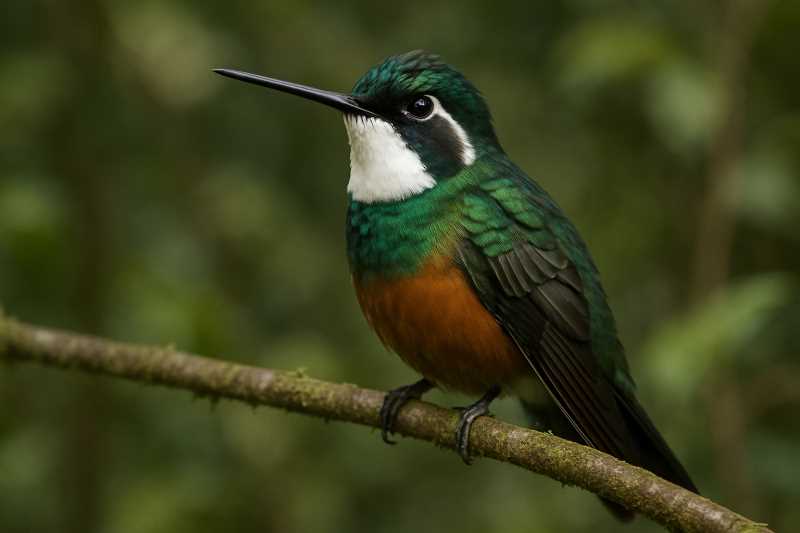
This medium-sized hummingbird measures about 12 centimetres in length. It has a straight, medium-length black bill, a white line behind the eye and predominantly green upperparts. The exact appearance varies geographically, and the population in southern Costa Rica has sometimes been treated as the separate Grey-tailed Mountaingem, Lampornis cinereicauda.
Adult males are largely bronzy green above, with a brighter green crown and a contrasting white throat. The breast and lower underparts are darker, while the tail may appear dark bluish or greyish depending on the population. Adult females are less brightly coloured, with green upperparts, paler or rufous-buff underparts and a generally duller bronze or greyish tail. The white postocular stripe remains a useful feature in both sexes.
Juveniles are duller than adults. Young males develop the adult throat and crown colours gradually, and the first pale throat feathers may be edged with buff or rufous.
Range and Habitat
The White-throated Mountaingem is restricted to the highlands of southern Costa Rica and western Panama. Its range follows the Talamanca mountain system, including the Cordillera de Talamanca and the Chiriquí highlands.
It is primarily a resident species rather than a long-distance migrant. It uses humid montane and cloud forest, especially oak woodland with mosses, lichens and bromeliads. It may also occur along forest margins, in shrubby clearings, secondary growth and gardens close to suitable forest. In Costa Rica it is most often associated with higher elevations, commonly from approximately 1,500 metres to the upper forest zone, although local movements to lower elevations may occur after breeding or when food availability changes.
Geographic variation is important. Birds from southern Costa Rica have traditionally been included within L. castaneoventris, although some taxonomic authorities have treated the grey-tailed population as a separate species. The currently used species treatment should therefore be checked against the relevant bird checklist when comparing records.
Where to See This Species
Cloudbridge Nature Reserve, San José Province, Costa Rica
The reserve is in the upper Savegre Valley, within the species’ Costa Rican range. Its protected montane forest, forest edges and hummingbird-rich trails provide suitable habitat, and the reserve’s bird inventory documents White-throated Mountaingem. Look for it in flowering vegetation and along forest margins, particularly in the higher parts of the reserve.
Nearby accommodation: San Gerardo de Dota and the wider Savegre Valley offer lodges, guest houses, cabins and other small-scale nature-tourism accommodation.
La Amistad International Park, Chiriquí, Panama
White-throated Mountaingem is documented from the Panamanian side of La Amistad International Park, including the Cerro Punta area. The park’s high-elevation montane forest and adjacent woodland are appropriate places to search, especially along accessible forest edges and flowering areas.
Nearby accommodation: Cerro Punta is the most practical gateway, with lodges, guest houses, cabins and self-catering accommodation available in the surrounding highlands.
Los Quetzales Trail, Chiriquí, Panama
The Los Quetzales Trail near Boquete and Cerro Punta has recorded White-throated Mountaingems in high-elevation forest. The trail passes through suitable montane woodland and forest edge habitat, where hummingbirds may be found visiting flowers or defending feeding areas. Morning visits are generally most productive for active hummingbirds.
Nearby accommodation: Boquete and Cerro Punta provide hotels, lodges, guest houses, cabins and other accommodation suited to birdwatchers.
Behaviour and Diet
White-throated Mountaingems are active, agile hummingbirds that commonly forage alone. Males may defend productive feeding areas aggressively, chasing other hummingbirds and making rapid aerial pursuits. Territorial behaviour is especially noticeable where flowers or feeders provide a concentrated food supply.
The diet consists mainly of nectar from a range of flowering plants. The bird also takes small insects and spiders, which provide protein and other nutrients. It may use a regular circuit of flowering plants, a behaviour often described as trap-lining, while also defending particularly productive flowers.
Breeding activity has been recorded during the wetter part of the year in Costa Rica. The female builds the small cup-shaped nest, usually attaching it to a shrub or low plant in a sheltered forest margin, clearing or understorey site. Moss, lichen and fine plant fibres help camouflage the nest. She incubates the eggs and feeds the young alone, as is typical of many hummingbirds.
Identification Tips
- Look for a medium-sized hummingbird with green upperparts, a white line behind the eye and a relatively straight black bill.
- Adult males show a conspicuous white throat contrasting with the darker breast and green head and back.
- Females are less brightly coloured and may show buff, rufous or greyish underparts, making them harder to identify confidently.
- Tail colour is geographically variable. Birds in western Panama may show a darker bluish tail, while the Costa Rican population can appear greyer.
- Females can be difficult to separate from female Purple-throated Mountaingems. Tail colour, overall underpart colour and the exact location are useful, but close views or photographs may be needed for a confident identification.
- Juveniles are duller and may lack the full contrast of the adult male’s white throat and bright crown.
Conservation Status
The White-throated Mountaingem is currently classified as Least Concern by the IUCN Red List. It has a restricted highland range, but it remains present in protected areas and in some modified habitats near montane forest.
Deforestation, agricultural expansion, development and the degradation of cloud-forest habitat may reduce local habitat quality. Climate change could also alter the distribution of montane vegetation and flowering plants, although the population-level effects on this species are not fully established. Protecting connected high-elevation forest, maintaining forest edges and supporting restoration in the Talamanca region are important conservation measures.
Frequently Asked Questions
Where is the White-throated Mountaingem found?
It is found in the highlands of southern Costa Rica and western Panama, particularly in the Talamanca mountain region and the Chiriquí highlands.
What habitat does the White-throated Mountaingem use?
It favours humid montane and cloud forest, especially oak woodland, forest edges, shrubby clearings and nearby gardens with flowering plants.
How can a male White-throated Mountaingem be identified?
The male is mainly green and bronzy above, with a conspicuous white throat, a white stripe behind the eye and a darker lower breast and tail.
What does the White-throated Mountaingem eat?
It feeds mainly on flower nectar and supplements this diet with small insects and spiders.
Is the White-throated Mountaingem migratory?
It is generally considered a resident species. Local movements may occur between elevations or habitats in response to breeding activity, flowering and food availability.
Is the White-throated Mountaingem endangered?
No. The species is currently assessed as Least Concern, although habitat loss and changes to high-elevation forest remain conservation concerns.
References
- IUCN Red List of Threatened Species
- IOC World Bird List
- Cloudbridge Nature Reserve
Related posts