Introduction
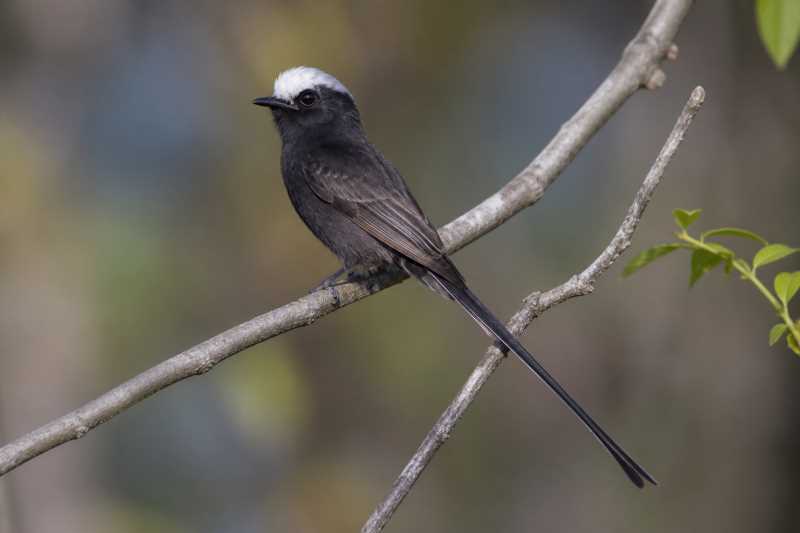
The Long-tailed Tyrant (Colonia colonus) is a fascinating bird species known for its striking appearance and intriguing behavior. Belonging to the Tyrannidae family, this bird is a member of the suborder Tyranni, which is characterized by its diverse range of species and behaviors. The Long-tailed Tyrant is particularly notable for its distinctive long tail feathers, which set it apart from other members of its family.
Physical Description
The Long-tailed Tyrant is relatively small, measuring about 16 to 18 cm in length. Its most distinctive feature is its elongated tail, which can be up to twice the length of its body, accounting for nearly half of its entire length. The bird’s plumage is primarily black with a glossy sheen, giving it a striking appearance. In contrast, its throat and chest area are white, providing a stark contrast to its otherwise dark coloration. The eyes are a prominent feature, with a piercing gaze that adds to its charismatic appearance.
Habitat and Distribution
This species is predominantly found in the tropical and subtropical regions of Central and South America. Its range extends from southern Mexico, through Central America, and into northern South America, including Colombia, Venezuela, Ecuador, Peru, and Brazil. The Long-tailed Tyrant primarily inhabits lowland forests, forest edges, and secondary growth, where it can often be observed perched conspicuously on branches or wires.
Behavior
The Long-tailed Tyrant is known for its agile and acrobatic flight patterns. It often engages in aerial sallies to catch insects mid-flight, showcasing its impressive hunting skills. This species is primarily insectivorous, feeding on a variety of flying insects, including beetles, flies, and moths. Its long tail feathers play a crucial role in its flight dynamics, helping it maneuver with precision while hunting.
Socially, the Long-tailed Tyrant is often observed alone or in pairs, though it may sometimes be seen in small family groups. It is a territorial species, often defending its feeding and breeding territories vigorously against intruders. The bird communicates through a series of sharp, high-pitched calls, which it uses to establish territory and attract mates.
Breeding and Nesting
The breeding season for the Long-tailed Tyrant varies depending on its geographical location but generally coincides with the rainy season when food availability is at its peak. The species is known for its elaborate courtship displays, which involve vocalizations and intricate flight patterns designed to attract a mate.
Nesting typically occurs in tree cavities or in abandoned woodpecker holes. The female is primarily responsible for nest construction, using materials such as twigs, moss, and feathers to create a secure environment for her eggs. Clutch size usually ranges from two to three eggs, which are incubated by the female for about two weeks. Once hatched, both parents play an active role in feeding and caring for the chicks until they are ready to fledge.
Conservation Status
Currently, the Long-tailed Tyrant is listed as a species of Least Concern by the International Union for Conservation of Nature (IUCN). This classification is due to its wide range and stable population numbers. However, like many other bird species, it faces threats from habitat destruction and fragmentation due to deforestation and agricultural expansion. Conservation efforts aimed at preserving tropical forest habitats are crucial for ensuring the long-term survival of this and other species.
Conclusion
The Long-tailed Tyrant is a remarkable bird that captivates birdwatchers and ornithologists alike with its unique appearance and behaviors. Its role in the ecosystem as an insect predator contributes to maintaining ecological balance, showcasing the importance of preserving its natural habitat. As with many avian species, ongoing conservation efforts are essential to protect the Long-tailed Tyrant and the rich biodiversity of tropical and subtropical ecosystems.
References
- BirdLife International (2021). Species factsheet: Colonia colonus.
- Schulenberg, T.S., Stotz, D.F., Lane, D.F., O’Neill, J.P., & Parker III, T.A. (2007). Birds of Peru. Princeton University Press.
- Stiles, F. Gary, and Alexander F. Skutch. (1989). A Guide to the Birds of Costa Rica. Cornell University Press.
Related posts