Introduction
The White-faced Whistling Duck (Dendrocygna viduata) is a widespread whistling duck in the family Anatidae. Its disjunct range includes sub-Saharan Africa, Madagascar and the Comoros, as well as Central and South America. It is a strongly social wetland bird, often forming large flocks and communicating with clear, whistling calls. The species is one of eight living species currently placed in the genus Dendrocygna. (ww.worldbirdnames.org)
Physical Description
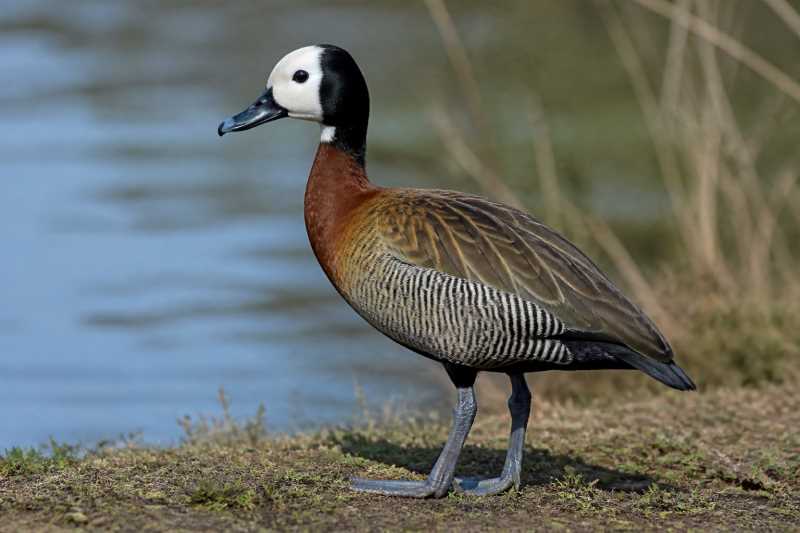
The White-faced Whistling Duck is a slender, long-legged duck measuring approximately 40–48 centimetres in length. Adults have a distinctive white face and throat set against a dark crown, hindneck and upper breast. The back and sides are chestnut-brown to grey-brown, while the underparts are largely black and the flanks show fine pale barring. The long neck, upright posture and relatively long legs give the species a goose-like appearance when it is standing or walking.
Males and females have very similar plumage and are difficult to distinguish visually in the field. Juveniles are duller than adults and initially lack the sharply contrasting white face and strongly marked black head and underparts. These adult features develop progressively as the young birds mature. (snr.unl.edu)
Range and Habitat
The species has a notably disjunct distribution. In Africa, it occurs across much of sub-Saharan Africa, with additional populations in Madagascar and the Comoros. In the Americas, it ranges from parts of Central America through northern and eastern South America, extending southwards into areas of Argentina, Uruguay and southern Brazil. African and American populations are geographically separated and do not form a single continuous population. (avibase.bsc-eoc.org)
White-faced Whistling Ducks occupy a broad range of wetland habitats, including freshwater marshes, shallow lakes, floodplains, swamps, lagoons, rice fields, flooded grassland and farm ponds. They may also use brackish wetlands and artificial water bodies such as sewage lagoons. Open wetlands with emergent vegetation and nearby feeding areas are particularly suitable.
The species is generally regarded as resident or locally nomadic rather than a long-distance migrant. Local movements are influenced by rainfall, water levels and the availability of food. During dry periods, birds may gather at permanent wetlands in large concentrations. (snr.unl.edu)
Behaviour and Diet
White-faced Whistling Ducks are highly gregarious. They may occur in pairs during the breeding season but commonly form flocks of hundreds or thousands of birds outside that period. Their clear whistling calls help maintain contact between members of a flock, particularly when birds are spread across a wetland or moving between feeding and roosting areas.
They feed by wading, swimming and occasionally diving. Their diet includes seeds, grasses, aquatic plants, grain and aquatic invertebrates, including insects and other small animals. Feeding may occur during the day, at dusk or at night, depending on local conditions and disturbance.
Breeding is commonly associated with the rainy season, when wetlands expand and food becomes more abundant. Nests may be placed on the ground near water, among dense shoreline vegetation or in reed beds, and the species may sometimes use elevated or abandoned nests. Clutches generally contain about 8–12 eggs. Both parents participate in incubation and care of the young, with incubation lasting approximately 30–31 days in documented accounts. Pair bonds are strong, and mutual preening is an important social behaviour. (snr.unl.edu)
Identification Tips
- Look for the sharply contrasting white face and throat, dark crown and hindneck, and blackish underparts.
- Fine pale barring on the flanks is visible at close range and helps separate the species from plainer brown ducks.
- The long neck, long legs and upright stance are characteristic of whistling ducks.
- Listen for the repeated, clear whistling call, especially when birds are moving or maintaining contact within a flock.
- Do not rely on sex-specific plumage: adult males and females are essentially alike in appearance.
- Juveniles are less boldly marked, with a duller face and less developed dark head and underparts.
- The Fulvous Whistling Duck (Dendrocygna bicolor) is generally more uniformly warm brown and lacks the White-faced Whistling Duck’s strongly contrasting white face and black underparts. The Black-bellied Whistling Duck (Dendrocygna autumnalis) is also similar in structure but usually shows a different head pattern and a more obvious pale wing patch in adults.
Conservation Status
The White-faced Whistling Duck is currently assessed as Least Concern on the IUCN Red List. Its extensive distribution and large overall population mean that it is not presently considered globally threatened. However, local populations may be affected by wetland drainage, agricultural expansion, pollution, altered water regimes, drought, disturbance and hunting in some parts of its range. (datazone.birdlife.org)
Conservation measures should focus on protecting and restoring wetlands, maintaining natural seasonal flooding, reducing pollution and unsustainable hunting, and monitoring important concentrations of the species. Regional assessments may identify local declines even when the global category remains Least Concern. For example, recent South African assessment work reported a decreasing regional trend, while retaining a regional category of Least Concern. (birdlife.org.za)
Frequently Asked Questions
Where does the White-faced Whistling Duck live?
It occurs in sub-Saharan Africa, Madagascar and the Comoros, and in parts of Central and South America. It uses marshes, shallow lakes, floodplains, lagoons, rice fields and other wetlands.
Is the White-faced Whistling Duck migratory?
It is not normally considered a long-distance migrant. Instead, it makes local or regional movements in response to rainfall, changing water levels and food availability.
What does the White-faced Whistling Duck eat?
Its diet includes aquatic plants, grasses, seeds, grain and aquatic invertebrates. It feeds by wading, swimming and sometimes diving.
How can the species be identified?
Adults are recognised by their white face and throat, dark head, chestnut-brown upperparts, blackish underparts and finely barred flanks. Their long neck, upright posture and whistling calls are also useful identification features.
Do male and female White-faced Whistling Ducks look different?
No obvious sexual dimorphism is present. Adult males and females have very similar plumage and are usually difficult to separate by sight.
Is the White-faced Whistling Duck endangered?
The species is currently classified as Least Concern globally. Nevertheless, the loss and degradation of wetlands can cause local declines, so habitat protection and responsible wetland management remain important.
References
- BirdLife International. 2024. White-faced Whistling-duck Dendrocygna viduata: Species Factsheet. BirdLife DataZone. Available at: https://datazone.birdlife.org/species/factsheet/white-faced-whistling-duck-dendrocygna-viduata (accessed 8 September 2026).
- BirdLife South Africa. 2025. White-faced Whistling Duck Dendrocygna viduata. Red Data Book. BirdLife South Africa. Available at: https://www.birdlife.org.za/red-data-book/red-list/white-faced-whistling-duck/ (accessed 8 September 2026).
- Duck Specialist Group. 2010. DSG Age & Sex Guide: White-faced Whistling-duck, version 1.0. IUCN Species Survival Commission Duck Specialist Group. Available at: https://ducksg.org/wp-content/uploads/2014/06/DSG-Ageing-Sexing-Guide-White-faced-Whistling-duck.pdf (accessed 8 September 2026).
- Gill, F., Donsker, D. and Rasmussen, P., eds. 2026. IOC World Bird List, version 15.2. International Ornithologists’ Union. Available at: https://www.worldbirdnames.org/ (accessed 8 September 2026).
- Johnsgard, P. A. 1978. Ducks, Geese and Swans of the World. University of Nebraska Press, Lincoln, Nebraska.
- University of Nebraska–Lincoln. n.d. White-faced Whistling Duck. Game Birds of the World, Madson Bird Collection. School of Natural Resources. Available at: https://snr.unl.edu/data/appliedecology/madsonbird/individualbird.aspx?bid=1 (accessed 8 September 2026).
- Zootierliste and Avibase. n.d. Dendrocygna viduata, White-faced Whistling Duck: distribution and taxonomic information. Avibase, hosted by Birds Canada. Available at: https://avibase.bsc-eoc.org/species.jsp?avibaseid=A534AFEA126DBD62&lang=EN (accessed 8 September 2026).
Related posts