Introduction
The Cinereous Tinamou (Crypturellus cinereus) is a secretive, ground-dwelling bird of northern South America. It belongs to the tinamou family, Tinamidae, a group of mostly terrestrial birds that can nevertheless fly. The species is more often detected by its clear, far-carrying whistle than seen in the dense vegetation of humid lowland forests.
Physical Description
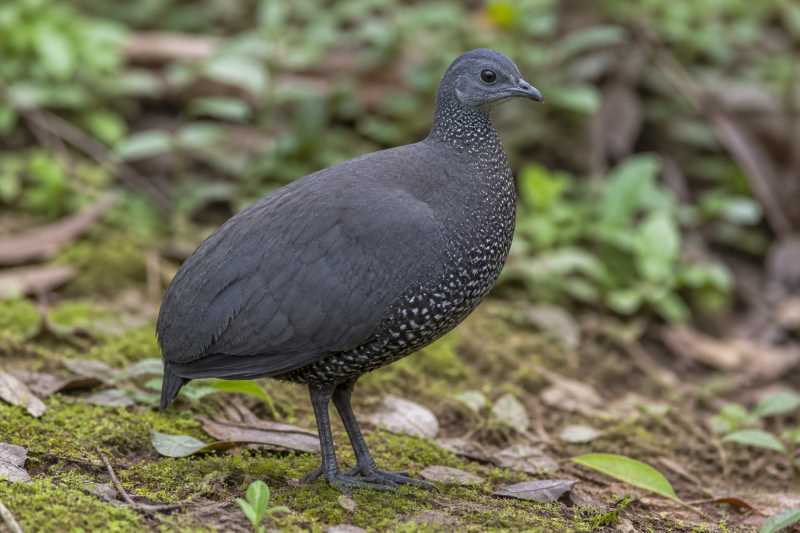
The Cinereous Tinamou is approximately 29–32 centimetres long. It has predominantly dark brown, sooty brown or brownish-black plumage, with a slightly paler underside. The crown and nape are often smoky grey to reddish brown, while pale feather shafts on the sides of the head may be visible at close range.
The species has a pale eye-ring, a dark upper mandible and a yellowish lower mandible. Its legs are dull orange to yellow. Females are generally larger than males, although the sexes are otherwise broadly similar in appearance. Reliable information on age-related plumage differences is limited, but young birds are expected to be more heavily marked and cryptic than adults, as in other forest tinamous.
Range and Habitat
The Cinereous Tinamou occurs across northern South America, including parts of Colombia, southern Venezuela, Guyana, Suriname, French Guiana, Brazil, eastern Ecuador, eastern Peru and northern Bolivia. It is a resident species rather than a long-distance migrant.
It inhabits humid lowland forest, including terra firme forest, seasonally wet or flooded forest, forested swamp, dense secondary growth and some overgrown or abandoned plantations. Records from Bolivia and other parts of its range show that it can occur at moderately elevated sites, but it is principally associated with lowland tropical environments. In Guyana, it is recorded from lowland forest and scrub habitats.
Behaviour and Diet
The Cinereous Tinamou is primarily terrestrial and usually moves quietly through leaf litter and dense understorey. It is shy and difficult to observe, often freezing or running through cover before taking flight. When flushed, it can make a rapid, powerful escape flight, although it normally spends most of its time on the ground.
Its diet consists mainly of fallen fruit, seeds and other plant material, supplemented by insects and other small invertebrates. Foraging birds search beneath leaves and among ground vegetation, using the bill to investigate suitable food. The species may therefore contribute to the movement of seeds through the forest, although its precise ecological importance has not been fully quantified.
The species is particularly vocal around dawn and dusk. Its advertisement call is a clear, low-pitched whistle, and the bird’s concealed position can make the sound appear to come from farther away or from a different direction. Vocal activity is important in communication and courtship.
Tinamous have an unusual breeding system in which the male normally incubates the eggs and cares for the newly hatched young. The nest is usually a shallow depression on the ground, often beside a tree, buttress or other form of cover. The chicks are precocial and can move soon after hatching. Detailed, species-specific information on clutch size, incubation period and breeding season remains limited.
Identification Tips
- Listen for a distinctive, clear whistle in humid lowland forest, especially around dawn or dusk.
- Look for a uniformly dark, sooty-brown ground bird with a somewhat paler underside.
- A reddish-brown or smoky crown and nape, pale eye-ring, yellowish lower mandible and dull orange-yellow legs can help confirm an identification.
- The bird’s secretive behaviour and tendency to remain in dense understorey are characteristic.
- The uniformly dark plumage helps separate it from more strongly barred or patterned forest tinamous. Identification should still be based on the combination of plumage, habitat and vocalisation, because several tinamou species can be difficult to distinguish when seen briefly.
Conservation Status
The Cinereous Tinamou is currently assessed as Least Concern. It has a broad distribution across the Amazon Basin and adjacent regions, but detailed information on its total population and long-term population trend is limited.
Potential local threats include the loss and fragmentation of humid forest through logging, agricultural expansion, mining, roads and other development. Hunting may also affect local populations in areas where tinamous are taken for food. Protecting large areas of native forest, maintaining habitat connectivity and supporting sustainable land use are important conservation measures. The species also benefits from protected areas and from monitoring that improves knowledge of its distribution, abundance and breeding ecology.
Frequently Asked Questions
Where can the Cinereous Tinamou be found?
It occurs in northern South America, including Brazil, Colombia, Venezuela, Guyana, Suriname, French Guiana, Ecuador, Peru and Bolivia. Most records are from humid lowland forest and associated dense vegetation.
What does the Cinereous Tinamou look like?
It is a medium-sized, mostly dark brown or sooty-brown ground bird, about 29–32 centimetres long. It has a pale eye-ring, a dark upper bill, a yellowish lower bill and dull orange-yellow legs.
Is the Cinereous Tinamou migratory?
No. It is generally regarded as resident within its range, although individuals may make short local movements in response to habitat conditions and food availability.
What does the Cinereous Tinamou eat?
Its diet includes fallen fruit, seeds and other plant material, along with insects and other small invertebrates. The exact balance of foods varies with habitat and season.
Why is the Cinereous Tinamou difficult to see?
It is a shy, ground-dwelling bird that moves through dense understorey and leaf litter. Its dark, cryptic plumage blends with shadowed forest floors, and it is often detected by its whistle rather than by sight.
Who incubates the eggs?
As in other tinamous, the male normally incubates the eggs and cares for the young after hatching. The nest is a simple depression on the forest floor, usually placed in a sheltered position.
References
- BirdLife International. n.d. Crypturellus cinereus, species account and conservation information. BirdLife International Data Zone. Accessed 8 September 2026.
- Gill, F., Donsker, D. and Rasmussen, P. (eds). 2026. IOC World Bird List, version 15.2. International Ornithologists’ Union. Accessed 8 September 2026.
- Hilty, S. L. 2002. Birds of Venezuela. Princeton University Press, Princeton, New Jersey.
- National Museum of Natural History, Smithsonian Institution. n.d. A Field Checklist of the Birds of Guyana, 2nd Edition. Smithsonian Institution, Washington, DC. Accessed 8 September 2026.
- Spaans, A. L., Ottema, O. H. and Ribot, J. H. 2015. Field Guide to the Birds of Suriname. Brill, Leiden.
- Stotz, D. F., Fitzpatrick, J. W., Parker, T. A. III and Moskovits, D. K. 1996. Neotropical Birds: Ecology and Conservation. University of Chicago Press, Chicago.
- Tobias, J. A. and Seddon, N. 2003. “Birds of the Pilón Lajas Biosphere Reserve and Communal Lands, Bolivia.” Bird Conservation International 13: 319–349. https://doi.org/10.1017/S0959270903003241
- WWF Guianas. 2023. Wildlife Guidelines: Birds, Tinamous. World Wide Fund for Nature Guianas. Accessed 8 September 2026.
- World Bird Names. n.d. Cinereous Tinamou / Crypturellus cinereus. WorldBirdNames.com. Accessed 8 September 2026.
Related posts