Introduction
The Pallid Fat-tailed Opossum (Thylamys pallidior) is a fascinating marsupial species native to South America. This small, nocturnal mammal belongs to the family Didelphidae and is known for its distinctive appearance and adaptive behaviors. As an integral part of its ecosystem, the Pallid Fat-tailed Opossum plays a crucial role in controlling insect populations and dispersing seeds. This article delves into the various aspects of this intriguing species, covering its physical characteristics, habitat, behavior, and conservation status.
Physical Description
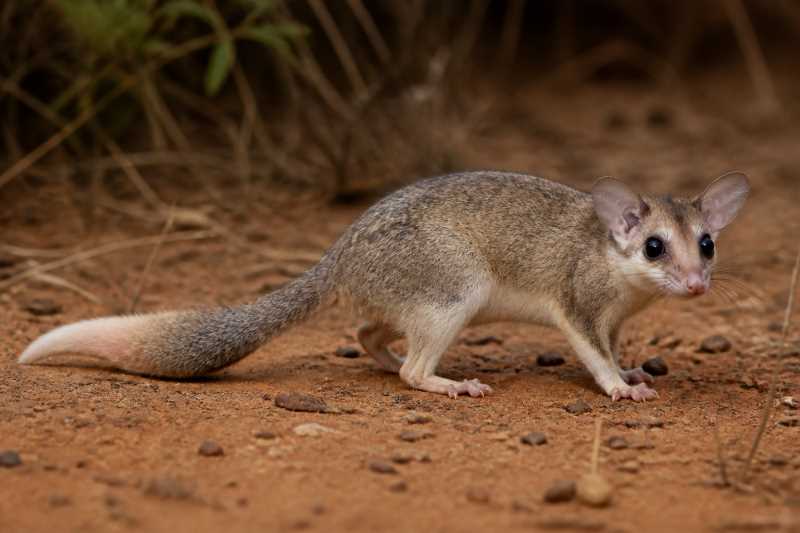
The Pallid Fat-tailed Opossum is a small marsupial characterized by its pale, grayish-brown fur, which provides excellent camouflage in its natural habitat. Adults typically measure between 10 to 15 centimeters in body length, with a tail that can extend up to 12 centimeters. As its name suggests, this species has a notably fat tail, which serves as a storage area for fat reserves, allowing it to survive periods of food scarcity.
The opossum’s face is marked by a distinctive white stripe that runs from its nose to its forehead, flanked by dark brown eyes and ears. Its limbs are relatively short, with sharp claws that facilitate climbing and foraging. The hind feet of the Pallid Fat-tailed Opossum are equipped with an opposable toe, aiding in grasping branches and other surfaces.
Range and Habitat
The Pallid Fat-tailed Opossum is primarily found in the arid and semi-arid regions of South America, including parts of Argentina, Bolivia, Chile, and Peru. It prefers habitats such as dry forests, shrublands, and rocky areas, where vegetation is sparse, and the climate is harsh. This opossum is highly adaptable, capable of surviving in a variety of environmental conditions, from lowland deserts to mountainous regions.
The species is most commonly associated with xerophytic vegetation, which consists of plants adapted to dry environments. These plants provide the opossum with both food and shelter, as well as protection from predators.
Behavior and Diet
The Pallid Fat-tailed Opossum is a solitary and nocturnal creature, primarily active during the night. It spends the daytime resting in nests made of leaves and twigs, which it constructs in tree hollows, rock crevices, or burrows. When night falls, the opossum emerges to forage for food.
As an omnivore, its diet is diverse and includes insects, small vertebrates, fruits, and seeds. The opossum plays a vital role in its ecosystem by controlling insect populations and aiding in seed dispersal. Its ability to store fat in its tail allows it to endure periods when food is scarce, particularly during the dry season.
Identification Tips (Field Recognition Cues)
Identifying the Pallid Fat-tailed Opossum in the wild can be challenging due to its nocturnal habits and elusive nature. However, there are several key features to look for:
- Coloration: Look for the opossum’s pale, grayish-brown fur, which blends into the arid landscapes it inhabits.
- Facial Markings: Note the distinctive white stripe running from the nose to the forehead and the dark rings around its eyes.
- Tail: Observe the characteristic fat tail, which is thicker at the base and tapers towards the end.
- Behavior: Spot the opossum at night, as it is primarily nocturnal, and listen for rustling noises in the underbrush.
Conservation Status (With Threats and Protections)
The conservation status of the Pallid Fat-tailed Opossum is currently listed as "Least Concern" by the International Union for Conservation of Nature (IUCN). This classification is due to its wide distribution and stable population numbers. However, the species faces several threats that could impact its future survival.
Threats
- Habitat Loss: The main threat to the Pallid Fat-tailed Opossum is habitat destruction caused by agricultural expansion, urbanization, and deforestation.
- Climate Change: Changes in climate patterns can alter the availability of food and suitable habitats, putting additional stress on populations.
- Predation: Natural predators such as birds of prey, snakes, and mammals pose a constant threat to the opossum.
Protections
Efforts to conserve the Pallid Fat-tailed Opossum focus on habitat preservation and the establishment of protected areas. Conservation organizations are working to mitigate habitat loss by promoting sustainable land-use practices and raising awareness about the importance of preserving native ecosystems.
Frequently Asked Questions
What is the diet of the Pallid Fat-tailed Opossum?
The Pallid Fat-tailed Opossum is an omnivore, feeding on a variety of insects, small vertebrates, fruits, and seeds. This diverse diet allows it to adapt to different food availability in its arid habitat.
How does the Pallid Fat-tailed Opossum store fat?
The opossum stores fat in its tail, which becomes thicker at the base when resources are abundant. This adaptation enables the opossum to survive periods of food scarcity by utilizing the stored energy.
Where can I find the Pallid Fat-tailed Opossum?
This species is found in the arid and semi-arid regions of South America, particularly in Argentina, Bolivia, Chile, and Peru. It inhabits dry forests, shrublands, and rocky areas.
How does the Pallid Fat-tailed Opossum contribute to its ecosystem?
The opossum helps control insect populations and aids in seed dispersal, playing a crucial role in maintaining the balance of its ecosystem.
Is the Pallid Fat-tailed Opossum endangered?
Currently, the Pallid Fat-tailed Opossum is classified as "Least Concern" by the IUCN due to its wide distribution and stable population levels. However, ongoing habitat loss and climate change pose potential threats to its future survival.
Related posts