Introduction
The Spotted-tailed Quoll (Dasyurus maculatus), also known as the Tiger Quoll, is one of Australia’s most charismatic and intriguing marsupials. As the largest carnivorous marsupial on the mainland, the Spotted-tailed Quoll plays a crucial role in its ecosystem. This article delves into the fascinating world of the Spotted-tailed Quoll, covering its physical characteristics, habitat, behavior, and the conservation challenges it faces.
Physical Description
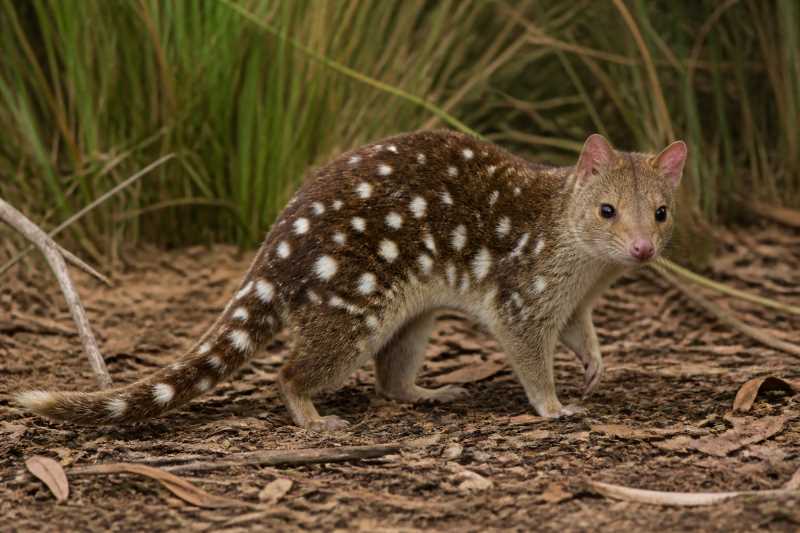
The Spotted-tailed Quoll is a striking creature, known for its distinctive appearance. Adult quolls can reach a body length of 38 to 76 cm, with their tail adding an additional 37 to 55 cm. They weigh between 1.3 to 7 kg, with males generally larger than females.
Their fur is primarily reddish-brown or dark brown, adorned with prominent white spots that cover their back and extend to their characteristic long, bushy tail. This pattern serves as excellent camouflage in their forested habitats. Quolls have sharp claws and strong jaws, adapted for their carnivorous diet.
Range and Habitat
The Spotted-tailed Quoll is native to Australia, with two subspecies recognized: Dasyurus maculatus maculatus found in southeastern Australia, including Tasmania, and Dasyurus maculatus gracilis in the wet tropics of Queensland.
These quolls thrive in a variety of habitats, from rainforests and wet sclerophyll forests to woodlands and coastal heathlands. They prefer environments with dense vegetation, which provide ample cover and hunting ground. Quolls are semi-arboreal, meaning they are adept climbers, often using trees both for hunting and shelter.
Behavior and Diet
Spotted-tailed Quolls are primarily solitary creatures, coming together only for mating. They are nocturnal hunters, relying on their keen senses of smell and hearing to locate prey. Their diet is diverse, consisting mainly of small mammals, birds, reptiles, and insects. They are opportunistic feeders and have been observed scavenging on carrion.
During the breeding season, which occurs from late autumn to early winter, males compete fiercely for access to females. After mating, females give birth to up to six young after a gestation period of about 21 days. The young are carried in the mother’s pouch for about two months before becoming independent at around six months old.
Identification Tips
Field recognition of the Spotted-tailed Quoll can be challenging due to their elusive nature and nocturnal habits. However, there are some key identification tips:
- Spotting: Look for the distinctive white spots on a reddish-brown or dark brown coat.
- Size: Note the size, as they are larger than most other quoll species.
- Tail: Their long, bushy tail is a notable feature, often spotted like the rest of their body.
- Tracks and Scats: Quolls leave behind distinctive tracks and scats, which can be useful in identifying their presence in an area.
Conservation Status
The Spotted-tailed Quoll is currently listed as Near Threatened on the IUCN Red List, with the Queensland subspecies classified as Endangered. Several factors contribute to their declining numbers:
- Habitat Loss: Deforestation and land clearing for agriculture and urban development have significantly reduced their natural habitats.
- Predation and Competition: Invasive species such as foxes and feral cats pose a significant threat through predation and competition for food.
- Poisoning and Trapping: Baiting programs targeting invasive species sometimes inadvertently harm quolls.
Conservation efforts are being implemented, including habitat protection, feral predator control, and public education to raise awareness about the species.
Frequently Asked Questions
Q1: What do Spotted-tailed Quolls eat?
Spotted-tailed Quolls have a carnivorous diet, primarily feeding on small mammals, birds, reptiles, and insects. They are opportunistic hunters and scavengers, occasionally feeding on carrion.
Q2: Where can I see a Spotted-tailed Quoll in the wild?
Spotted-tailed Quolls are found in southeastern Australia and Tasmania, with a small population in Queensland. They inhabit rainforests, wet sclerophyll forests, and woodlands.
Q3: How can I help in the conservation of Spotted-tailed Quolls?
Supporting conservation organizations, advocating for habitat protection, and participating in community programs aimed at controlling invasive species can help in the conservation of Spotted-tailed Quolls.
Q4: Are Spotted-tailed Quolls dangerous to humans?
Spotted-tailed Quolls are not dangerous to humans. They are shy and elusive, generally avoiding human contact.
Q5: How do Spotted-tailed Quolls communicate?
Quolls communicate through vocalizations, scent markings, and body language. They use these methods to establish territory and during mating.
Related posts