Introduction
The Roloway Monkey (Cercopithecus roloway) is an alluring and critically endangered primate species that inhabits the dense forests of West Africa. Known for its striking facial markings and vibrant coloration, the Roloway Monkey plays a significant role in the biodiversity of its ecosystem. This article explores the fascinating world of the Roloway Monkey, providing detailed information on its physical characteristics, habitat, behavior, and conservation status.
Physical Description
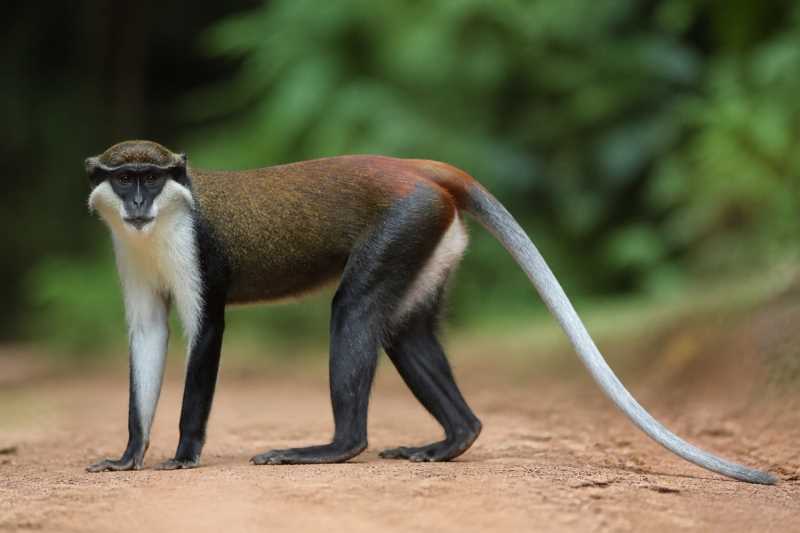
The Roloway Monkey is a medium-sized Old World monkey, with adults typically weighing between 4 to 7 kilograms and measuring approximately 40 to 55 centimeters in body length, excluding their long, non-prehensile tails. One of the most distinctive features of the Roloway Monkey is its striking black and white facial mask, which is complemented by a white beard and a long, white tuft of hair on its forehead. The species has a predominantly dark brown or black coat, with a lighter, orange-yellow hue on the back and limbs, which allows it to blend seamlessly into the forest canopy.
Additionally, the Roloway Monkey’s expressive, large eyes and agile limbs are adapted for an arboreal lifestyle, enabling it to navigate the intricate maze of branches and foliage in its native habitat. The species’ vocalizations are varied and complex, serving as essential communication tools within the troop.
Range and Habitat
Historically, the Roloway Monkey’s range extended across the tropical forests of Côte d’Ivoire and Ghana. However, due to significant habitat loss and fragmentation, its current distribution is restricted to a few isolated pockets within these countries. The species primarily inhabits mature, primary lowland forests, where it can find abundant food sources and adequate shelter.
The Roloway Monkey thrives in dense, multi-layered canopies, which provide both protection from predators and a diverse array of fruits, leaves, and insects. Unfortunately, ongoing deforestation for agricultural expansion, logging, and human settlement continues to threaten these critical habitats, pushing the species closer to extinction.
Behavior and Diet
Roloway Monkeys are social animals, typically living in groups, or troops, consisting of 10 to 30 individuals. These groups are usually composed of a dominant male, multiple females, and their offspring. Such social structures facilitate cooperative behaviors, such as grooming and collective defense against predators.
The diet of the Roloway Monkey is primarily frugivorous, with a strong preference for ripe fruits. However, their dietary repertoire is quite diverse, also including young leaves, flowers, seeds, and insects. This varied diet helps the Roloway Monkey maintain its nutritional needs throughout the year, particularly during periods of fruit scarcity.
Identification Tips (Field Recognition Cues)
Identifying the Roloway Monkey in the wild can be challenging due to its elusive nature and fragmented habitat. However, several field recognition cues can aid in their identification:
- Facial Markings: Look for the distinctive black and white facial mask, complete with a white beard and forehead tuft.
- Coat Coloration: Observe the contrasting dark and light coloration on their body—dark brown or black with an orange-yellow back and limbs.
- Vocalizations: Listen for their varied calls, which include sharp chirps and whistles, often used for communication within the troop.
- Group Behavior: Spot them high in the forest canopy, often in groups, engaging in social activities like grooming and feeding.
Conservation Status (With Threats and Protections)
The Roloway Monkey is listed as Critically Endangered on the IUCN Red List, primarily due to habitat loss and hunting pressures. The species faces several threats:
- Deforestation: Large-scale logging and agricultural activities have led to significant habitat fragmentation and loss.
- Hunting: The Roloway Monkey is hunted for bushmeat, a practice that is unsustainable given its dwindling population.
- Limited Range: Their restricted distribution makes them particularly vulnerable to environmental changes and human encroachment.
To combat these threats, several conservation measures have been implemented:
- Protected Areas: Establishment of reserves and national parks in Ghana and Côte d’Ivoire provides some refuge for the species.
- Community Engagement: Initiatives to involve local communities in conservation efforts, promoting alternative livelihoods to reduce hunting pressures.
- Research and Monitoring: Continued research and monitoring are essential to understand population trends and implement effective conservation strategies.
Frequently Asked Questions
What is the Roloway Monkey’s current population trend?
The Roloway Monkey’s population is decreasing, with estimates suggesting that only a few hundred individuals remain in the wild. Conservation efforts are crucial to prevent further declines.
Where can I see Roloway Monkeys in the wild?
The Roloway Monkey can be observed in some protected areas within Ghana and Côte d’Ivoire, such as the Ankasa Conservation Area and the Tai National Park. However, sightings are rare due to their elusive nature.
How can I help in the conservation of Roloway Monkeys?
Supporting conservation organizations, promoting awareness about the species, and advocating for sustainable forest management are ways in which individuals can contribute to the preservation of the Roloway Monkey.
Why is the Roloway Monkey important to its ecosystem?
The Roloway Monkey plays a crucial role in seed dispersal, aiding in forest regeneration and maintaining biodiversity within its habitat.
Are Roloway Monkeys kept in captivity?
Roloway Monkeys are rarely found in captivity, and efforts are focused on preserving their populations in the wild rather than in zoos or sanctuaries.
Related posts