Introduction
L’Hoest’s Monkey, scientifically known as Allochrocebus lhoesti, is a fascinating primate species that captures the interest of wildlife enthusiasts and researchers alike. Known for their distinctive appearance and social behavior, these Old World monkeys are native to the montane forests of Central Africa. This article delves into various aspects of L’Hoest’s Monkey, including their physical characteristics, habitat, diet, and conservation status, providing a comprehensive overview for anyone interested in these intriguing primates.
Physical Description
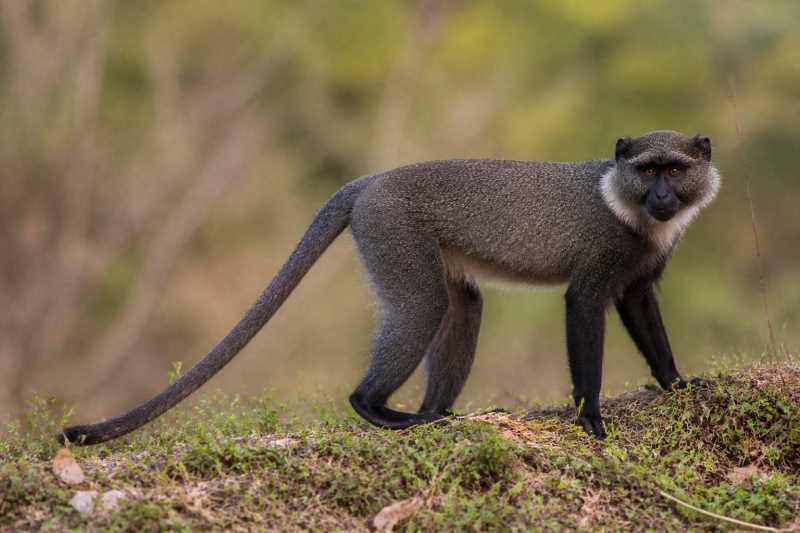
L’Hoest’s Monkey is a medium-sized primate with a striking appearance that makes it relatively easy to identify. Adult L’Hoest’s Monkeys typically weigh between 4 and 7 kilograms, with males being slightly larger than females. They possess a long tail, often used for balance, that can be up to twice the length of their body.
Their fur is predominantly dark, ranging from deep brown to black, with a characteristic white beard and cheek whiskers that provide a stark contrast to their darker body. This white facial hair is one of their most recognizable features. Additionally, they have a light-colored patch on their chest, which can range from cream to white. Their eyes are set forward, giving them excellent binocular vision necessary for navigating their arboreal environment.
Range and Habitat
L’Hoest’s Monkeys are primarily found in the montane and sub-montane forests of Central and East Africa. Their range extends across several countries, including the Democratic Republic of the Congo, Rwanda, Uganda, and Burundi. These monkeys favor dense, moist forests and are often found at elevations ranging from 1,000 to 3,000 meters.
The preferred habitat of L’Hoest’s Monkeys includes primary and secondary forests, where they spend most of their time in the understory and mid-canopy levels. They tend to avoid highly disturbed areas, although they can occasionally be found in forest edges and fragmented habitats if necessary.
Behavior and Diet
L’Hoest’s Monkeys are diurnal and arboreal, spending the majority of their time in trees, although they will descend to the ground to forage and move between trees. Their social structure is matriarchal, with groups typically consisting of 10 to 17 individuals, led by a dominant female. Males are usually solitary, joining groups only temporarily for mating purposes.
Their diet is omnivorous and varies seasonally, consisting mainly of fruits, leaves, seeds, and flowers. They also consume insects, small mammals, and birds when the opportunity arises. This varied diet allows them to adapt to different seasonal food availability, making them resilient in their forest habitats.
Identification Tips (Field Recognition Cues)
Identifying L’Hoest’s Monkeys in the wild can be a rewarding experience for wildlife enthusiasts. Here are some tips to help you recognize these primates:
- White Facial Hair: Look for the distinctive white beard and cheek whiskers that contrast sharply with their darker fur.
- Long Tail: Notice the long, bushy tail, which they use for balance in their arboreal habitat.
- Chest Patch: Identify the light-colored chest patch, visible as they move through the trees.
- Size and Build: Observe their medium size and slender build, which facilitates agile movement through dense foliage.
Conservation Status (With Threats and Protections)
L’Hoest’s Monkey is currently classified as Vulnerable on the International Union for Conservation of Nature (IUCN) Red List. The primary threats to their survival include habitat destruction due to agricultural expansion, logging, and human settlement. Additionally, they are sometimes hunted for bushmeat, further exacerbating their decline.
Conservation efforts are underway to protect these primates and their habitats. Protected areas such as national parks and reserves in Rwanda, Uganda, and the Democratic Republic of the Congo play a crucial role in their conservation. Efforts to curb illegal hunting and habitat destruction, along with community education initiatives, are vital for ensuring the survival of L’Hoest’s Monkeys in the wild.
Frequently Asked Questions
1. What is the lifespan of L’Hoest’s Monkey?
L’Hoest’s Monkeys typically live for about 20 years in the wild. However, in captivity, where they face fewer threats and have consistent access to food, they can live slightly longer, sometimes reaching up to 25 years.
2. How do L’Hoest’s Monkeys communicate?
L’Hoest’s Monkeys use a variety of vocalizations, facial expressions, and body postures to communicate with each other. Their vocal repertoire includes alarm calls, mating calls, and contact calls. Visual cues, such as gestures and facial expressions, also play a significant role in their social interactions.
3. Are L’Hoest’s Monkeys endangered?
L’Hoest’s Monkeys are classified as Vulnerable, not endangered. This status reflects their declining population due to threats like habitat destruction and hunting. Conservation efforts are crucial to prevent their status from worsening.
4. What do L’Hoest’s Monkeys eat?
Their diet is varied and includes fruits, leaves, seeds, flowers, insects, and occasionally small animals. This omnivorous diet helps them adapt to seasonal changes in food availability.
5. Where can I see L’Hoest’s Monkeys in the wild?
L’Hoest’s Monkeys can be seen in protected areas such as Nyungwe Forest National Park in Rwanda, Bwindi Impenetrable National Park in Uganda, and Kahuzi-Biéga National Park in the Democratic Republic of the Congo, where they are relatively well protected and can be observed in their natural habitat.
Related posts