Introduction
The North African Sengi (Petrosaltator rozeti), also known as the North African Elephant Shrew, is a captivating small mammal recognized for its unique behavior and distinct appearance. Despite its name, the North African Sengi is not closely related to shrews but is more closely allied with elephants, sea cows, and aardvarks, belonging to the order Macroscelidea. This intriguing species, found across parts of North Africa, is notable for its survival in arid environments and its fascinating adaptations.
Physical Description
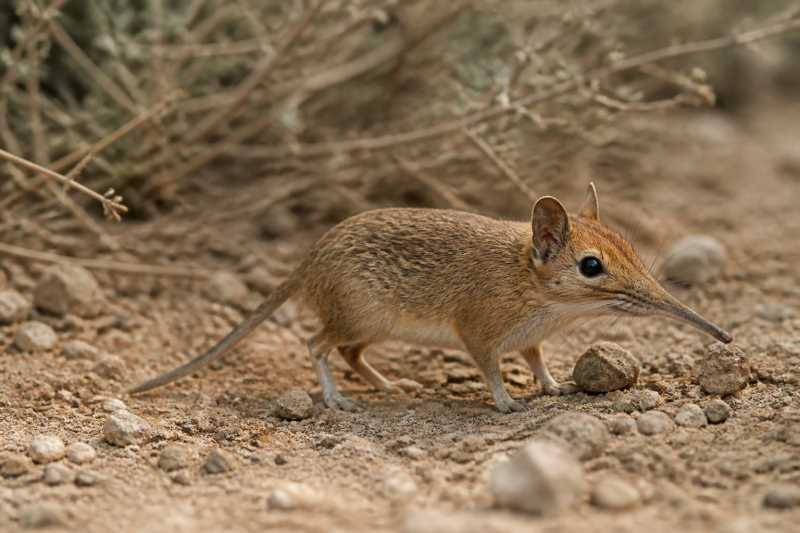
The North African Sengi is a small mammal, typically measuring between 9 to 11 centimeters in body length, with a tail that adds an additional 10 to 15 centimeters. They weigh between 50 to 80 grams. Their fur is generally a sandy or grayish-brown, providing excellent camouflage against their desert and rocky habitats. A distinctive feature is their long, flexible snout, which resembles a miniature elephant trunk, used for probing into crevices and sand to forage for food. Their large, round eyes and ears suggest a reliance on strong visual and auditory senses, essential for detecting predators in their open habitats. Their hind limbs are considerably longer than their forelimbs, adapted for quick, bounding movements, which are crucial for escaping threats.
Range and Habitat
Petrosaltator rozeti is primarily found in the arid and semi-arid regions of North Africa, including Algeria, Tunisia, Libya, and Morocco. They favor rocky deserts and semi-desert regions, where sparse vegetation provides cover and food resources. These sengis are adept at navigating rugged terrains, utilizing their agility and speed to traverse rocky outcrops and sandy soils. Their choice of habitat is influenced by the availability of insects and other invertebrates, which constitute their main diet.
Behavior and Diet
North African Sengis are diurnal, meaning they are active during the day. They are solitary creatures, coming together only for mating purposes. Their daily activities include foraging for food, primarily consisting of ants, termites, and other small invertebrates. They use their long snouts to dig into the soil and under rocks to locate prey. These mammals are known for their territorial behavior, often marking their territory with scent glands. They have a complex system of trails that they maintain meticulously, which helps them escape from predators and navigate their environment efficiently. Communication between individuals is primarily through scent markings and a variety of vocalizations.
Identification Tips
Identifying the North African Sengi in the wild requires keen observation of several key features:
- Long Snout: Look for their distinctive elongated snout which they use for foraging.
- Hind Limb Proportions: Note their long hind limbs, which are much more pronounced than the forelimbs, aiding in their characteristic hopping locomotion.
- Coloration: Their fur is typically sandy or grayish-brown, blending seamlessly with the desert environment.
- Size: They are small, typically no more than 11 centimeters in body length, with a tail almost equal in length.
- Behavior: Observe their quick, darting movements and the maintenance of a network of small paths or trails.
Conservation Status
Currently, the North African Sengi is classified as ‘Least Concern’ by the IUCN Red List. However, they face several threats that could impact their populations. The primary threats include habitat destruction due to agricultural expansion, human encroachment, and climate change, which affects their arid habitats. Additionally, they are sometimes captured for the pet trade, although this is not widespread. Conservation efforts focus on habitat preservation and monitoring population trends to ensure this unique species remains a part of the North African fauna.
Frequently Asked Questions
- What is the North African Sengi’s primary diet?
The North African Sengi primarily feeds on ants, termites, and other small invertebrates, using their long snouts to forage.
- Where can the North African Sengi be found?
They are found in arid and semi-arid regions of North Africa, including parts of Algeria, Tunisia, Libya, and Morocco.
- How does the North African Sengi avoid predators?
They rely on their speed and agility, using a complex network of trails and their excellent camouflage to escape predators.
- Are North African Sengis related to elephants?
Despite their name, they are not directly related to shrews but share a distant evolutionary relationship with elephants, aardvarks, and sea cows.
- What is the conservation status of the North African Sengi?
They are classified as ‘Least Concern’ but face threats from habitat loss and environmental changes.
Related posts