Macleay’s Forest Wallaby: An In-depth Exploration
Introduction
Macleay’s Forest Wallaby, scientifically known as Dorcopsulus macleayi, is a captivating marsupial residing in the dense forests of New Guinea. Named after William John Macleay, an Australian naturalist, this species is one of the lesser-known wallabies, often overshadowed by its larger relatives. Despite its low profile, Macleay’s Forest Wallaby plays a crucial role in the ecosystem, and understanding its characteristics and ecological contributions is vital for its conservation.
Physical Description
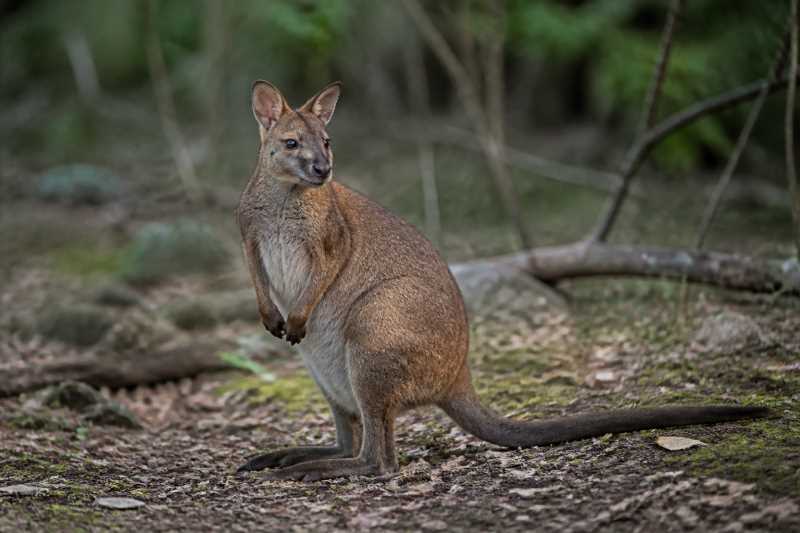
Macleay’s Forest Wallaby is a small to medium-sized marsupial. Adults typically measure between 45 to 60 centimeters in body length, with a tail length ranging from 40 to 55 centimeters. The wallaby’s weight varies from 4 to 8 kilograms. Its fur is generally soft and dense, featuring a grey-brown coloration with a lighter shade on the underbelly. The face of Macleay’s Forest Wallaby is marked by a characteristic dark stripe running from the nose to the eyes, enhancing its distinct appearance.
The hind legs of this wallaby are robust and powerful, adapted for leaping through the forest undergrowth. In contrast, the forelimbs are shorter and used primarily for feeding and grooming. Notably, the tail is long and muscular, providing balance during movement.
Range and Habitat
Macleay’s Forest Wallaby is endemic to the island of New Guinea, inhabiting both Papua New Guinea and the Indonesian provinces of Papua and West Papua. Preferring dense, tropical, and subtropical rainforests, this wallaby is typically found at elevations ranging from sea level to 1,800 meters.
Its habitat selection is influenced by the availability of cover and food resources. The wallaby thrives in areas with abundant undergrowth, which offers protection from predators and harsh weather conditions. These environments also support a diverse plant community, making them ideal feeding grounds.
Behavior and Diet
Macleay’s Forest Wallaby is predominantly crepuscular, being most active during the early morning and late afternoon. This activity pattern helps it avoid the midday heat and predators. It is generally solitary, although it may occasionally be seen in small groups, especially in areas with abundant food.
The wallaby’s diet primarily consists of grasses, leaves, and fruits. Its feeding habits play a crucial role in seed dispersal and maintaining the health of its forest habitat. By consuming a variety of plant materials, Macleay’s Forest Wallaby helps regulate plant growth and contributes to the ecosystem’s diversity.
Identification Tips
Identifying Macleay’s Forest Wallaby in the field requires attention to several key features:
- Size and Build: Look for a medium-sized wallaby with a stocky build and a relatively long tail.
- Coloration: Note the grey-brown fur with a paler underside and the distinctive dark facial stripe.
- Behavior: Observe its crepuscular activity, with peak movement during dawn and dusk.
- Habitat: Focus on dense forest areas with abundant understory vegetation, as these are the preferred habitats.
Conservation Status
The conservation status of Macleay’s Forest Wallaby is currently listed as Near Threatened by the International Union for Conservation of Nature (IUCN). The primary threats to its survival include habitat loss due to deforestation, agricultural expansion, and human encroachment. Additionally, hunting for meat and fur poses a significant threat in some regions.
Conservation efforts are underway to protect this species, involving habitat preservation and legal protections against hunting. Effective conservation strategies require collaboration between local communities, governments, and international organizations to ensure the long-term survival of Macleay’s Forest Wallaby.
Frequently Asked Questions
What is the primary diet of Macleay’s Forest Wallaby?
Macleay’s Forest Wallaby primarily feeds on grasses, leaves, and fruits. This varied diet supports seed dispersal and helps maintain forest biodiversity.
Where can I find Macleay’s Forest Wallaby in the wild?
This wallaby is native to New Guinea, inhabiting dense tropical and subtropical rainforests at elevations up to 1,800 meters.
How does Macleay’s Forest Wallaby contribute to its ecosystem?
By consuming a range of plant materials, Macleay’s Forest Wallaby aids in seed dispersal and plant growth regulation, thus promoting ecosystem diversity and health.
What are the main threats to Macleay’s Forest Wallaby?
The main threats include habitat destruction from deforestation and agricultural expansion, along with hunting pressures.
What conservation measures are in place for Macleay’s Forest Wallaby?
Conservation measures include habitat preservation initiatives and legal protections against hunting. Collaboration among various stakeholders is crucial for effective conservation.
Related posts