Introduction
Johnston’s Mangabey, scientifically known as Lophocebus johnstoni, is a fascinating primate species belonging to the Old World monkey family, Cercopithecidae. These primates are part of the Cercopithecinae subfamily, which includes other well-known species such as baboons and macaques. Johnston’s Mangabey is an intriguing subject of study due to its unique adaptations, behaviors, and conservation status. This article provides a comprehensive overview of this species, exploring its physical characteristics, natural habitat, behaviors, diet, conservation status, and more.
Physical Description
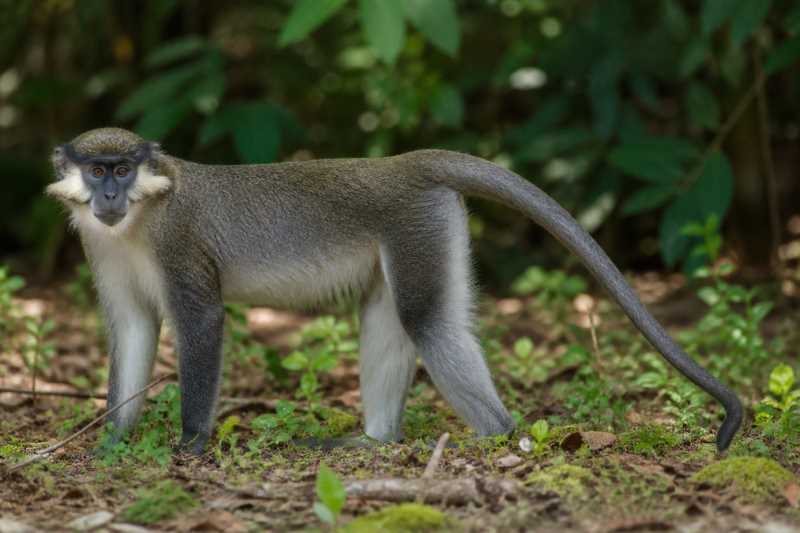
Johnston’s Mangabey is a medium-sized monkey, characterized by its slender build and long limbs, which are well-suited for an arboreal lifestyle. Adults typically measure between 45 to 60 centimeters in body length, with an additional tail length of approximately 50 to 70 centimeters. This elongated tail aids in balance and agility as they navigate through the forest canopy.
The fur of Johnston’s Mangabey is predominantly grey-brown, with a lighter underbelly. Its face is bare and dark, accentuated by striking white eyelids that give it a unique, expressive appearance. The species exhibits sexual dimorphism, with males generally larger and more robust than females. Males possess distinctive cheek pads that are absent in females, which play a role in social signaling.
Range and Habitat
Johnston’s Mangabey inhabits the dense tropical forests of Central Africa, particularly within the regions of the Democratic Republic of the Congo, Uganda, and Rwanda. These monkeys are arboreal and thrive in primary and secondary tropical rainforests, where they can be found in both lowland and montane areas.
Their habitat preference includes areas with abundant fruiting trees, as these constitute a significant portion of their diet. The presence of water bodies such as rivers and streams is also crucial, as these offer necessary resources and serve as natural boundaries for different social groups.
Behavior and Diet
Johnston’s Mangabeys are highly social animals, living in groups that range from 10 to 30 individuals. These groups consist of multiple males and females and are characterized by complex social structures and interactions. Communication within the group involves a variety of vocalizations, facial expressions, and body postures.
Their diet primarily consists of fruits, seeds, and leaves, though they are known to consume insects and small animals when available. Mangabeys have powerful jaws and teeth, enabling them to crack open hard nuts and seeds that other primates might find inaccessible. Foraging occurs mostly in the early morning and late afternoon, allowing them to avoid the midday heat.
Identification Tips
Identifying Johnston’s Mangabey in the wild requires attention to several key features:
- Size and Build: Look for a medium-sized monkey with a slender frame and long limbs.
- Facial Features: Note the dark, bare face and striking white eyelids, which are distinctive.
- Tail Length: Their long, non-prehensile tail is a prominent feature that aids in balance.
- Vocalizations: Listen for their characteristic calls, which include a variety of grunts, barks, and screams.
Conservation Status
The conservation status of Johnston’s Mangabey is currently listed as Near Threatened on the IUCN Red List. The primary threats to their survival include habitat destruction due to logging and agricultural expansion, as well as hunting for bushmeat.
Conservation efforts are underway, focusing on habitat preservation and the establishment of protected areas. Organizations are also working to raise awareness about the species and its ecological importance, promoting sustainable land use practices that benefit both local communities and wildlife.
Frequently Asked Questions
1. What is the lifespan of Johnston’s Mangabey in the wild?
Johnston’s Mangabey typically lives for about 20 to 30 years in the wild, depending on environmental conditions and threats.
2. How do Johnston’s Mangabeys communicate?
They communicate through a range of vocalizations, facial expressions, and body postures, which help maintain social cohesion and alert group members to potential threats.
3. Are Johnston’s Mangabeys endangered?
While not currently classified as endangered, Johnston’s Mangabey is considered Near Threatened due to habitat loss and hunting pressures.
4. What do Johnston’s Mangabeys eat?
Their diet consists mainly of fruits, seeds, leaves, and occasionally insects and small animals.
5. Where can Johnston’s Mangabey be found in the wild?
They are found in the tropical forests of Central Africa, particularly in the Democratic Republic of the Congo, Uganda, and Rwanda.
Related posts