Introduction
The Eastern Hoolock Gibbon (Hoolock leuconedys) is a captivating primate species native to the lush forests of Southeast Asia. Known for their distinctive vocalizations and acrobatic prowess, these gibbons are an integral part of their ecological landscape. As arboreal apes, Eastern Hoolock Gibbons spend their lives in the treetops, contributing to seed dispersal and forest dynamics. Despite their ecological importance, these gibbons face numerous threats that endanger their survival, making conservation efforts crucial.
Physical Description
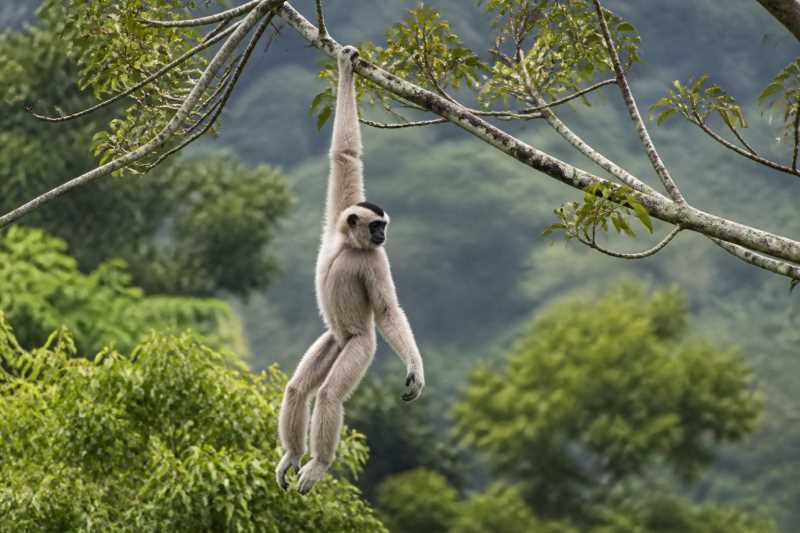
Eastern Hoolock Gibbons are medium-sized apes, characterized by their distinct sexual dimorphism. Males typically exhibit a striking black fur with white eyebrows, while females possess a lighter, tan to grayish-brown coat with dark facial markings. Both sexes have long, powerful arms adapted for brachiation—an efficient mode of locomotion through swinging from branch to branch. Weighing between 6 to 8 kilograms, these gibbons have a head-to-body length ranging from 45 to 64 centimeters. Their face is framed by a narrow white brow band, giving them an expressive appearance.
Range and Habitat
The Eastern Hoolock Gibbon inhabits the dense tropical and subtropical forests of Myanmar, India, and southwestern China. Preferring altitudes of up to 2,500 meters, they thrive in undisturbed forests where they find ample food and shelter. These gibbons are primarily found in the states of Arunachal Pradesh and Assam in India, Yunnan province in China, and several regions in Myanmar. They require large contiguous forest areas to maintain their territories, which can span approximately 20 hectares per family group.
Behavior and Diet
Eastern Hoolock Gibbons are diurnal and highly territorial, living in small family groups usually consisting of a mated pair and their offspring. Their day begins with a series of melodious calls, which serve to reinforce social bonds and delineate territorial boundaries. These gibbons primarily practice brachiation, showcasing their agility and strength as they navigate the forest canopy. Their diet is predominantly frugivorous, consisting mainly of ripe fruits, supplemented by leaves, flowers, and occasional invertebrates.
Identification Tips (field recognition cues)
To identify the Eastern Hoolock Gibbon in the wild, observers should note their distinct vocalizations, which are among the loudest and most complex of all gibbon species. Males and females can be differentiated by their fur color: males are black with white eyebrows, while females are lighter with a distinctive dark face. Their swift, fluid movement through the trees is another hallmark, aided by their long arms and minimal tail. Listening for their morning calls and observing their family groups in the forest canopy are effective ways to spot these elusive primates.
Conservation Status (with threats and protections)
The Eastern Hoolock Gibbon is currently listed as Vulnerable on the IUCN Red List, facing a high risk of extinction in the wild. The primary threats include habitat loss due to logging, agriculture, and infrastructure development, as well as hunting for bushmeat and the illegal pet trade. Conservation efforts are underway to protect these gibbons, focusing on habitat preservation, legal protection, and community awareness programs. Transboundary conservation initiatives between India, Myanmar, and China aim to safeguard critical habitats and promote sustainable forest management.
Frequently Asked Questions
What is the primary habitat of the Eastern Hoolock Gibbon? Eastern Hoolock Gibbons inhabit the tropical and subtropical forests of Myanmar, India, and China, preferring undisturbed woodland areas.
How do Eastern Hoolock Gibbons communicate? These gibbons communicate through complex vocalizations, particularly morning calls, which serve to strengthen social bonds and mark territories.
What are the main threats to Eastern Hoolock Gibbons? Habitat destruction, hunting, and the illegal pet trade are major threats to their survival, necessitating urgent conservation efforts.
How can we help protect Eastern Hoolock Gibbons? Supporting conservation organizations, promoting sustainable forestry practices, and raising awareness about their plight can aid in their protection.
How do Eastern Hoolock Gibbons contribute to their ecosystem? As frugivores, they play a crucial role in seed dispersal, which helps maintain forest biodiversity and ecological balance.
Related posts