Introduction
The Velvet-purple Coronet (Boissonneaua jardini) is a resident hummingbird of the humid western Andes. It occurs on the Pacific-facing slopes of southwestern Colombia and north-western Ecuador, where it inhabits mossy montane forest, forest edges and some shrubby habitats. The species is generally uncommon and local, but can be observed at selected cloud-forest reserves and hummingbird-feeding stations.
Physical Description
The Velvet-purple Coronet is a medium-sized hummingbird measuring about 11–12.7 centimetres in length and weighing approximately 8–8.5 grams. It has a short, straight black bill, a white spot behind the eye and small white feather tufts on the legs.
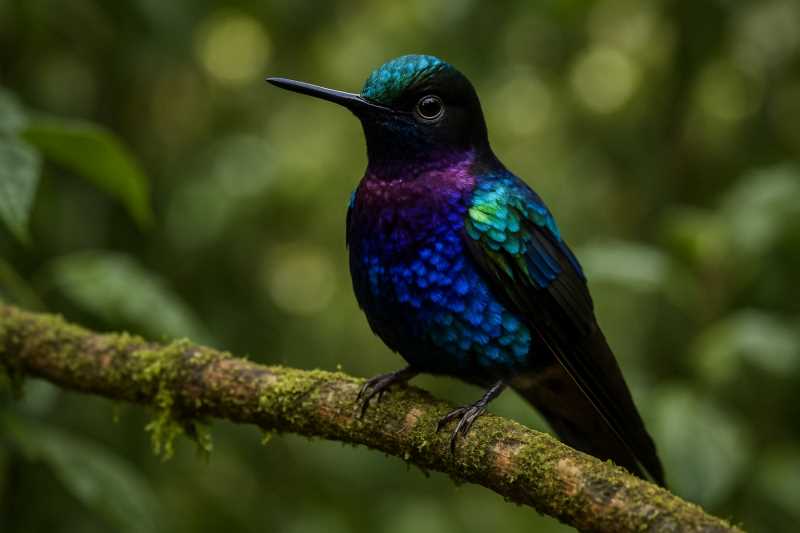
The male has a velvety black head and throat, a glittering purplish-blue crown, and shining blue-green upperparts. The breast and belly are strongly iridescent, ranging from blue to violet. Cinnamon to orange underwing-coverts become conspicuous when the bird raises or spreads its wings. The slightly notched tail has black central feathers, while the outer feathers are mainly white with black tips and edges.
Females resemble males but are duller overall. Their breast and belly feathers have buff or greyish-brown fringes, and the tail notch is less pronounced. Juveniles are similar to females, with less intense colour and more extensive brownish edging on the underparts.
Range and Habitat
The species occurs along the western slope of the Andes from Colombia’s Chocó region south through parts of western Colombia to north-western Ecuador, particularly in the province of Pichincha. It is considered a Chocó-Andean species and is not known to undertake long-distance migration.
Velvet-purple Coronets are associated with wet, moss-rich primary and secondary forest, forest borders, clearings and shrubby vegetation. Records range from roughly 350 to 2,200 metres above sea level, although the species is most often encountered above about 1,200 metres. It may make local or seasonal movements along elevational gradients, particularly in Colombia.
The species is monotypic, with no currently recognised subspecies. Its dependence on humid forest and flowering vegetation makes it vulnerable to the continuing loss and fragmentation of western Andean habitats.
Where to See This Species
Reserva Las Tangaras, Chocó, Colombia
Reserva Las Tangaras is a recognised birding site in the western Andes where Velvet-purple Coronets have been recorded in humid lower montane forest and at hummingbird feeders. The reserve’s forest trails, flowering plants and feeding stations provide realistic opportunities to look for the species, particularly during periods of good flowering activity.
Nearby accommodation: The nearest practical base is the rural Las Tangaras reserve area, with lodge-style accommodation available at or near the reserve and additional guest houses and small hotels in nearby western Andean settlements.
Refugio Paz de las Aves, Pichincha, Ecuador
Refugio Paz de las Aves, near Mindo, is a publicly accessible wildlife-viewing venue in suitable Andean cloud-forest habitat. The species has been documented there, and the reserve’s forest, gardens and hummingbird-feeding areas offer a practical place to search for it during a guided visit.
Nearby accommodation: Mindo is the principal gateway, with a wide choice of lodges, guest houses, small hotels and self-catering accommodation.
Amagusa Reserve, Pichincha, Ecuador
Amagusa Reserve in the Mashpi area protects humid Chocó-Andean forest and is a documented site for Velvet-purple Coronet. Look along forest edges, flowering shrubs and reserve feeding areas, especially in the mid-elevation cloud forest.
Nearby accommodation: Accommodation is available in the Mashpi area, including reserve lodges and rural ecolodges, while Mindo and Nanegalito provide broader choices of guest houses and small hotels.
Behaviour and Diet
Velvet-purple Coronets are active, agile fliers that may forage from the lower forest strata to the canopy. They take nectar from a range of flowering plants and also capture small insects and other arthropods, which provide an important source of protein.
They are territorial around productive flowers and may chase other hummingbirds from favoured feeding areas. After landing on a flower, an individual may briefly hold its wings raised, exposing the cinnamon underwing-coverts. This behaviour is useful for identification and is particularly noticeable at close range or at feeding stations.
Breeding information remains limited. The female is believed to build a small cup-shaped nest from moss, plant fibres and other soft materials, often attaching it to a branch or fork. Clutches usually contain two eggs. As in many hummingbirds, the female is responsible for incubation and care of the young.
Identification Tips
- Look for a dark, velvety-looking hummingbird that flashes purple, blue and green when struck by light.
- The short, straight black bill and white spot behind the eye are useful structural features.
- The cinnamon or orange underwing-coverts are conspicuous when the bird lifts its wings after landing.
- The tail is slightly notched, with black central feathers and mainly white outer feathers marked with black tips and edges.
- Females are less vividly coloured and show buff or greyish-brown edging on the breast and belly.
- The Buff-tailed Coronet is generally greener and has a much more obviously buff tail. The Chestnut-breasted Coronet has chestnut underparts rather than the Velvet-purple Coronet’s blue-violet breast and belly.
Conservation Status
The Velvet-purple Coronet is classified as Least Concern on the IUCN Red List. This global category reflects its broad enough range and current assessment, but it does not mean that the species is free from conservation pressure.
The principal concern is the destruction, degradation and fragmentation of humid western Andean forest through agriculture, settlement expansion, road building and other land-use changes. Protecting remaining cloud forest, maintaining habitat corridors and supporting well-managed reserves are important measures for the species and for the wider Chocó-Andean ecosystem.
Frequently Asked Questions
Where can the Velvet-purple Coronet be found?
It occurs on the Pacific-facing slopes of the Andes in southwestern Colombia and north-western Ecuador, especially in humid montane forest and forest-edge habitats.
Is the Velvet-purple Coronet migratory?
It is generally considered resident rather than migratory, although local or seasonal movements along elevational gradients may occur.
How large is the Velvet-purple Coronet?
It is about 11–12.7 centimetres long and weighs approximately 8–8.5 grams.
What does the Velvet-purple Coronet eat?
Its diet consists mainly of nectar, supplemented by small insects and other arthropods. It often defends productive flowers from competing hummingbirds.
How can it be identified in the field?
Look for the combination of a velvety black head and throat, iridescent blue-violet underparts, blue-green upperparts, cinnamon underwing-coverts, a white spot behind the eye and a slightly notched black-and-white tail.
Is the Velvet-purple Coronet threatened?
It is currently listed as Least Concern, but forest loss and fragmentation remain important local threats. Conservation of humid Andean forest is essential for maintaining suitable habitat.
References
- BirdLife International
- IUCN Red List of Threatened Species
- Cornell Lab of Ornithology, Birds of the World
Related posts