Introduction
The Flying Steamer Duck, Tachyeres patachonicus, is a large South American waterfowl species in the family Anatidae. It occurs mainly in Patagonia, Tierra del Fuego and adjacent areas of southern Chile and Argentina. Unlike the other recognised steamer ducks, it retains the ability to fly, although it often prefers to escape by swimming or diving. The name refers to its distinctive habit of using its wings and feet to drive itself rapidly across the water, resembling a paddle steamer.
Physical Description
The Flying Steamer Duck is a robust duck measuring approximately 60–70 cm in length. Reported body mass is generally about 2.4–3.2 kg, although measurements vary between individuals and populations. Males are usually larger than females.
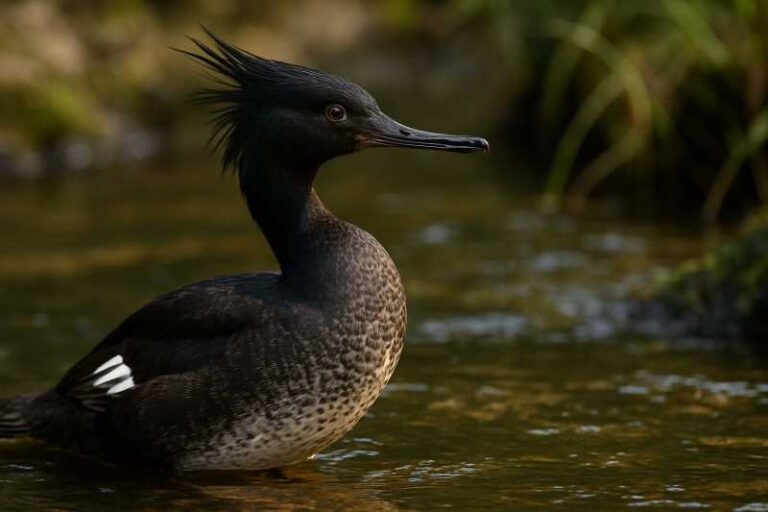
Adults have predominantly slate-grey or grey-blue plumage, with paler feather centres that can give the back and flanks a subtly scaled appearance. The belly and undertail are white. A conspicuous white eye-ring and post-ocular stripe extend towards the neck, while the wings show a broad white speculum bordered by darker feathers. The bill is yellow to orange-yellow, often with a darker hooked tip, and the legs are yellowish with darker feet.
Males usually have a paler grey head and a stronger orange-yellow bill. Females are smaller and tend to have a darker, browner or wine-coloured head and upperparts, with a duller bill. Juveniles resemble females but are generally duller overall. Head colour can vary with age, sex and moult, so it should not be used as the sole identification feature.
Range and Habitat
The species is distributed across southern Argentina and Chile, including Patagonia and the Tierra del Fuego region. It is also recorded in the Falkland Islands, although island birds require careful identification because the flightless Falkland Steamer Duck, Tachyeres brachypterus, also occurs there.
Flying Steamer Ducks use a wider range of habitats than the primarily marine flightless steamer ducks. They are commonly associated with inland lakes, lagoons, rivers and estuaries, including open water in Patagonian steppe and lightly wooded landscapes. They may also occur along sheltered marine coasts, bays, fjords and river mouths, particularly outside the breeding season or where inland waters freeze.
The species is generally resident within its range, although individuals may make local or seasonal movements between inland and coastal waters. It has been recorded from sea level to approximately 1,500 metres in parts of Patagonia.
Behaviour and Diet
Flying Steamer Ducks are strong swimmers and divers. They often sit low in the water and may leave a broad wake when swimming. When disturbed, they commonly dive, swim away or run heavily across the surface while beating their wings before taking flight. Their wings and feet are used together during rapid surface movement, producing the characteristic “steaming” action shared by the genus.
Pairs are often observed together, and the species can be territorial and aggressive, particularly during the breeding season. It may defend feeding or nesting areas against other waterbirds. Outside the breeding season, larger groups can form, especially on suitable coastal or inland waters.
The diet consists principally of aquatic invertebrates, especially molluscs and crustaceans. The birds obtain food by diving and probing underwater, and may also take other small aquatic animals when available. The strong bill and powerful swimming ability are well suited to foraging on or near the bottom.
Breeding generally takes place during the Southern Hemisphere spring and summer. Nests are made from grass and other plant material and are lined with down. They are usually placed close to water, among tall vegetation or on islands and islets, although some nests may be situated farther from the shore. Clutch sizes of approximately five to ten pale, creamy or buff-tinted eggs have been reported. The female undertakes most incubation, while the male may defend the nesting territory and sometimes remains near the brood. Ducklings are precocial and can swim soon after hatching.
Identification Tips
Look for the following combination of features:
- A large, heavy-bodied duck with slate-grey plumage.
- A white eye-ring and white stripe extending behind the eye.
- White belly and undertail contrasting with darker grey upperparts.
- A broad white wing speculum, most obvious when the wings are raised or during flight.
- Yellowish to orange-yellow bill and yellowish legs.
- A low swimming posture and a broad wake when moving quickly.
- Frequent use of wing-assisted swimming, diving or surface-running instead of immediate flight.
In coastal habitats, compare it carefully with the Fuegian Steamer Duck, Tachyeres pteneres, which is larger, flightless and usually shows less obvious sexual dimorphism. On the Falkland Islands, it must also be distinguished from the flightless Falkland Steamer Duck, Tachyeres brachypterus. Flight capability can be useful, but a bird should not be assumed to be this species solely because it flies, as behaviour can vary and some Flying Steamer Ducks may remain on the water when disturbed.
Conservation Status
The Flying Steamer Duck is currently assessed as Least Concern on the IUCN Red List. The available assessment does not indicate that the species is globally threatened, but its status should not be interpreted as evidence that every local population is secure.
The species depends on healthy freshwater, estuarine and sheltered coastal habitats. Local risks may include wetland alteration, disturbance, pollution, accidental capture in fishing gear and changes in food availability. Continued protection of Patagonian wetlands and coastal waters, together with monitoring of population trends and breeding success, is appropriate for maintaining the species across its range.
Frequently Asked Questions
Where does the Flying Steamer Duck live?
It occurs in southern Argentina and Chile, including Patagonia and Tierra del Fuego, and is also recorded in the Falkland Islands. It uses lakes, lagoons, rivers, estuaries and sheltered coastal waters.
Can the Flying Steamer Duck fly?
Yes. It is the only generally recognised steamer duck that retains regular flight across its range, although it often prefers to swim, dive or run across the water when disturbed.
What does the Flying Steamer Duck eat?
Its diet consists mainly of aquatic invertebrates, particularly molluscs and crustaceans. It obtains food by diving and probing underwater and may take other small aquatic animals.
Why is it called a steamer duck?
The name refers to the way it uses its wings and feet to propel itself rapidly across the water. This creates a broad wake and resembles the movement of an old paddle steamer.
How can the species be identified?
It is a large grey duck with a white eye-ring and post-ocular stripe, a white belly, a broad white wing speculum and a yellowish or orange-yellow bill. Its low swimming posture and wing-assisted surface movement are also useful clues.
Is the Flying Steamer Duck endangered?
No. The species is currently classified as Least Concern by the IUCN. Nevertheless, local habitat degradation, disturbance, pollution and other pressures may affect particular populations and should be monitored.
References
- BirdLife International. 2018. Tachyeres patachonicus: BirdLife International: The IUCN Red List of Threatened Species 2018. IUCN Red List of Threatened Species, e.T22680052A132524796. https://doi.org/10.2305/IUCN.UK.2018-2.RLTS.T22680052A132524796.en. Accessed 8 September 2026.
- Gill, F., Donsker, D. and Rasmussen, P. (eds). 2026. IOC World Bird List, version 15.2. International Ornithologists’ Union. https://www.worldbirdnames.org/ Accessed 8 September 2026.
- Livezey, B. C. and Humphrey, P. S. 1986. Flightlessness in steamer-ducks (Anatidae: Tachyeres): its morphological bases and probable evolution. Evolution 40(3): 540–558. https://doi.org/10.1111/j.1558-5646.1986.tb00506.x
- Weller, M. W. 1976. Ecology and behaviour of steamer ducks. Wildfowl 27: 45–53. https://tidsskrift.dk/Wildfowl/article/view/154343
- Ministerio del Medio Ambiente, Chile. n.d. Tachyeres patachonicus King, 1831. Plataforma Políticas de la Biodiversidad, species account 5082. https://simbio.mma.gob.cl/Especies/Details/5082 Accessed 8 September 2026.
- Sistema de Información de Biodiversidad, Administración de Parques Nacionales, Argentina. n.d. Tachyeres patachonicus (Quetro Volador, Flying Steamer-duck). https://sib.gob.ar/especies/tachyeres-patachonicus Accessed 8 September 2026.
- Edelaar, P. and García Borboroglu, P. 2005. Identificación de patos vapor Tachyeres spp.: desconocimiento, controversias, malentendidos y posibilidades. XI Reunión Argentina de Ornitología. https://rao.avesargentinas.org.ar/sobre/xi-rao/identificacion-de-patos-vapor-tachyeres-spp-desconocimiento-controversias-malentendidos-y-posibilidades/ Accessed 8 September 2026.
Related posts