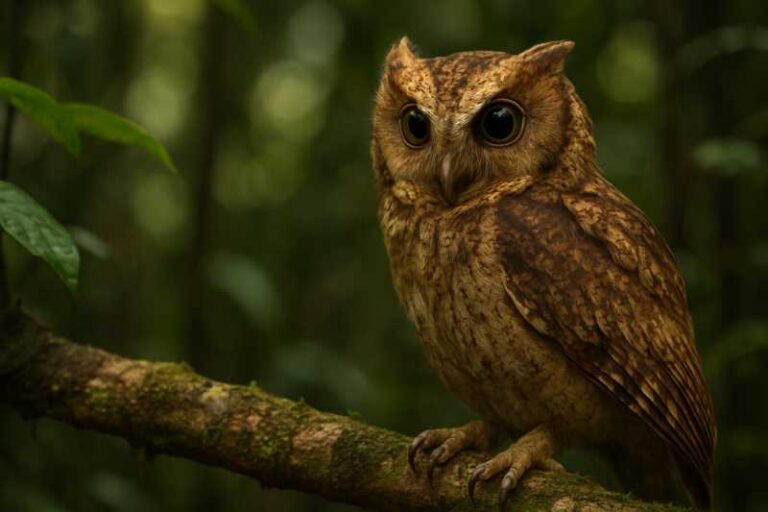
Deep within the dense undergrowth of Australia’s temperate rainforests, a small, secretive bird sings a powerful and far-carrying tune. This is the Rufous Scrub-bird (Atrichornis rufescens), a species so elusive and rarely seen that it has become an icon of conservation in eastern Australia. With its cryptic plumage, limited range, and booming call, the Rufous Scrub-bird is one of the continent’s most fascinating yet vulnerable avian inhabitants.
Identification and Description
The Rufous Scrub-bird is a small, ground-dwelling bird measuring around 17 cm in length. Its plumage is primarily rich rufous-brown with mottled patterns that help it blend seamlessly with the forest floor. It has a short, cocked tail, strong legs, and a fine, slightly downcurved bill suited to probing through leaf litter.
Despite its unassuming appearance, the species is famous for its extraordinarily loud and metallic call—a sharp “whee-tew!” or “shreep!”—which it uses to defend territory and attract mates. This vocal power is particularly striking given the bird’s small size and reclusive nature.
Range and Habitat
Endemic to Australia, the Rufous Scrub-bird once occupied a broad range across the eastern coast, but its habitat has dramatically shrunk. Today, the species survives in two isolated populations:
- The New England Tablelands in northern New South Wales
- The Border Ranges straddling southern Queensland and northern New South Wales
These birds inhabit cool, moist forests, particularly wet sclerophyll forests and subtropical rainforests at higher elevations. Dense understorey vegetation, deep leaf litter, and minimal disturbance are critical habitat features.
Behaviour and Ecology
Rufous Scrub-birds are notoriously shy and are seldom seen. They prefer to stay hidden in thick ground vegetation, where they move quietly and forage for insects, spiders, and other invertebrates among the leaf litter. Their feeding behaviour includes careful flicking and probing with their bill, often leaving little sign of their presence aside from their loud vocalisations.
They are territorial, and males are particularly vocal during the breeding season (spring and early summer). Their calls can be heard from surprisingly far distances and are often the only clue to their presence. Despite the volume, locating a calling bird can be difficult, as they are masters of staying concealed.
Breeding and Nesting
The Rufous Scrub-bird’s nest is a well-hidden dome structure, constructed from moss, bark, and leaves, with a side entrance. It is typically placed near the ground within dense vegetation or beneath fallen logs.
Only the female incubates the eggs, usually two per clutch, while the male defends the territory and continues vocal displays. Breeding success is sensitive to environmental disturbances, predation, and climatic conditions, which makes undisturbed habitat crucial.
Conservation Status
The Rufous Scrub-bird is classified as Endangered by both the IUCN Red List and under Australia’s Environment Protection and Biodiversity Conservation Act. Its population is estimated to be between 1,000 and 2,500 mature individuals, with continuing declines due to habitat loss, fragmentation, and the impacts of climate change.
Key threats include:
- Logging and land clearing
- Invasive predators such as foxes and cats
- Fire regime changes
- Increasing frequency of extreme weather events
Conservation actions include habitat protection, survey and monitoring programs, fire management, and community awareness initiatives. In some areas, targeted habitat restoration is underway to connect fragmented populations and promote breeding.
Significance and Scientific Importance
The Rufous Scrub-bird belongs to the ancient family Atrichornithidae, closely related to lyrebirds. Its lineage stretches back tens of millions of years, offering important insights into Australia’s evolutionary history. Its continued survival is not only vital for biodiversity but also for the preservation of one of Australia’s most distinct avian legacies.
It is considered a flagship species for conservation in the rainforests of eastern Australia. Its presence (or absence) is a key indicator of forest health and understorey integrity.
Birdwatching Tips
Seeing a Rufous Scrub-bird is a rare and rewarding experience. The best chance is to visit sites such as Washpool National Park, New England National Park, or the Border Ranges during the spring months when males are calling most frequently.
Use of playback calls is controversial and discouraged in sensitive populations, as it may disturb territorial birds. Instead, rely on quiet, patient listening walks through known territories. Look for areas with thick understorey and wet leaf litter—ideal Rufous Scrub-bird habitat.
Conclusion
The Rufous Scrub-bird is a testament to the rich, hidden diversity of Australia’s forests. Though small and secretive, its powerful voice echoes through misty gullies as a reminder of a prehistoric lineage and a fragile ecosystem. Protecting this species means protecting entire mountain ecosystems—forests that are vital not only for birds, but for the health of our planet.
Related posts