Introduction
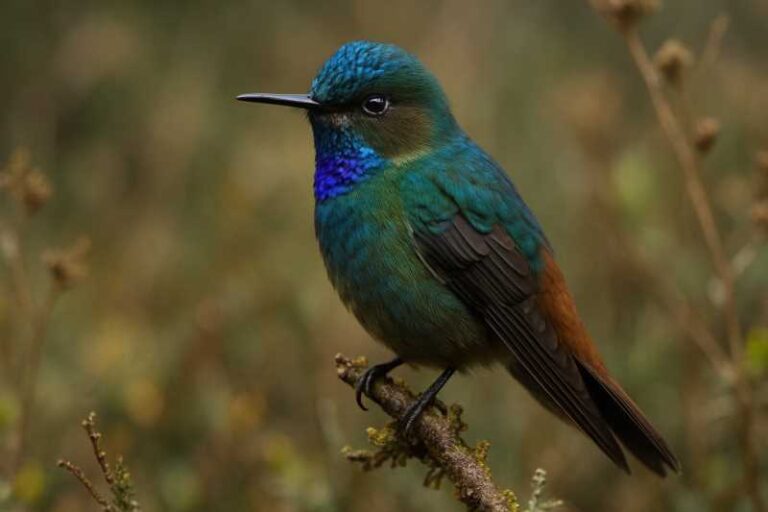
The Frilled Coquette (Lophornis magnificus) is a tiny hummingbird endemic to Brazil. It is best known for the male’s rufous crest and fan-shaped neck feathers, which contrast with iridescent green plumage. Although associated with the Atlantic Forest, the species also uses secondary woodland, forest edges, gardens, coffee plantations and cerrado habitats.
Physical Description
The Frilled Coquette measures approximately 7–8 centimetres in length and weighs about 3 grams. Both sexes have bronzy-green upperparts, a narrow white band across the rump and a short, straight bill that is reddish at the base and black-tipped.
The adult male is much more elaborate than the female. He has a long, erectile rufous-orange crest, an iridescent green forehead and throat, and prominent white cheek and throat feathers tipped with metallic green. The central tail feathers are bronzy green, while the outer feathers are rufous with darker edging.
The female lacks the crest and ornamental cheek feathers. She is mainly green above, with paler underparts, a less strongly marked throat and a darker bronze tail with rufous at the tips. Juveniles resemble adult females and gradually develop adult plumage as they mature.
Range and Habitat
The Frilled Coquette is endemic to Brazil, occurring mainly in the east-central and eastern parts of the country. Its range extends from areas including Espírito Santo and Rio de Janeiro southwards, with records farther west and occasional records in northern states. Documented records from southern Brazil have helped clarify the species’ distribution.
It is not restricted to continuous primary forest. Suitable habitats include humid forest edges, secondary woodland, semi-open vegetation, coffee plantations, gardens and cerrado. The species has been recorded from near sea level to approximately 1,000 metres. It appears to make some seasonal local movements, possibly following changes in flowering and nesting conditions, but it is not considered a long-distance migrant.
Where to See This Species
Itatiaia National Park, Rio de Janeiro, Brazil
Itatiaia National Park is one of the most reliable publicly accessible locations for looking for the Frilled Coquette. The species is documented from the park, particularly in humid lower-elevation forest, forest edges and flowering gardens. It may visit flowering plants and feeders, although sightings are not guaranteed.
Nearby accommodation: The town of Itatiaia and the nearby settlement of Penedo provide hotels, guest houses, lodges and self-catering accommodation for visitors to the park.
Brasília National Park, Federal District, Brazil
The Frilled Coquette is included in the official bird guide for Brasília National Park. Birders should check wooded edges, gallery-forest margins and flowering vegetation, especially where cerrado meets denser woodland. Local conditions and seasonal food availability may influence how often it is encountered.
Nearby accommodation: Brasília is the practical accommodation base, with a wide range of hotels, guest houses and self-catering options.
Behaviour and Diet
The Frilled Coquette is active during the day and usually forages alone. It takes nectar from a variety of small flowers and supplements this energy-rich food with small arthropods, including insects and spiders. It may catch insects in short sallies from a perch and can hover precisely while feeding.
Like many hummingbirds, it can be assertive around concentrated food resources. However, it may defer to larger hummingbirds at flowers or feeding sites. The species’ rapid flight and small size can make it difficult to follow once it moves into dense vegetation.
Breeding is reported mainly from August to March. The female builds the nest alone, making a small cup from plant down, moss and other fine materials, often decorating the outside with lichens. The nest is typically placed on a branch of a shrub or small tree. A clutch normally contains two white eggs, and the female is responsible for incubation and care of the young. Published accounts report an incubation period of roughly 12–13 days, with fledging about 20 days after hatching.
Identification Tips
- Look for a very small hummingbird, approximately 7–8 centimetres long, with a white rump band.
- An adult male is distinctive because of his rufous crest and broad, fan-like white cheek feathers with green tips.
- The male’s forehead and throat are iridescent green, while his body is mainly bronzy green.
- Females and juveniles lack the crest and frilled cheek feathers. Their darker bronze tail with rufous tips is useful for recognition.
- The short, straight, reddish bill with a black tip helps separate the species from hummingbirds with longer or more strongly curved bills.
- In flight, the white rump band and very small size may be more noticeable than the male’s crest, which can be held flat against the body while hovering.
Conservation Status
The Frilled Coquette is currently assessed as Least Concern. A global population estimate and detailed population trend are not available, so this status should not be interpreted as evidence that all local populations are secure.
Habitat loss and fragmentation remain relevant concerns, particularly where forest is cleared for agriculture, urban development or other land uses. The species’ ability to use secondary vegetation, plantations and gardens may provide some resilience, but the protection of native forest, flowering resources and habitat connections remains important. Protected areas, habitat restoration and responsible management of gardens and farms can help maintain suitable conditions.
Frequently Asked Questions
Where does the Frilled Coquette live?
The Frilled Coquette is endemic to Brazil. It occurs mainly in eastern and east-central Brazil, using humid forest edges, secondary woodland, gardens, coffee plantations and cerrado as well as more continuous forest.
How large is a Frilled Coquette?
It is approximately 7–8 centimetres long and weighs about 3 grams, making it one of Brazil’s smallest hummingbirds.
How can you identify a male Frilled Coquette?
The male has a rufous-orange crest, iridescent green forehead and throat, and white fan-shaped cheek feathers edged with green. A white band across the rump is visible in both sexes.
What does the Frilled Coquette eat?
It feeds mainly on nectar from small flowers and also takes small arthropods, including insects and spiders. Insects may be caught during short flights from a perch.
Is the Frilled Coquette migratory?
It is not considered a long-distance migrant. Some seasonal local movement may occur as flowering and nesting conditions change.
Where can I see a Frilled Coquette?
Itatiaia National Park in Rio de Janeiro is a well-documented place to look for the species. Brasília National Park also lists it in its official bird guide. Sightings depend on local conditions, season and food availability.
References
- IOC World Bird List
- Cornell Lab of Ornithology, Birds of the World
- Instituto Chico Mendes de Conservação da Biodiversidade
Related posts