Introduction
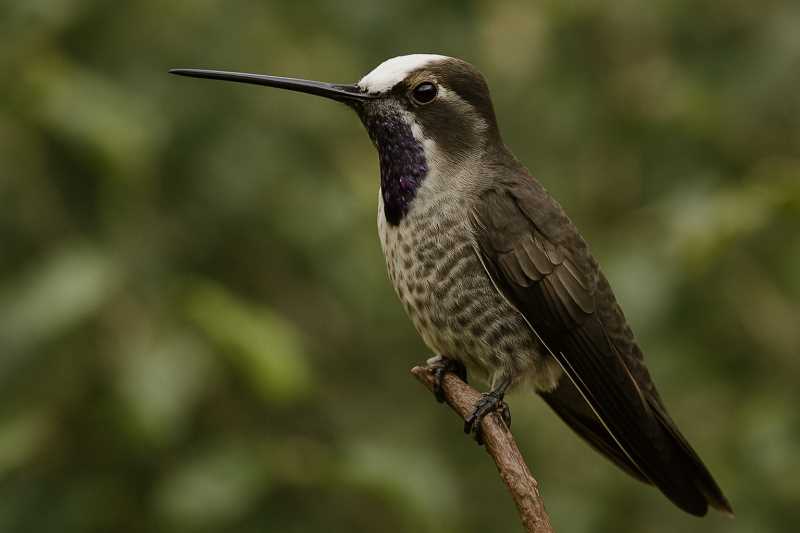
The Plain-capped Starthroat (Heliomaster constantii) is a large, long-billed hummingbird of dry forests, woodland edges and scrublands from western Mexico through Central America to north-western Costa Rica. Its subdued bronze-green plumage can make it easy to overlook, but the white rump stripe, long bill and concealed pinkish-red throat patch are distinctive field marks.
Physical Description
The Plain-capped Starthroat measures approximately 10–15 cm in length and weighs about 3–6 g. It has a relatively large body, a very long, straight to slightly decurved black bill, narrow wings and a short, notched or rounded tail.
The upperparts are bronze-green, while the underparts are generally greyish or dull green. A broad white stripe behind the eye, white feathering at the sides of the breast and a conspicuous white stripe across the rump are important identification features. The metallic pinkish-red gorget is usually visible only in favourable light or when the bird turns its head, so it may appear plain overall.
Males and females are broadly similar in appearance, with differences in the extent and intensity of the throat colour. Immature birds may have a darker, sooty throat with pale grey feather edges and less obvious adult markings. Plumage varies geographically, and some recognised forms differ subtly in underpart colour, bill proportions and gorget tone.
Range and Habitat
The species breeds from north-western Sonora and western Mexico south through Central America to north-western Costa Rica. It is resident across much of its range, although birds in northern Sonora show seasonal movements. It is a rare or casual visitor to the United States, particularly in south-eastern Arizona, with occasional records in New Mexico.
Plain-capped Starthroats occupy dry and semi-dry forest, open woodland, forest edges, thorn scrub, savanna and wooded canyons. They may also use streamside vegetation, arroyos and flowering clearings, especially where suitable nectar plants are available. The species is not restricted to a single elevation zone, and local records span lowlands and foothill habitats.
Three geographic forms are commonly recognised: H. c. pinicola in western Mexico, H. c. leocadiae in south-western Mexico and Guatemala, and the nominate H. c. constantii from El Salvador through Honduras and Nicaragua to north-western Costa Rica.
Where to See This Species
The Plain-capped Starthroat is uncommon in many areas, and sightings are not guaranteed. It is most realistic to search during periods of flowering activity, particularly along forest edges, stream corridors and open canyon vegetation.
Coronado National Memorial, Arizona, United States
The memorial has documented records of this species, including a report from Montezuma Pass. In south-eastern Arizona it is a rare late-spring and summer visitor, and observers should check flowering agaves, canyon vegetation and other open woodland areas. Local records are occasional rather than regular, so recent bird reports are useful before visiting.
Nearby accommodation: Sierra Vista and the surrounding Huachuca Mountains provide hotels, guest houses, cabins and self-catering accommodation.
White Sands National Park, New Mexico, United States
The National Park Service bird checklist lists the Plain-capped Starthroat as an accidental migrant. This makes the park a very unlikely destination for the species, but it is a verified public venue with a documented record. Any search would be most sensible around vegetated margins and other areas where flowering plants and insects occur, particularly during the warmer months.
Nearby accommodation: Alamogordo is the practical gateway town, with hotels, motels, guest houses, campsites and self-catering options.
El Imposible National Park, Ahuachapán Department, El Salvador
A published avian inventory recorded Plain-capped Starthroats in and around the park’s forest and lakeside habitats during late May, early June and July. The park’s dry forest, woodland edges and flowering vegetation provide suitable habitat, although the species is regarded as uncommon in El Salvador. Visits should be arranged in accordance with current park access requirements.
Nearby accommodation: Tacuba is the nearest recognised gateway settlement, with small guest houses and rural accommodation in the surrounding area.
Behaviour and Diet
Plain-capped Starthroats feed mainly on nectar from a range of flowering trees, shrubs and other plants. They may also take small insects and spiders, either by hawking them in flight or gleaning them from vegetation. This animal protein is particularly important during breeding and for the growth of young birds.
Like other hummingbirds, they hover while feeding and beat their wings rapidly. Individuals may defend productive flowers or feeding areas from other hummingbirds, and chases can be accompanied by sharp chips or high-pitched calls. The species is usually encountered alone rather than in organised flocks.
Breeding biology remains poorly documented. In western Mexico, breeding has been recorded mainly from January to June, while records from Costa Rica indicate breeding between October and January. The female builds a shallow cup nest using soft plant material and spider silk, with bark or lichen sometimes added to the exterior. Nests are typically placed near the end of a branch high in a tree. The original article’s precise incubation and fledging figures are not retained because reliable species-specific evidence is limited.
Identification Tips
- Look for a large, long-billed hummingbird with a relatively short tail.
- Check for the broad white stripe behind the eye and the white stripe across the rump.
- The white side tufts can be conspicuous when the bird turns or spreads its wings.
- The bronze-green upperparts contrast with greyish underparts and a generally subdued appearance.
- The pinkish-red gorget may appear only briefly in direct light, so do not reject a likely bird because the throat looks grey.
- The exceptionally long bill is often the easiest feature to notice at a distance.
- Distinguish it from other long-billed hummingbirds by combining the short tail, white rump stripe, white facial marking and plain greyish throat. Care is needed because lighting can conceal the gorget and alter the apparent colour of the plumage.
Conservation Status
The Plain-capped Starthroat is classified as Least Concern on the IUCN Red List. It has a broad distribution and occurs in a variety of habitats, although it is uncommon in some parts of its range and highly localised in the United States.
No immediate species-wide threat is identified in the available global assessment. Nevertheless, the loss and fragmentation of dry forest, woodland edges and flowering habitat may affect local populations. Protecting native vegetation, maintaining flowering plants and conserving forest corridors can help preserve feeding and breeding habitat. More information is also needed about population trends and breeding success across the species’ range.
Frequently Asked Questions
Where can the Plain-capped Starthroat be found?
It occurs from western and north-western Mexico through Central America to north-western Costa Rica. It is only a rare or casual visitor to the United States, mainly in south-eastern Arizona and occasionally New Mexico.
How do you identify a Plain-capped Starthroat?
Look for a large hummingbird with an exceptionally long bill, bronze-green upperparts, greyish underparts, a white stripe behind the eye, white side tufts and a white rump stripe. The reddish throat patch is often difficult to see.
What does the Plain-capped Starthroat eat?
Its diet consists mainly of nectar from flowering plants, supplemented by small insects and spiders. It may catch insects in flight or pick them from foliage.
Is the Plain-capped Starthroat migratory?
It is resident through much of its range, but northern populations show seasonal movement. Birds appearing in Arizona and New Mexico are generally considered rare or accidental visitors rather than regular migrants.
Where does the Plain-capped Starthroat breed?
It breeds in suitable forest, woodland and scrub habitats from Mexico through Central America to north-western Costa Rica. Documented breeding seasons vary geographically, and many details of its reproductive biology remain unknown.
Is the Plain-capped Starthroat endangered?
No. The species is currently classified as Least Concern, although local habitat loss and the decline of flowering resources may create conservation concerns in some areas.
References
- BirdLife International and the IUCN Red List of Threatened Species
- Cornell Lab of Ornithology, Birds of the World
- National Park Service
Related posts