The Red-tailed Black-Cockatoo is one of Australia’s most iconic and charismatic parrots, known for its striking appearance, haunting calls, and strong cultural significance. Found across various parts of the Australian continent, this large cockatoo is both a marvel of the wild and a symbol of the challenges facing native wildlife amid habitat loss and climate change. With several subspecies exhibiting unique regional characteristics, the Red-tailed Black-Cockatoo continues to captivate birdwatchers, ecologists, and Indigenous communities alike.
Identification
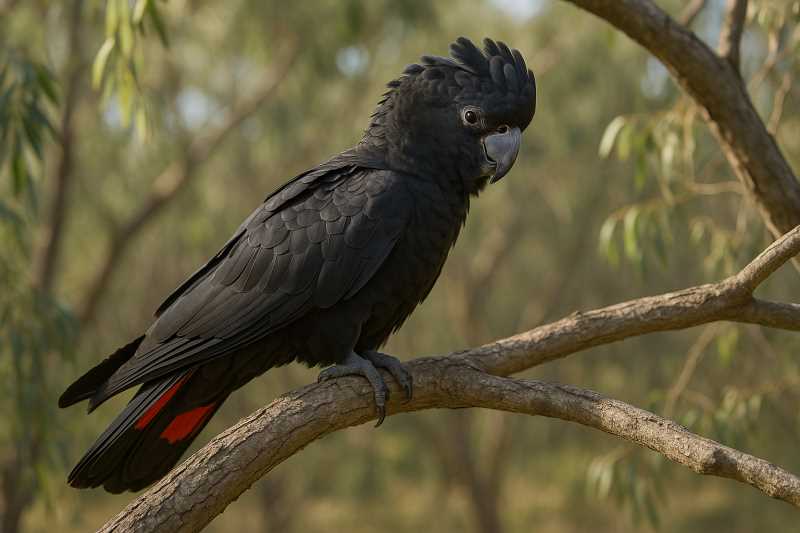
The Red-tailed Black-Cockatoo is a large, glossy black cockatoo, easily distinguished by its vibrant red tail panels, particularly prominent in adult males. Measuring 55–65 cm in length, this species exhibits sexual dimorphism. Males are entirely black with bright crimson tail feathers, while females are slightly smaller, adorned with yellow-orange spots on the head and chest, and barred orange-yellow markings on the tail. Their powerful, curved beaks are built for cracking hard seeds, while their crests can be raised in displays of emotion or alarm.
The bird’s call is a distinctive, harsh “kree” or “kaarrr,” which can be heard echoing through woodlands and open forests, particularly at dawn or dusk. Their slow, heavy wingbeats and wide-winged gliding flight further distinguish them in the air.
Habitat and Distribution
Red-tailed Black-Cockatoos inhabit a variety of environments depending on the subspecies and region. Their range extends across northern, central, and southwestern Australia, from semi-arid shrublands to tropical savannas and temperate eucalypt forests. Five recognized subspecies are distributed across different regions:
- C. b. banksii – northern Australia
- C. b. graptogyne – southeastern South Australia and western Victoria (endangered)
- C. b. naso – southwestern Western Australia
- C. b. samueli – central and western inland Australia
- C. b. macrorhynchus – tropical northern Australia
Each subspecies has adapted to its local ecosystem, with dietary and nesting preferences shaped by regional flora and environmental conditions.
Behavior
These cockatoos are highly social birds, often found in small to large flocks, especially outside the breeding season. They display complex social structures and engage in mutual preening, calling, and acrobatic flight displays. Red-tailed Black-Cockatoos are strong fliers and can cover large distances in search of food and suitable nesting sites.
They are also known for their playful nature, often seen hanging upside down from branches or engaging in mock battles in the air. At waterholes and roost sites, their noisy gatherings can be a spectacular sight and sound for observers.
Diet
Primarily granivorous, Red-tailed Black-Cockatoos feed on the seeds of native trees and shrubs, particularly eucalypts, casuarinas (she-oaks), banksias, and grevilleas. Their strong beaks allow them to extract seeds from tough cones and pods. Depending on the subspecies and location, they may also consume fruits, flowers, and occasionally insect larvae.
In agricultural areas, they are sometimes observed feeding on introduced crops like almonds, making them both admired and controversial in farming communities. Their dietary habits reflect both their adaptability and vulnerability to habitat changes that affect food availability.
Breeding
Red-tailed Black-Cockatoos typically breed during the dry season, though timing can vary based on regional climate conditions. Nests are built in large tree hollows, often in old eucalypts, where the female lays a single egg. She incubates the egg alone for about 30 days while the male provides food. After hatching, the chick remains in the nest for several months before fledging, and parental care can continue for a considerable time afterward.
The dependence on mature, hollow-bearing trees for nesting makes them especially sensitive to logging and land clearing, as suitable nesting sites can take over a century to form.
Conservation Status
While the overall species is not currently listed as globally threatened, several subspecies face significant conservation challenges. The southeastern subspecies (C. b. graptogyne), for example, is classified as endangered due to habitat fragmentation, loss of nesting sites, and low breeding success.
Conservation efforts include habitat restoration, installation of artificial nest boxes, community monitoring programs, and protection of old-growth trees. Indigenous groups play a critical role in conservation through traditional knowledge and land management practices that support cockatoo habitats.
Public interest in the Red-tailed Black-Cockatoo has also spurred ecotourism and educational campaigns, further raising awareness of the bird’s plight and the importance of preserving native woodlands across Australia.
Related posts