Exploring Prevost’s Ground Sparrow: A Jewel of Central America
Prevost’s Ground Sparrow (Melozone biarcuata) stands as one of the more elusive yet captivating avian species in Central America. Nestled in the undergrowth of dense forests and agricultural lands, this bird captivates ornithologists and birdwatchers alike with its striking appearance and distinctive behaviors. This article delves into the life of this remarkable species, exploring its habitat, physical characteristics, behavior, and conservation status.
Habitat and Distribution
Prevost’s Ground Sparrow is mainly found in the montane and subtropical forests of Central America, with a range that includes southern Mexico, Guatemala, Honduras, and El Salvador. This bird prefers the underbrush within these forests, often inhabiting areas with dense vegetation and proximity to water sources. It is not uncommon to spot them in coffee plantations and secondary growth forests, where they find sufficient cover and food resources.
The habitat preference of Melozone biarcuata significantly influences its distribution. While they can adapt to modified habitats, their presence is a strong indicator of the health of native forest ecosystems. This adaptability, however, is not without limits, as extensive deforestation poses a notable threat to their populations.
Physical Characteristics
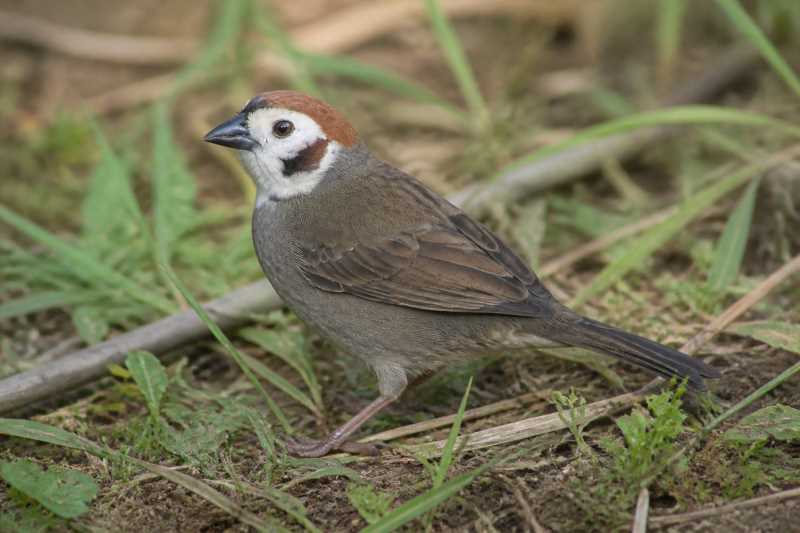
Characterized by its vibrant plumage, the Prevost’s Ground Sparrow is a visual delight. Adults typically measure around 17 to 18 centimeters in length. Their most striking feature is the rich chestnut coloration on their back and wings, contrasted with a white belly and greyish underparts. The bird’s head is adorned with a distinctive black crown and facial markings that enhance its striking appearance. The species also features a robust beak adapted to their diet, along with strong legs that facilitate their ground-dwelling lifestyle.
Juveniles exhibit a more subdued coloration, lacking the sharp contrasts seen in adults. This dimorphism is not only a fascinating aspect of their life cycle but also plays a role in their survival, as the muted tones help young birds remain inconspicuous to predators.
Behavior and Diet
Prevost’s Ground Sparrow is primarily a ground forager, navigating the forest floor with agility in search of food. Their diet predominantly consists of seeds, insects, and small invertebrates. Their foraging technique involves a distinctive scratching motion, using their feet to uncover food beneath the leaf litter. This behavior is not only essential for their sustenance but also contributes to the ecological dynamics of their habitat by aiding in seed dispersal and pest control.
Socially, they are known to be relatively solitary or found in pairs, especially during the breeding season. Their calls, a series of melodious whistles and trills, play a crucial role in communication, particularly in establishing territories and attracting mates. The breeding season, typically coinciding with the onset of the rainy season, sees these sparrows constructing cup-shaped nests in low shrubs or on the ground, further highlighting their ground-oriented lifestyle.
Conservation Status
The conservation status of Prevost’s Ground Sparrow is currently classified as Least Concern by the International Union for Conservation of Nature (IUCN). However, this status does not imply the species is free from threats. Habitat destruction due to agriculture expansion, logging, and urbanization poses significant risks. Conservation efforts must focus on preserving natural habitats and promoting sustainable land-use practices to ensure the long-term survival of these birds.
Local and international conservation organizations emphasize the importance of community-based conservation strategies. By involving local communities in conservation efforts, it becomes possible to achieve sustainable outcomes that benefit both the wildlife and the human populations that share their environment.
Conclusion
Prevost’s Ground Sparrow remains a symbol of the rich biodiversity found in Central America’s montane forests. Its striking appearance and unique behaviors make it a species of interest not only for scientific study but also for ecotourism, which can provide economic incentives for conservation. Protecting this species and its habitat requires a collaborative approach, integrating scientific research, community involvement, and policy-making to address the environmental challenges they face.
As we continue to explore the natural wonders of the world, the Prevost’s Ground Sparrow reminds us of the intricate connections within ecosystems and the role each species plays. By safeguarding these connections, we preserve not just the sparrow, but the symphony of life that thrives within these forests.
To truly appreciate the beauty and ecological significance of the Prevost’s Ground Sparrow is to acknowledge our responsibility in ensuring its survival for future generations to enjoy.
References
- BirdLife International. "Melozone biarcuata." IUCN Red List of Threatened Species.
- Howell, S. N. G., & Webb, S. (1995). A Guide to the Birds of Mexico and Northern Central America. Oxford University Press.
- Stiles, F. G., & Skutch, A. F. (1989). A Guide to the Birds of Costa Rica. Cornell University Press.
Related posts