Introduction
The Peaceful Dove, Geopelia placida, is a small, long-tailed pigeon native to Australia, New Guinea and parts of Indonesia. It is a resident species of open woodland, savannah, grassland, scrub and lightly modified habitats. Its quiet cooing, finely barred plumage and habit of feeding on the ground make it a familiar bird across much of northern and eastern Australia.
Physical Description
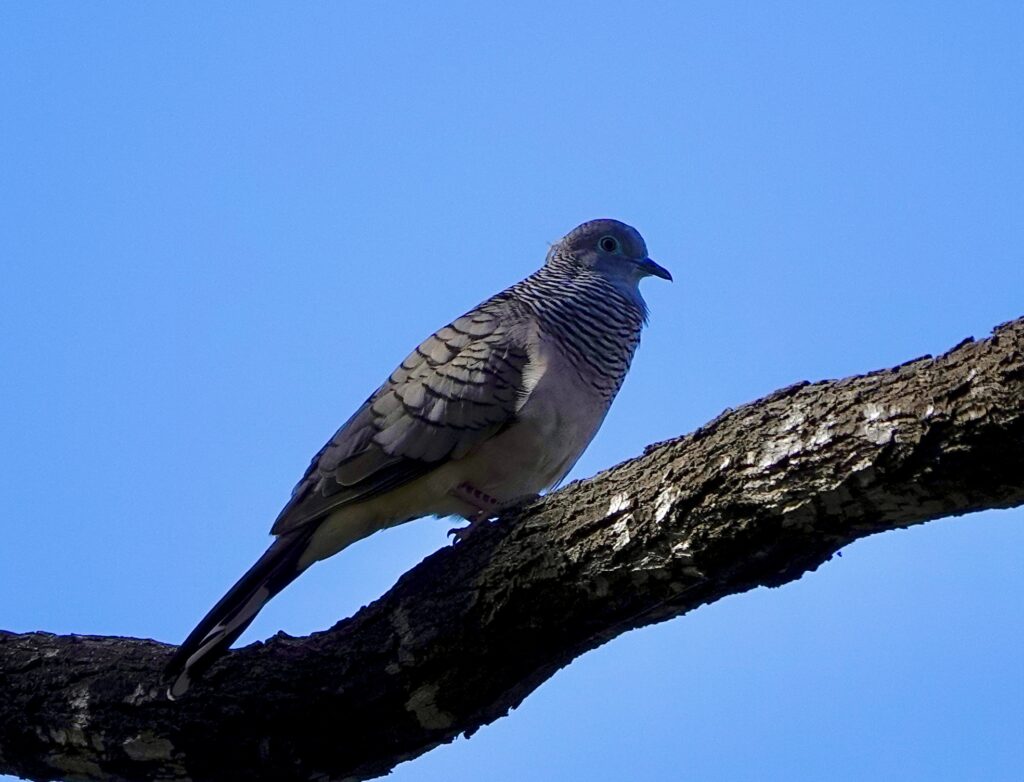
The Peaceful Dove measures approximately 19–21 centimetres in length. It has a slim body, a relatively long graduated tail and soft grey-brown upperparts. The face is blue-grey, with a bluish orbital ring around the eye and the upper base of the bill. Fine dark barring is especially noticeable across the throat, neck, nape and upper breast, while the lower underparts are pale grey to whitish.
The wings are grey-brown with darker barring and edging, giving the bird a subtly chequered appearance in good light. The sexes are very similar, with no consistently reliable difference in plumage. Adult males may average slightly larger than females, and some observers associate brighter blue bare skin around the eye with males, although this is not a dependable field mark.
Juveniles are generally paler and less strongly marked than adults. Their barring develops as they mature, and young birds may show duller grey or brown bare parts around the eye and bill.
Range and Habitat
The Peaceful Dove occurs across much of northern and eastern Australia, including the Northern Territory, Queensland and parts of New South Wales. It also occurs in New Guinea and Indonesia. The species is considered resident rather than migratory, although local movements may occur in response to food and water availability.
It favours open habitats rather than dense forest. Typical environments include open eucalypt woodland, tropical and subtropical savannah, grassland, dry scrub, rural gardens, pasture, cultivated land and the edges of wetlands. It often tolerates moderate habitat disturbance and may occur around towns, parks and lightly developed rural areas. The recorded elevation range extends from sea level to approximately 1,070 metres.
Where to See This Species
Kakadu National Park, Northern Territory, Australia
Peaceful Doves are documented in Kakadu National Park, where they feed along road verges and other open areas. Look for them on the ground near woodland margins, grassed areas and roadsides, particularly during quieter periods of the morning or late afternoon.
Nearby accommodation: Jabiru and Cooinda are the main gateway areas, with campsites, cabins, lodges and other visitor accommodation.
Fogg Dam Conservation Reserve, Northern Territory, Australia
Fogg Dam is a publicly accessible wildlife reserve with floodplain, woodland and monsoon habitats. Peaceful Doves occur in the wider Top End region, and the reserve’s open margins, tracks and woodland edges provide suitable places to search while birdwatching. Early morning is generally the most productive time for bird activity.
Nearby accommodation: Humpty Doo is the nearest practical settlement, while Darwin provides a wider range of hotels, guest houses, caravan parks and self-catering accommodation.
East Point Reserve, Darwin, Northern Territory, Australia
Peaceful Doves have been recorded in the biodiversity surveys for East Point Reserve. The reserve combines open woodland, grassed areas and coastal vegetation, making the inland tracks, clearings and habitat edges the most suitable places to look for this ground-feeding dove.
Nearby accommodation: Darwin is immediately accessible and offers hotels, apartments, guest houses, caravan parks and other visitor accommodation.
Behaviour and Diet
Peaceful Doves are usually seen singly, in pairs or in small groups. They spend much of their time walking on the ground beneath grasses and shrubs, where they search for fallen seeds. Larger gatherings may form near reliable water sources, especially in dry conditions.
The diet consists mainly of small seeds, including grass and other herbaceous plant seeds. Small invertebrates are also taken, particularly when available. The birds feed primarily on the ground and may use disturbed areas, roadsides, rural land and garden margins where suitable food is present.
Their soft, repeated coo is one of the easiest ways to detect them. Calling may continue from a low perch or concealed position, and vocalisations are used in communication between mates and nearby birds.
Peaceful Doves form long-term pair bonds. Both parents participate in raising the young, which may remain close to the adults after fledging. In the Northern Territory, breeding commonly occurs towards the end of the Wet Season and into the early Dry Season, although breeding timing varies across the species’ broad range. The nest is a small, simple platform made from fine twigs and other plant material, usually placed in low vegetation or a small tree.
Identification Tips
- Look for a small, slim dove with a long tail and subdued grey-brown plumage.
- The blue-grey face and blue eye-ring are useful clues at close range.
- Fine dark barring across the throat and neck is more extensive than in the Bar-shouldered Dove.
- The Peaceful Dove is smaller and more delicately built than the Bar-shouldered Dove.
- It is similar in overall size to the Diamond Dove, but the Diamond Dove has conspicuous white spots on the wings and a different, more distinctly spotted appearance.
- The Peaceful Dove usually feeds on the ground and often remains near grasses, woodland edges or open clearings.
- Its soft, repetitive coo can reveal a bird that is difficult to see in dense grass or low scrub.
Conservation Status
The Peaceful Dove is assessed as Least Concern. BirdLife International reports that the global population has not been quantified, but the species has an extremely large range and is considered widespread and adaptable. The population trend is currently regarded as stable.
There is no indication that the species is globally threatened, although local populations may be affected by habitat clearance, predation by introduced cats and foxes, and other pressures associated with land-use change. Protecting open woodland, grassland, scrub and reliable water sources benefits Peaceful Doves as well as many other ground-feeding birds.
Frequently Asked Questions
Where is the Peaceful Dove found?
The Peaceful Dove is found across much of northern and eastern Australia, as well as New Guinea and parts of Indonesia. It is a resident species and does not undertake regular long-distance migration.
What does a Peaceful Dove look like?
It is a small grey-brown dove with a long tail, a blue-grey face, a bluish eye-ring, pale underparts and fine dark barring across the throat, neck and upper breast.
What does the Peaceful Dove eat?
Its diet consists mainly of small seeds collected from the ground. It also eats small invertebrates when available and may use open areas, roadsides, gardens and rural land while foraging.
Is the Peaceful Dove the same as the Zebra Dove?
No. The Peaceful Dove was formerly treated by some authorities as an Australian subspecies of the Zebra Dove, but it is now generally recognised as the separate species Geopelia placida. The Zebra Dove is Geopelia striata and is native to parts of Southeast Asia.
Where is the best place to look for a Peaceful Dove?
Search quietly along grassy woodland edges, open tracks, road verges, parklands and the margins of wetlands. Kakadu National Park, Fogg Dam Conservation Reserve and East Point Reserve are documented viewing locations in Australia’s Northern Territory.
Are Peaceful Doves endangered?
No. The species is currently assessed as Least Concern, with a very large distribution and a suspected stable population trend. Local habitat loss and introduced predators can still affect individual populations.
References
- BirdLife International
- Parks Australia
- Northern Territory Government
Related posts