Introduction
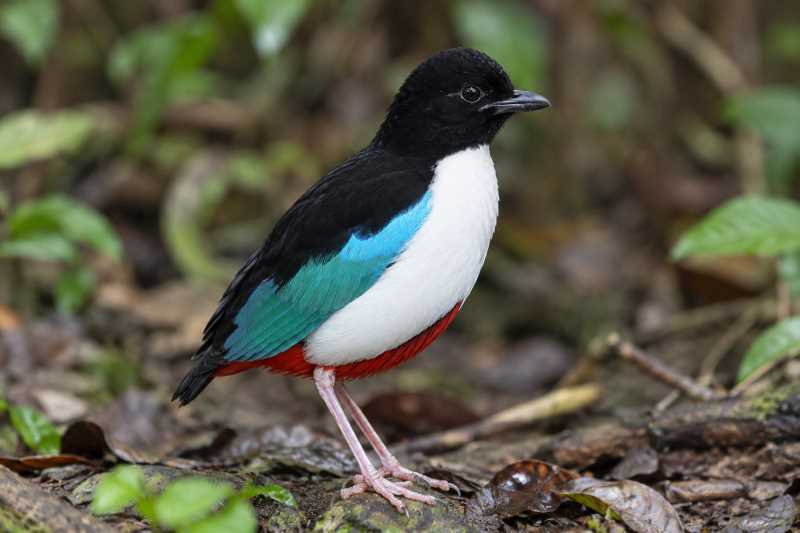
The Ivory-breasted Pitta, Pitta maxima, is a striking forest-floor bird endemic to Indonesia’s North Maluku islands. It is one of the largest pittas, with glossy black upperparts, a broad ivory-white breast, a vivid red lower breast and belly, and flashes of blue-green on the wings. Known locally as Paok Halmahera, it occurs mainly in humid lowland and foothill forests on Halmahera and nearby islands. Although its restricted island range makes habitat protection important, the species is currently assessed as Least Concern. (ksdae.kehutanan.go.id)
This pitta is easy to recognise when seen well, but it can be difficult to observe. It spends much of its time walking quietly through leaf litter and dense undergrowth, where its dark back provides excellent camouflage. Its loud, distinctive calls are often a more reliable indication of its presence than direct sightings.
Physical Description
The Ivory-breasted Pitta is a compact, powerful-looking passerine measuring approximately 25–28 centimetres in length. Available Indonesian identification material gives adult male mass as about 172–206 grams and female mass as about 166–172 grams, although weights can vary with condition and locality. It is among the largest members of the pitta family. (ksdae.kehutanan.go.id)
Adults have a glossy black head, mantle, back and tail. The chin and throat are also black, forming a strong contrast with the pale underparts. The breast, flanks and upper belly are predominantly ivory-white, while the centre of the lower breast, belly and undertail region are marked by a large red area. The red colour may appear richest on the lower belly and central underparts, especially in good light.
The upperwing coverts show metallic blue and green reflections. The main wings are black, crossed by a conspicuous white band on the primaries. The inner flight feathers may show green edging or sheen. The bill is black, the iris is brown, and the legs and feet are pale flesh-coloured to greyish flesh-coloured.
The sexes are reported to be similarly coloured, so reliable field sexing is difficult. Some descriptions suggest that females may show slightly less intense colour or a smaller red area, but this should not be treated as a dependable identification feature without a close comparison. The Indonesian protected-species guide specifically describes the sexes as alike in colour. (ksdae.kehutanan.go.id)
Juveniles are duller than adults. They generally lack the strong gloss of mature plumage, and the white and red underparts are less vivid. Young birds may therefore appear browner, greyer or more subdued overall. Details of moult and the timing of the transition into adult plumage remain poorly documented in the wild.
The species has relatively short wings and a short tail, proportions typical of pittas that forage on or close to the ground. Its legs are well suited to walking through leaf litter, while the robust bill is useful for handling sizeable invertebrate prey. When alarmed, it may freeze, crouch or move rapidly into cover rather than immediately taking flight.
Two geographical forms are commonly discussed. The nominate form, Pitta maxima maxima, occurs on Halmahera and nearby islands including Bacan and Kasiruta. The Morotai population has traditionally been treated as Pitta maxima morotaiensis, although some taxonomic authorities have considered it distinct enough to warrant species rank as the Morotai Pitta. The width of the white wing band is reported to differ between these forms, but island variation should be interpreted cautiously because field information remains limited.
Range and Habitat
The Ivory-breasted Pitta is endemic to the North Maluku region of Indonesia. Its principal range is on Halmahera, the largest island in the Moluccan group. It is also recorded from Bacan and Kasiruta, while records or historical reports from Obi and Mandioli have been treated as possible rather than equally well established in some accounts. The Morotai population lies to the north and is generally associated with the form morotaiensis. (ksdae.kehutanan.go.id)
This is a resident island bird rather than a long-distance migrant. There is no well-established evidence of regular seasonal migration, although individuals may move locally in response to food availability, breeding activity, habitat conditions or disturbance. Because the species is confined to a group of islands, the loss of suitable forest on any one island can have a disproportionate effect on the local population.
Its typical habitat is humid tropical lowland forest with a well-developed understorey and a substantial layer of leaf litter. It has been recorded in primary forest, secondary forest, limestone and karst woodland, forest edges, swamp margins and some overgrown cultivated areas. On Halmahera, published field material has recorded it from near sea level to approximately 650 metres, while other accounts have reported it at higher elevations, locally reaching about 1,100 metres. These higher records may reflect local conditions, forest structure or differences in survey coverage rather than a uniform preference for montane habitat. (birdforum.net)
The species appears especially associated with moist ground, shaded forest floors and places where leaf litter is relatively open beneath trees. Valleys, damp gullies, old swamp margins and limestone forest can provide suitable feeding conditions. Dense undergrowth is important for concealment and nesting, but completely impenetrable vegetation may make the bird difficult to detect even when it is present.
Habitat use is not restricted to untouched primary forest. Records from secondary forest and cultivated landscapes indicate a degree of tolerance, particularly where mature trees, shaded ground and connected vegetation remain. This tolerance should not be interpreted as proof that heavily modified landscapes provide equivalent habitat. The availability of leaf litter, soil invertebrates, nesting cover and safe movement routes is likely to determine whether altered areas remain suitable.
The species’ distribution is not evenly known across the islands. Halmahera has received considerably more ornithological attention than many smaller islands in the region, and apparent gaps may partly reflect limited survey effort. Reports from Obi and Mandioli should therefore be regarded as requiring confirmation rather than automatically included in the core range.
Where to See This Species
The most reliably documented public wildlife venue currently identified for the Ivory-breasted Pitta is on Halmahera. The species has been recorded within Aketajawe-Lolobata National Park through park observations, biodiversity surveys and documented nesting records. Visitors should arrange access with the park authority or a recognised local guide, as access, permits, transport and site availability can change.
Aketajawe-Lolobata National Park, North Maluku, Indonesia
Aketajawe-Lolobata National Park protects extensive forest on Halmahera and is one of the best-supported places to look for the species. The Ivory-breasted Pitta has been listed among the park’s characteristic protected birds, recorded in biodiversity surveys, and documented nesting at Resort Binagara in the park’s Aketajawe sector. A recent birding report also recorded an individual from a hide in the park. (ksdae.menlhk.go.id)
Look for shaded trails, damp valleys, forest edges and areas with open leaf litter beneath mature trees. The bird may be heard at dawn or dusk and can remain motionless on the ground or a low branch, so patient scanning is more productive than walking quickly. Local guides familiar with the park’s bird hides and trails can greatly improve the chance of a sighting while reducing disturbance to nesting birds.
Nearby accommodation: Sofifi is the administrative gateway for park arrangements, while accommodation may also be available in local villages and community-based guest houses near accessible sections of the park. Conditions are basic in some areas, so visitors should confirm transport, permits, food and overnight arrangements before travelling.
Behaviour and Diet
The Ivory-breasted Pitta is primarily terrestrial and diurnal. It spends much of the day walking or hopping through leaf litter, low vegetation and shaded clearings. Its movements can be deliberate and cautious, with frequent pauses while it listens or searches the ground. It may remain still for surprisingly long periods, which makes visual detection difficult even in habitat where its call is frequent.
The species is generally regarded as shy and secretive. It may forage alone, in pairs or in loose local groups, although observations of more than one bird do not necessarily indicate permanent social groups. Territorial calling may bring individuals into proximity, especially during breeding periods or in favourable feeding areas. Older field observations from Halmahera noted birds calling to one another around open, leaf-covered forest floors, but the social significance of these gatherings is not fully understood. (conservationleadershipprogramme.org)
Its call is loud and distinctive, and birds may be most vocal around dawn and dusk. The exact structure and regional variation of the vocal repertoire remain insufficiently documented. For field observers, the practical lesson is simple: stop and listen before attempting to search visually. A calling bird may be close by but hidden beneath foliage.
The diet is believed to consist mainly of ground-dwelling invertebrates. Earthworms, caterpillars and other insect larvae are frequently mentioned, and snails or other molluscs may also be important. Local observations have reported broken snail shells in areas associated with the species, while Indonesian conservation personnel have described earthworms and insects found in decaying wood as food items. One historical field report recorded an Ivory-breasted Pitta carrying a dead snake, suggesting that opportunistic vertebrate prey may occasionally be taken, although this is not enough to indicate that snakes form a regular part of the diet. (oiseaux.net)
Foraging probably depends strongly on moisture and soil conditions. Wet leaf litter and rotting wood support earthworms, larvae and other prey, while shaded forest floors help prevent desiccation. The species may probe, strike or toss aside leaves with its bill and feet, but detailed observations of its feeding technique are scarce.
Breeding information is limited but confirms that the species nests close to the ground. Nests have been reported between the buttress roots of large trees or attached to bark a short distance above the ground. They are constructed from sticks, dead leaves, fine roots and other plant material, and may form a domed or enclosed structure. Indonesian park staff have documented nests and young in Aketajawe-Lolobata National Park. One official account reported a single egg and an incubation period of approximately four weeks, but these details should be treated as observations rather than a complete description of the species’ breeding biology. (ksdae.menlhk.go.id)
Both parents are believed to participate in nest-related activities. At least one field account described adults collecting food near the nest while incubation was taking place, allowing the incubating bird to be provisioned. The species’ low nest placement makes it vulnerable to trampling, predators, flooding and disturbance, particularly along frequently used paths.
Identification Tips
When seen clearly, the Ivory-breasted Pitta is distinctive. Focus on the combination of features rather than any single colour:
- Large size for a pitta, around 25–28 centimetres long.
- Glossy black head, back and tail.
- Black chin and throat.
- Broad ivory-white breast and upper underparts.
- Strong red patch across the lower breast, belly and undertail area.
- Blue-green sheen on the upperwing coverts.
- Black wings with a contrasting white band across the primaries.
- Black bill, brown eye and pale flesh-coloured legs.
The best field mark at a distance may be the contrast between the black upperparts and pale underparts, especially when the bird walks across open leaf litter. The red belly can be difficult to see in shadow, and the blue-green wing sheen may disappear unless the bird turns in the light.
Do not confuse this species with smaller pittas that show blue wings or red underparts. The Ivory-breasted Pitta is unusually large, has a predominantly black head and back, and has a broad ivory-white central breast. Other North Maluku pittas may share some red, blue or black plumage, but they differ in overall size, pattern and the extent of the white underparts.
Juveniles are more challenging. Their plumage is duller and less glossy, and the adult red, white and blue-green pattern may be muted. A young bird walking quietly through dense vegetation can be mistaken for a dark, medium-sized forest bird unless its shape and movement are studied carefully.
The call is useful for locating the species but should not be used alone for identification unless the observer is familiar with local birds. Recordings, playback and close approaches should be used sparingly, especially near suspected nests. A quiet wait along a suitable forest-floor habitat is usually less disruptive and may produce a better observation.
Conservation Status
The Ivory-breasted Pitta is currently assessed as Least Concern on the IUCN Red List. This category does not mean that the species is free from risk. It indicates that the available evidence does not place it within a higher global threat category under current assessment criteria. The global population has not been reliably quantified, and a precise population trend should not be assumed. (gefieo.org)
The species’ most important long-term concern is the loss and degradation of humid forest within its restricted island range. Logging, forest conversion, mining, road construction, agricultural expansion and settlement growth can reduce habitat quality or fragment populations. Even where some secondary forest remains, changes to soil moisture, understorey structure and leaf-litter habitat may reduce feeding and nesting opportunities.
Its ground-foraging and ground-level nesting habits may increase sensitivity to disturbance in heavily used forest. Dogs, feral animals, nest predators, uncontrolled fires, trampling and repeated human access can all affect local breeding success, although the scale of these pressures has not been adequately measured. There is not enough reliable evidence to describe illegal capture as a major global threat, and population figures should not be inferred from local observations.
Indonesia lists the Ivory-breasted Pitta as a protected species. Aketajawe-Lolobata National Park is therefore important not only because it contains suitable habitat, but also because it provides a legal and institutional framework for forest protection, monitoring and controlled wildlife tourism. (ksdae.kehutanan.go.id)
Useful conservation measures include maintaining large blocks of lowland and foothill forest, protecting limestone and wet valley habitats, retaining forest connections between suitable areas, preventing uncontrolled clearing, and monitoring birds and nests without excessive disturbance. Responsible birdwatching should follow park rules, avoid playback near breeding birds, keep to established trails where possible and rely on local guides who understand access restrictions and wildlife sensitivities.
Frequently Asked Questions
Where does the Ivory-breasted Pitta live?
It is endemic to Indonesia’s North Maluku islands. The main range is on Halmahera, with additional records from Bacan and Kasiruta. The Morotai population is often treated as a subspecies, while records from Obi and Mandioli are less certain in some accounts.
Is the Ivory-breasted Pitta migratory?
No regular long-distance migration is known. It is generally considered a resident island species, although local movements may occur as birds search for food, breeding sites or suitable forest-floor habitat.
What does the Ivory-breasted Pitta eat?
Its diet is thought to consist mainly of earthworms, caterpillars, insect larvae, snails and other ground-dwelling invertebrates. Occasional opportunistic prey may also be taken, but detailed dietary studies are limited.
Where is the best place to see this species?
Aketajawe-Lolobata National Park on Halmahera is the best-documented publicly accessible wildlife venue identified for the species. It has records from forest surveys, park areas and a documented nesting site. A local guide and advance permission are recommended.
What does the Ivory-breasted Pitta look like?
Adults have glossy black upperparts and throat, an ivory-white breast, a large red patch on the lower underparts, blue-green wing sheen and a white wing band. It is a large pitta, measuring about 25–28 centimetres.
Is the Ivory-breasted Pitta endangered?
It is currently assessed as Least Concern, not Endangered, on the IUCN Red List. Nevertheless, it has a restricted island range and depends largely on humid forest, so habitat loss and degradation remain important conservation concerns.
References
- IUCN Red List of Threatened Species
- International Ornithologists’ Union, IOC World Bird List
- Directorate-General of Conservation of Natural Resources and Ecosystem, Ministry of Environment and Forestry, Republic of Indonesia
Related posts