Introduction
The Oriental Cuckoo, Cuculus optatus, is a medium-sized migratory cuckoo of northern Eurasia. It breeds mainly across Russia, Mongolia, northern China, Korea and Japan, then moves south for the non-breeding season, reaching Southeast Asia, New Guinea and northern and eastern Australia. It is an obligate brood parasite, laying its eggs in the nests of other birds.
Physical Description
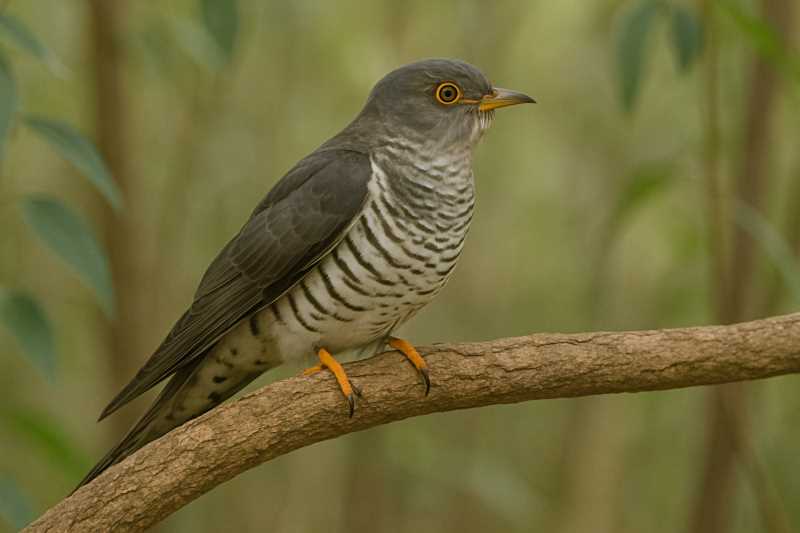
The Oriental Cuckoo is approximately 30–33 centimetres long, with a long tail, pointed wings and a slender, slightly curved bill. Adults commonly have slate-grey or grey-brown upperparts, a pale throat and breast, and strongly barred white or buff underparts. The legs and feet are yellowish, and a yellow eye-ring may be visible at close range.
Plumage varies considerably. Grey birds are generally the most familiar, while rufous or hepatic birds show warmer brown tones and heavier barring. Females and juveniles can be particularly difficult to distinguish from related cuckoos. Juveniles usually appear browner and have pale fringes to the feathers, giving the plumage a more scaly or edged appearance. Reliable sexing in the field is often difficult because male and female plumages overlap.
Range and Habitat
The Oriental Cuckoo breeds across northern and eastern Asia, from western Russia and Siberia through Mongolia and northern China to Korea and Japan. During the non-breeding season, it migrates south through Southeast Asia to Indonesia, New Guinea, northern and eastern Australia and nearby islands.
Breeding habitat includes coniferous, mixed and deciduous woodland, forest edges and scrubby areas. In Australia, it is a non-breeding migrant that may occur in monsoon rainforest, wet sclerophyll forest, open woodland, vine thickets and other vegetated habitats, particularly along forest edges and ecotones. It may also be recorded in gardens, plantations and lightly cleared areas while on passage.
The species is sometimes treated differently by taxonomic authorities because the Oriental Cuckoo was formerly included with the Himalayan Cuckoo, Cuculus saturatus. The IOC World Bird List recognises Cuculus optatus as a separate species, while some BirdLife and handbook treatments have historically used a broader species concept.
Where to See This Species
K’gari, Queensland, Australia
The Oriental Cuckoo is included on the documented bird list for K’gari, formerly Fraser Island. The island’s forest, woodland and vegetation-edge habitats provide suitable conditions for a migrant cuckoo, although sightings are seasonal and can be irregular. The species is most likely to be encountered during the Australian non-breeding season, when it may forage quietly in trees and dense vegetation.
Nearby accommodation: Eurong and other K’gari accommodation areas offer resorts, guest houses, campsites and self-catering options. Hervey Bay and Rainbow Beach are practical mainland gateway towns with hotels, guest houses and holiday accommodation.
Dularcha National Park, Queensland, Australia
Queensland’s park management information lists the Oriental Cuckoo as an international migratory species recorded in Dularcha National Park. The park’s eucalypt forest and woodland-edge habitat are suitable for a migrant bird that often remains unobtrusive in the canopy. Visits during the warmer months offer the best chance of encountering a seasonal migrant, although the species is not guaranteed on any particular day.
Nearby accommodation: Landsborough is the nearest practical settlement, with guest houses, hotels, holiday rentals and camping available in the wider Sunshine Coast hinterland.
Mackay Islands Protected Areas, Queensland, Australia
The Oriental Cuckoo is listed in Queensland park information for the Mackay Islands protected areas. The islands and nearby coastal habitats contain woodland, forest and other vegetated environments used by migratory birds. Access and birding opportunities vary between islands, so visitors should check current park access arrangements before travelling.
Nearby accommodation: Mackay is the main gateway, offering hotels, motels, holiday apartments, guest houses, cabins and camping facilities.
Behaviour and Diet
The Oriental Cuckoo is usually solitary and spends much of its time in trees, where it searches foliage, branches and bark for food. It feeds mainly on invertebrates, including caterpillars and other insects. In Australia, it has been reported feeding among foliage, in mistletoes and on loose bark along trunks and branches.
The species is generally more vocal on its breeding grounds than during migration or the non-breeding season. Its breeding call is a repeated series of notes that can carry through woodland, while other calls may include whistles, trills and chattering sounds.
The Oriental Cuckoo is an obligate brood parasite. Females lay their eggs in the nests of other birds, particularly small leaf warblers in parts of the breeding range. Research in Russia has documented associations with Arctic Warbler, Siberian Common Chiffchaff, Yellow-browed Warbler and Pallas’s Leaf Warbler. The cuckoo chick may eject host eggs or young, reducing competition for food from the foster parents.
Identification Tips
- Look for a medium-sized, long-tailed cuckoo with grey or brown upperparts and strongly barred underparts.
- Check for yellowish legs and a yellow eye-ring, although these features may be difficult to see in poor light.
- Rufous birds are warmer brown overall and can show heavy barring across the upperparts and underparts.
- The flight is direct and swift, with pointed wings and a long tail.
- Do not rely on plumage alone when separating the Oriental Cuckoo from the Himalayan Cuckoo, Cuculus saturatus. The two are extremely similar, and voice, range, measurements and careful documentation may be needed for confident identification.
- In Australia, the species is often quiet, so habitat, shape and plumage pattern may be more useful than call.
Conservation Status
The Oriental Cuckoo is listed as Least Concern under the conservation treatment used by BirdLife International and the IUCN-associated bird assessment framework. The species has a very large distribution, but a precise global population estimate is not given here because available figures depend on taxonomy and assessment boundaries.
Potential pressures include the loss and fragmentation of breeding forests, degradation of stopover habitat and changes to wet-season and woodland habitats along migration routes. Because the species crosses many national boundaries, maintaining connected forests, woodland edges and other suitable habitats across the East Asian–Australasian migration system is important.
Frequently Asked Questions
Where does the Oriental Cuckoo live?
It breeds mainly in northern and eastern Asia, including Russia, Mongolia, northern China, Korea and Japan. It migrates south to Southeast Asia, Indonesia, New Guinea and northern and eastern Australia.
Is the Oriental Cuckoo a brood parasite?
Yes. It lays its eggs in the nests of other birds rather than building a nest and raising its own young. Leaf warblers of the genus Phylloscopus are important documented hosts in parts of its breeding range.
What does the Oriental Cuckoo eat?
It mainly eats insects and other invertebrates, especially caterpillars and insects found on foliage, branches, tree trunks and loose bark.
How can the Oriental Cuckoo be identified?
Look for a long-tailed cuckoo with grey or brown upperparts, heavily barred pale underparts, pointed wings and yellowish legs. Because it closely resembles the Himalayan Cuckoo, identification may require attention to range, voice and measurements as well as plumage.
When can the Oriental Cuckoo be seen in Australia?
It is mainly a non-breeding migrant in Australia and is generally most likely to be recorded during the warmer months, especially in northern and eastern regions. Sightings are often irregular and the species can be quiet.
Is the Oriental Cuckoo endangered?
No. It is currently assessed as Least Concern, although habitat loss and degradation along its breeding and migration routes remain conservation concerns.
References
- IOC World Bird List
- Australian Government Department of Agriculture, Water and the Environment
- Journal of Zoology
Related posts