Introduction
Longuemare’s Sunangel (Heliangelus clarisse) is a medium-sized hummingbird of the northern Andes. It occurs mainly in eastern Colombia and western Venezuela, including the Sierra de Perijá and Tamá regions. The species is known for its iridescent plumage, hovering flight and preference for humid mountain habitats.
Physical Description
Longuemare’s Sunangel measures approximately 10–12 cm in length. Like other sunangels, it has a relatively compact body, a straight bill and pointed wings suited to fast, manoeuvrable flight.
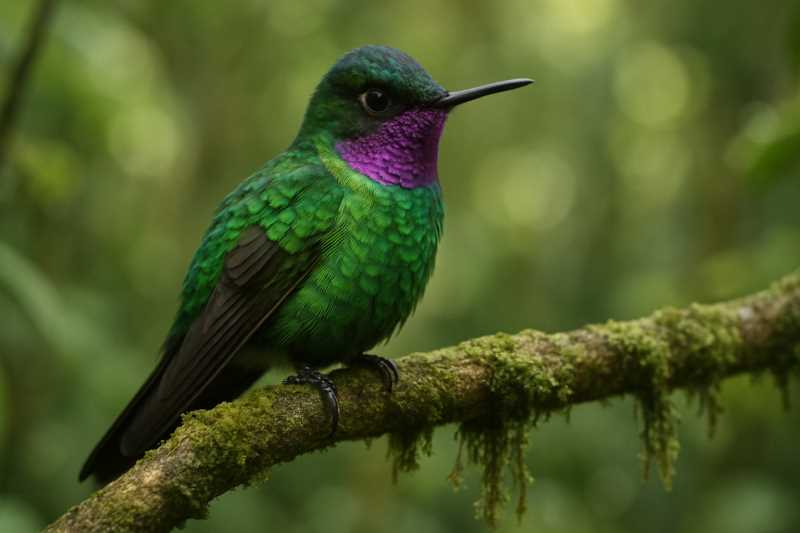
Adult males are more brightly coloured than females. Depending on the subspecies, the male may show a green or blue frontlet, a bronzy or purplish crown, and a contrasting throat patch or gorget. A pale whitish to buffy band across the upper breast is an important feature, although the exact appearance varies geographically.
Females are generally duller, with a less prominent frontlet and a smaller, browner or less intensely coloured throat patch. Juveniles resemble adult females. Plumage differences between the recognised subspecies are most noticeable in the colour of the forehead, crown and gorget.
Range and Habitat
Longuemare’s Sunangel is found in the Eastern Andes of Colombia and adjacent western Venezuela. Its range includes the Sierra de Perijá on the Colombia–Venezuela border and the Tamá region of north-eastern Colombia and north-western Venezuela. It is not endemic to a single country and is regarded as largely sedentary.
The species usually occupies humid cloud-forest edges and elfin forest at roughly 1,800–3,600 metres above sea level. It may also occur in páramo, open woodland, overgrown ravines and cultivated landscapes with scattered shrubs and trees. Local distribution varies between mountain ranges and subspecies.
Where to See This Species
Chingaza National Natural Park, Cundinamarca, Colombia
Longuemare’s Sunangel is documented in Chingaza National Natural Park, where high-Andean forest, cloud forest and páramo provide suitable habitat. It is most likely to be found along forest edges, sheltered mountain tracks and areas with flowering plants. The park is accessible from the Bogotá region, although some routes and visitor areas may require advance planning or local guidance.
Nearby accommodation: La Calera is a practical gateway for visits from the Bogotá side, with guest houses, small hotels and rural accommodation available in the surrounding area.
Serranía de los Yariguíes National Natural Park, Santander, Colombia
The species is recorded from the Serranía de los Yariguíes, including high-elevation forest and mountain habitats in Santander. Its presence in this protected area makes forest edges, ravines and other humid montane sites worthwhile places to search, particularly with an experienced local guide.
Nearby accommodation: San Vicente de Chucurí is the nearest practical town for arranging simple hotels, guest houses and local guiding services.
Behaviour and Diet
Longuemare’s Sunangel is active during the day and can hover while feeding. It usually forages at low to medium levels in vegetation, often near streams and forest edges. Individuals may defend feeding territories where nectar-producing plants are abundant.
Nectar forms the main part of its diet. The bird also takes small insects and other arthropods, which provide additional protein. It may capture insects in short flights from a perch, a behaviour known as hawking.
The species is generally sedentary rather than migratory, although local movements may occur in response to flowering conditions and changes in food availability. Breeding information is limited. The female is responsible for nest construction, incubation and care of the young. The nest is a small cup made from moss and fine plant material, usually placed beneath a leaf or another sheltered structure. Clutches of two eggs have been reported.
Identification Tips
- Look for a medium-sized hummingbird in humid highland forest, forest edge, páramo margins or nearby open vegetation.
- Note the contrasting pale band across the upper breast and the strongly iridescent forehead, crown and throat of adult males.
- Females are less vivid, with a duller frontlet and a smaller, browner throat patch.
- The species is usually recognised by a combination of habitat, elevation, pale breast band and male head and throat pattern rather than by any single colour.
- In areas where several sunangels occur, compare the colour and shape of the gorget, the frontlet and the upper breast band. Regional variation in Longuemare’s Sunangel can make identification more difficult, so photographs and range information are useful.
Conservation Status
Longuemare’s Sunangel is currently classified as Least Concern. Available assessments indicate that the population is considered stable, although the total population size has not been quantified.
The species occupies several protected mountain landscapes, but local habitat loss and fragmentation remain relevant concerns for Andean cloud forests. Agricultural expansion, development and changes in land management can reduce suitable forest-edge and high-elevation habitat. Conservation measures include maintaining protected areas, retaining native vegetation along streams and forest margins, and managing surrounding agricultural land in ways that preserve ecological connections.
Frequently Asked Questions
Where is Longuemare’s Sunangel found?
It is found in eastern Colombia and western Venezuela, including the Sierra de Perijá, the Tamá region and parts of the Eastern Andes.
What habitat does Longuemare’s Sunangel use?
It mainly uses humid cloud-forest edges and elfin forest at high elevations. It may also occur in páramo, open woodland, ravines and wooded agricultural landscapes.
Is Longuemare’s Sunangel migratory?
It is generally regarded as sedentary. Local movements may occur when flowering patterns or food availability change.
What does Longuemare’s Sunangel eat?
Its diet consists mainly of nectar, supplemented by small insects and other arthropods.
How can Longuemare’s Sunangel be identified?
Adult males are recognised by their iridescent forehead, crown and throat, together with a contrasting pale breast band. Females are duller and have a smaller, less colourful throat patch.
Is Longuemare’s Sunangel endangered?
No. The species is currently assessed as Least Concern, although protection of Andean forest and páramo habitats remains important.
References
- BirdLife International
- IOC World Bird List
- Parques Nacionales Naturales de Colombia
Related posts