Introduction
The Marvelous Spatuletail, Loddigesia mirabilis, is a small hummingbird endemic to the Utcubamba Valley of northern Peru. It is the only species in the genus Loddigesia and is best known for the male’s extraordinary tail, which ends in two violet-blue spatules. The species is non-migratory and closely associated with flowering vegetation in the Andean cloud-forest region.
Physical Description
The Marvelous Spatuletail is a compact hummingbird with mainly green, white and bronze plumage. The sexes are strongly dimorphic.
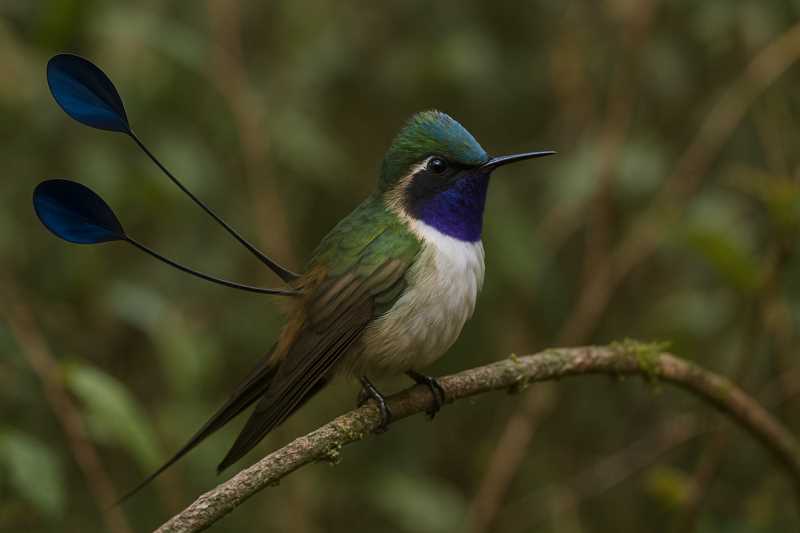
The adult male has a brilliant blue crown, an iridescent turquoise throat and a dark central stripe running down the otherwise pale underparts. Its tail contains only four feathers. The two outer feathers are exceptionally long, narrow and flexible, crossing near the tips and ending in large violet-blue discs or spatules. These specialised feathers may grow to several times the length of the bird’s body and can be moved independently during display.
The female lacks the male’s prominent crown, throat patch and central breast stripe. Her upperparts are green to bronze, with paler underparts. She has elongated outer tail feathers, but the spatules are much smaller and less conspicuous than those of the male.
Juveniles and immature birds are less distinctive than adult males. They generally show duller plumage and lack the fully developed ornamental tail feathers of mature males.
Range and Habitat
The Marvelous Spatuletail occurs only in a restricted area of the Utcubamba Valley in the Amazonas region of northern Peru. It is endemic to the country and is considered non-migratory.
The species is most often associated with open montane habitats rather than continuous mature forest. Suitable sites include forest edges, regenerating woodland, dense scrub, flowering thickets, steep valleys and areas of secondary vegetation. Records are generally concentrated between approximately 2,000 and 2,900 metres above sea level, although the precise elevational range may vary between localities.
Its limited distribution makes the species vulnerable to the loss and fragmentation of flowering scrub and montane forest. Agricultural expansion, burning and wood-cutting have reduced and altered parts of its habitat.
Where to See This Species
Huembo Reserve and Interpretation Centre, Amazonas, Peru
Huembo is the best-established wildlife-viewing site for the Marvelous Spatuletail. The community-owned reserve near San Lucas de Pomacochas is managed for conservation in partnership with Asociación Ecosistemas Andinos, or ECOAN. The site protects flowering scrub and other suitable habitat, and hummingbird feeding stations provide regular opportunities to observe the species. Spatuletails may be present throughout the year, although sightings are still dependent on local conditions and bird activity.
Nearby accommodation: San Lucas de Pomacochas is the practical gateway, with local hotels, guest houses and lodge-style accommodation. Huembo also has conservation-focused lodge accommodation when available.
Behaviour and Diet
Marvelous Spatuletails feed mainly on nectar from flowering shrubs and other montane plants. They often perch while feeding rather than hovering continuously. Individuals may follow regular circuits between nectar sources, a behaviour known as trap-lining. They also visit artificial feeders at established viewing sites.
Males defend feeding territories and may aggressively exclude rival males and large insects from productive flowers. The species is generally encountered singly or in loose concentrations around flowering plants rather than in large flocks.
Courtship is one of the species’ most remarkable behaviours. Males gather at communal display grounds, or leks, where they perform energetic aerial and tail displays for visiting females. The specialised tail feathers are moved independently and form an important part of the display. Males do not provide parental care after mating.
The female builds the nest alone, using plant fibres, moss and spider webbing. She usually places it on a low horizontal branch and incubates the two white eggs without assistance from the male. The young hatch blind and featherless and develop rapidly before leaving the nest after roughly one to ten days, according to available observations.
Identification Tips
- Look for a small green, white and bronze hummingbird in flowering scrub, forest edges and regenerating montane vegetation.
- An adult male is unmistakable when seen well: the blue crown, turquoise throat and two long wire-like tail feathers ending in violet-blue spatules are diagnostic.
- The female is more subdued but still shows elongated tail feathers with small spatulate tips.
- Males may perch conspicuously near flowers or display sites before making short, energetic flights.
- Do not rely on the tail alone at a distance. Poor light, flight angle and worn feathers can make the spatules difficult to see, so confirm the combination of habitat, body shape, plumage and tail structure.
Conservation Status
The Marvelous Spatuletail is currently listed as Near Threatened on the IUCN Red List. Its extremely restricted range and continuing pressure on suitable habitat place it close to the threshold for a threatened category.
The main threats are habitat destruction and fragmentation, particularly through agricultural burning, land conversion and illegal wood-cutting. The loss of flowering scrub can reduce both feeding opportunities and breeding habitat.
Important conservation measures include the protection and management of community-owned habitat at Huembo, habitat restoration, planting native nectar-producing vegetation, monitoring breeding activity and working with local communities to promote sustainable land use. Conservation initiatives are also being developed in other parts of the Utcubamba Valley.
Frequently Asked Questions
Where is the Marvelous Spatuletail found?
It is found only in the Utcubamba Valley of northern Peru, mainly in the Amazonas region. The species has a very restricted distribution in the Andean montane zone.
Is the Marvelous Spatuletail endangered?
The current IUCN category is Near Threatened, not Endangered. However, its small range and continuing habitat loss mean that it requires ongoing conservation attention.
What does the Marvelous Spatuletail eat?
It feeds primarily on nectar from flowering shrubs and other montane plants. It may also visit artificial feeders, but natural flowering vegetation remains important to its survival.
Why does the male have such a long tail?
The male’s elongated tail feathers are specialised ornaments used during courtship displays. Their violet-blue spatules can be moved independently and help males attract and impress females.
Can the female Marvelous Spatuletail fly with a long tail?
Yes. The female also has elongated outer tail feathers, although they are much shorter and less elaborate than the male’s. Her tail does not have the same exaggerated appearance.
Where is the best place to see this species?
Huembo Reserve and Interpretation Centre near San Lucas de Pomacochas is the most established viewing site. The reserve protects suitable habitat and operates hummingbird feeding stations where the species is regularly sought by visitors.
References
- IOC World Bird List
- BirdLife International
- American Bird Conservancy
Related posts